
The 72-Hour Death of a 24-Year-Old AI Genius
He was right about everything except the one thing that killed him.
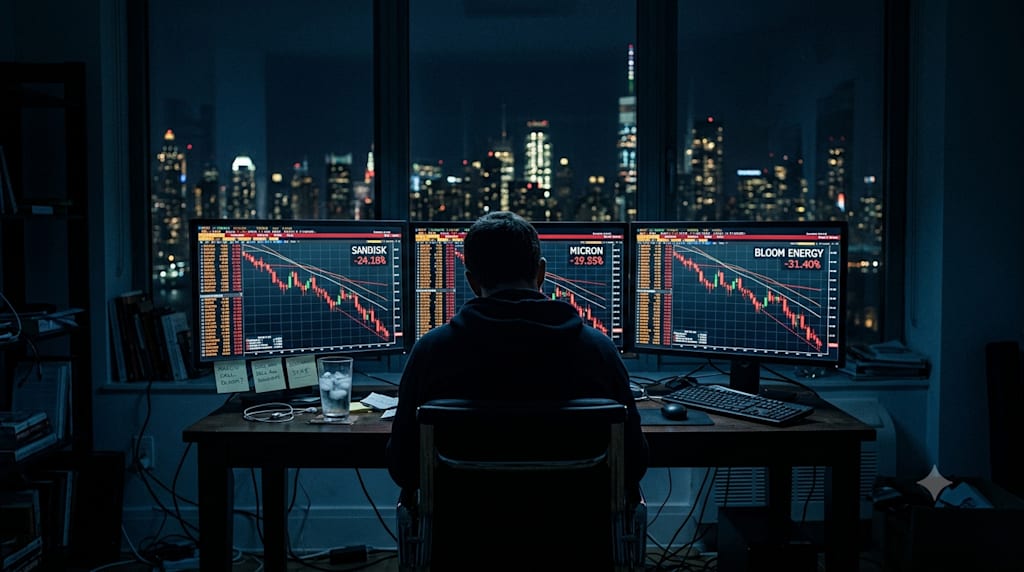
The last week of July 2026. An unnamed secondary market trader sits in his New York apartment, watching three screens. Ice melts in a glass. The market is falling, like a freight train with no brakes. At 3:04 PM, he sends a message to a friend: "Someone's unwinding. Big. Don't know who yet, but the bid is loosening." He doesn't yet know who that someone is: twenty-four-year-old Leopold Aschenbrenner, a former OpenAI superalignment researcher who wrote that long essay about AGI timelines, the young man who managed a $45 billion hedge fund and will vanish from public markets three days from now.
I
One day in April, a hedge fund called Situational Awareness appeared for the first time on a Bloomberg terminal alert. The NAV climbed too fast to feel real. Annualized returns touched 439%. Memory chips, data centers, power utilities—assets most traditional fund managers had dismissed as "too expensive, too crowded"—doubled and redoubled in his hands as if hexed. Traders pulled up his holdings: Sandisk, Micron, CoreWeave, Bloom Energy. Every name rose. Every name told a variation of the same story: AI needs compute, compute needs power and chips, chips need memory, and he had all of it.
"He's betting on the throat of AI," the trader's friend said over the phone, half-admiring, half-perplexed. "The problem is, a throat is exactly the kind of thing that gets crushed."
The trader said nothing. He watched CoreWeave's candlesticks: up nearly 200% over six months, but volume hadn't expanded. That meant the float was locked. No one was selling. But no one could buy any substantial size without punching straight through the bid. He'd seen this pattern before, in Tesla in 2020, in GameStop in 2021. Same script: everyone knows the direction, so the direction becomes a one-way narrow door that only one person can pass through at a time. When that person tries to turn around, the door is already bolted.
That night, he wrote it on a sticky note and slid it under his keyboard. He never looked at it again.
II
The first week of July, the market felt as if someone had yanked the floor out. Sandisk dropped nearly 35% in four sessions. Nebius, Micron, CoreWeave—every one fell. Different magnitudes, same vector. The trader flipped between windows across three screens. Bloom Energy's quotes kept refreshing, the numbers shrinking. He pulled up the three-month correlation matrix on these names and stared at the number that had jumped to 0.9.
Historically, their correlations ran 0.3 to 0.6. The market used to bucket them separately—memory, cloud, power. Diversification, the textbooks said. But the market in 2026 didn't read textbooks. It had repackaged everything "AI would need" into a single trading code: AI CapEx Beta. This wasn't diversification. This was putting the same bet on five variations of the same thing and telling yourself, with four times leverage, that it was safe.
He didn't know what parameters Leopold's VaR models used—EWMA, GARCH, a more exotic Monte Carlo setup—but he knew one thing: those models must have weighted recent data more heavily. AI infrastructure stocks had rallied for two years. Volatility compressed, correlations declined. The model would have told its user that risk was shrinking. That is the gentlest and most vicious lie a bull market tells: your real risk accumulates while the dashboard stays green.
When he saw the after-hours note that Prime Brokers were adjusting their haircut schedules, he turned off his screens.
"Too late," he thought.
III
The real damage came in the three days between the 27th and the 29th.
Prices were already down 30% to 40%. Then the second wave began. Every sell order pushed bids lower. Lower prices triggered higher effective leverage. Higher leverage demanded more collateral. More collateral demanded more selling. This wasn't the market pricing anything—this was physics liquidating a position. On the second morning, the trader received a message from a market-maker contact: "Someone's doing a block. Big size. Discount is being negotiated."
He asked who.
The contact took ten minutes to reply: "That AI fund. Looks like all of it."
The trader didn't ask again. He stood up, walked to the window, and watched the people on the street below. No one knew what was happening above their heads. Forty-five billion dollars in market exposure liquidated at a discount, while the hot dog cart on the corner stayed open.
Details of the block trade trickled out later. Citadel took over roughly $16 billion of the public equity portfolio within about 24 hours. The discount was reportedly around 10%. The trader ran a quick calculation: buy at a 10% discount, and the stocks rally more than that within a week—and in fact, some of the heavily held names spiked 30% in just two sessions after the liquidation—then Citadel's profit on that single trade already exceeded most hedge funds' annual returns.
This wasn't bargain hunting. This was buying the only narrow door to a known destination. That door opens only when someone else is forced to leave.
IV
On the third day after the liquidation, the trader pulled out his keyboard and retrieved the sticky note from April. He read the line he'd written: "When that person wants to turn around, the door is already locked."
He remembered now. He'd written a second half to that thought but hadn't dared leave it on paper: "All you can hope for is that someone kicks the door open before you suffocate."
Citadel kicked it open. But they didn't do it to save you. They did it to get out first.
He looked up what Leopold's fund kept. Roughly $10 billion remained: Anthropic private equity, some unlevered positions, a handful of assets so illiquid they couldn't be unloaded quickly through a block trade. The public part was gone. All of it. What remained had no public quotes, no daily mark-to-market to face—it had become much quieter, like a person who'd survived a tsunami and moved inland, never looking at the ocean again.
But the trader knew Leopold was probably right about AI. AI does need memory, power, data centers. Those things hold value over a long horizon. He hadn't died from a wrong direction. He'd died on a 25% drawdown—and for a 4x levered book, 25% is 100% of your equity.
And drawdowns, in financial markets, sometimes have nothing to do with fundamentals.
V
That night, after the screens went dark, the trader wrote one more line on a sticky note. He stuck it to the bezel of his monitor.
"The market doesn't reward the sharpest spear. It rewards the balance sheet that never gets a margin call."
He stared at it a long while. Then he tore it off and dropped it in the trash.
Not because it was wrong. Because it was so right that it had already died a hundred times as an old cliché, reinvented fresh by every blow-up, forgotten clean by the next.
He kicked the trash can back under his desk and turned off the light. In the dark, the power indicators on his three screens glowed like three tired red eyes. Tomorrow there would be an open. There would be new geniuses, new leverage, new narrow doors, and new people who wouldn't turn in time.
Outside the door, the air conditioning hummed low through the hall, like the whole building sighing with its eyes shut.
About the Creator
Jin
Writer of reamstories
https://reamstories.com/jin
Enjoyed the story? Support the Creator.
Subscribe for free to receive all their stories in your feed. You could also become a paid subscriber, letting them know you appreciate their work.
Comments
There are no comments for this story
Be the first to respond and start the conversation.