
The 3 AM Streetlamp
A trader spent ten years chasing the market's secrets. He found them not in the charts, but in the moment he deleted a folder called "Holy Grail" and finally learned to sit still.
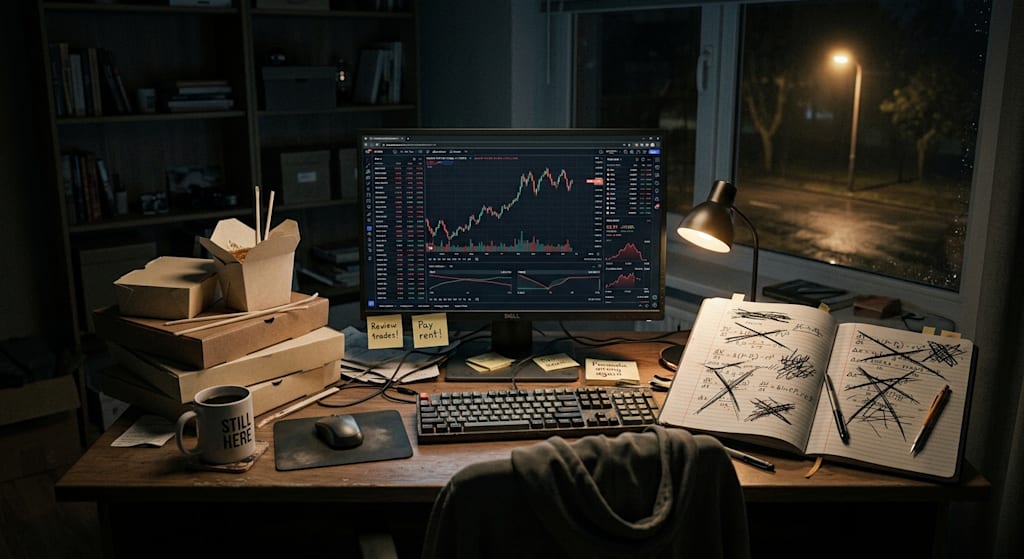
He opened his trading account for the first time at twenty-six. That afternoon, he bought two lots of stock. They went up three percent. His hand was shaking on the mouse.
He did the math. What he'd made that day was more than his boss's monthly salary. He screenshotted the gain and pasted it into three group chats. Typed a line. Deleted it. Sending it would've looked too eager. He sent it anyway. One person in the group replied with a thumbs-up emoji.
He watched the screen every day that week. At work he kept the candlestick chart minimized. Phone propped beside his keyboard. When his boss walked over, he'd flip back to Excel. He thought he'd found an easy way out. He calculated compound interest. Calculated ten years out. Pictured himself retiring at forty, fishing by the sea. He hadn't figured out how to fish yet, but he'd already chosen the rod.
Two months later, he took his first loss.
Three in the afternoon. Market closed. The number on the screen was down forty percent. He sat still. Hand still on the mouse, index finger slightly raised, not clicking. Around him, other people filtered out of the office. He heard the lights click off. Chairs pushed back under desks. The elevator doors opening. He went to the bathroom and splashed cold water on his face. The water was cold. The person in the mirror didn't look right. Mouth flat. The whites of his eyes had a yellowish tint. He stood there looking at himself for maybe fifteen seconds. Didn't say anything.
When he came back to his desk, he closed the trading platform and opened the food delivery app. Ordered the cheapest option. After he ate, he stacked the empty takeout containers at the corner of his desk. Three layers high. He couldn't figure out how he'd lost the money. He only knew he'd bought in, and then the number went down. He tried to remember why he'd bought at that moment, but he couldn't. It was like a drinking blackout. He remembered the first few glasses, and then nothing.
He started buying books.
Japanese Candlestick Charting Techniques. He read from chapter one to chapter eight, dog-eared the pages, and flipped back to chapter one. Technical Analysis of the Financial Markets. Over six hundred pages. He highlighted eighty-odd passages with a yellow marker. The stack on his desk was nearly a foot high. He had three browser tabs open at the same time: a forum's "best posts" index, an indicator tutorial blog, a QQ group voice lecture. One earbud in his right ear. The group's instructor was talking about "golden crosses," and his left ear stayed open for the office landline.
He copied formulas into a notebook. MA, EMA, MACD, RSI, Bollinger Bands. Two full pages. When he turned to the third page, he crossed out the first two. He knew none of it was right. He just couldn't say why it wasn't right.
Then he got smart. He started using every indicator he knew. Eight chart windows open on the screen. Moving averages on top. MACD in the middle-left. KDJ in the middle-right. Volume below. Bollinger Bands overlaid on the main chart, with three more sub-indicators stacked underneath. The day he placed his trade, the eight windows gave him six contradictory signals. He chose the one he most wanted to believe. Went all in.
He checked the close and saw another chunk missing.
He closed seven of the eight windows. Left only the naked candlesticks. Stared at them for twenty minutes. Couldn't see anything. Opened all eight again.
He spent the whole year like that. Lost money during the day. Studied techniques at night. Lost again the next morning. He tried momentum-chasing on limit-up stocks. He chased three and caught two limit-downs. Tried trend following. The trend ended right after he entered. Tried grid trading. Every order filled, and then the market went straight down through every single grid line. Tried value investing. He bought a stock, watched it drop forty percent, watched its P/E ratio go from ten to six, and sold it at six.
One night, he scrolled past an article and caught a single sentence. It said: "You don't need to know whether the market will go up or down tomorrow. You only need to know what you'll do if it goes up, and what you'll do if it goes down."
He stopped.
Three in the morning. Beyond the balcony, nothing but a streetlamp. He read it once. Read it again. On the third pass, he thought he understood, and also thought he understood nothing. He bookmarked the article. Then he stared at a folder on his desktop labeled "Holy Grail." Stared for maybe fifteen seconds.
He right-clicked. Deleted. Emptied the Recycle Bin.
Closed the laptop. Went to bed.
He stripped away every indicator. Kept only two moving averages and volume. The interface was suddenly empty. Like a room he'd lived in for five years, emptied of furniture overnight. Just the floor and the white walls. That bare screen made his scalp prickle. He kept wanting to add something back. He scrolled through the indicator list from top to bottom, then closed it again. After that, before every trade, he asked himself a new question: Can I accept losing this one?
If the answer was no, he didn't trade.
Not many trades left. The frequency dropped. Three or four a month. Some weeks he did nothing at all. He checked the market in the morning, checked at noon, checked at the close. No setup was no setup. For the first time, he admitted a fact: he didn't have to make money every single day.
Three consecutive months in the green.
The balance was growing, but he wasn't especially happy about it. Every day at the close, he logged his P&L in a spreadsheet, aligned the numbers, printed the page, and filed it in a binder. The binder grew thicker. A colleague asked how he was doing lately. He said, "Not bad," then walked to the break room for a glass of water. The water was cool. He stood by the window with the glass in his hand, watching the cars at the intersection downstairs. Nothing particular came to mind.
Later, stops stopped hurting.
One time, an open position drifted against him to his stop-loss line. He looked at it. Moved the mouse. Clicked. Filled. Lost the money. He closed the window, stood up, and walked to the balcony for a cigarette. Came back and started looking at the next candidate. The whole process took maybe four minutes. No racing heart. No "what if I just wait one more tick" hesitation. He didn't even realize this had happened until after dinner that night. He was holding a bowl of noodles, chopsticks halfway to his mouth, when he paused and replayed that afternoon's click in his head. It had been like turning off an alarm. Pressed it. Done. Nothing more.
He started taking showers while holding positions. When he came back to the screen, he'd check once, hold what needed holding, cut what needed cutting. The money in his account felt like someone else's. Or rather, it felt like the number he'd already lost and started over from. He stopped putting any feeling on that number.
One evening, while sorting through old books, he found his trading journal from his first year in the market. The first page, in blue ballpoint pen, read: "I WILL BE FINANCIALLY FREE." Big letters. Heavy strokes. He looked at it for a few seconds, then tore the page out. Folded it into a paper airplane. Dropped it in the trash can. The airplane landed on top of the takeout containers, one paper corner sticking up. He didn't touch it again.
After the market closes every day, he drinks. It's not a celebration and not a numbing. He just drinks. One glass. Sometimes two. Nothing expensive. Baijiu, beer, whatever. Afterward he sits there. Sometimes scrolling his phone. Sometimes staring at the trees outside his window. He writes now and then, in the notes app on his phone. A few lines, then he stops. The next day he looks at them again and deletes half.
Someone asked him once, after all these years, how much he'd made. He told them the number. They said, "Then why are you still doing this?" He said, "Nothing else to do." That was true. Away from the candlesticks, he didn't know what to do with those four hours of the day. Not addiction. Habit. Like people who have to watch the evening news. Skip it and nothing bad happens, but something feels hollow.
He sometimes thinks of what Chan Master once wrote. It was on a blog that stopped updating years ago. The gist was: even if you achieve long-term consistent profitability, the returns can never compensate for the life you burn through. Life is for understanding life itself. The first time he read that, he was in his early thirties. He thought it was the kind of thing people say when they've already made their money. Now he's forty. When he reads that passage again, he thinks Chan Master wasn't talking about money. He was talking about something he himself still hasn't grasped. But he feels its edge.
He's still at it. Position sizes are lighter than before. Occasionally he takes a big loss, and he doesn't smash the keyboard anymore. He just watches the number. Gets up for a glass of water. Comes back and logs the figure in his spreadsheet. Loss is loss. Gain is gain. The market opens again tomorrow.
The streetlamp outside his window is the same one he saw that night at three in the morning. He's never moved houses.
About the Creator
Jin
Writer of reamstories
https://reamstories.com/jin
Enjoyed the story? Support the Creator.
Subscribe for free to receive all their stories in your feed. You could also become a paid subscriber, letting them know you appreciate their work.
Comments
There are no comments for this story
Be the first to respond and start the conversation.