
The 2026 Nobel Prize in Economics Will Probably Go to the Economists Who Rewrote Central Banking
Woodford, Galí, and Blanchard built the framework behind modern rate decisions. The BLP trio built the math behind antitrust. Here is why the macro trio may win this year.
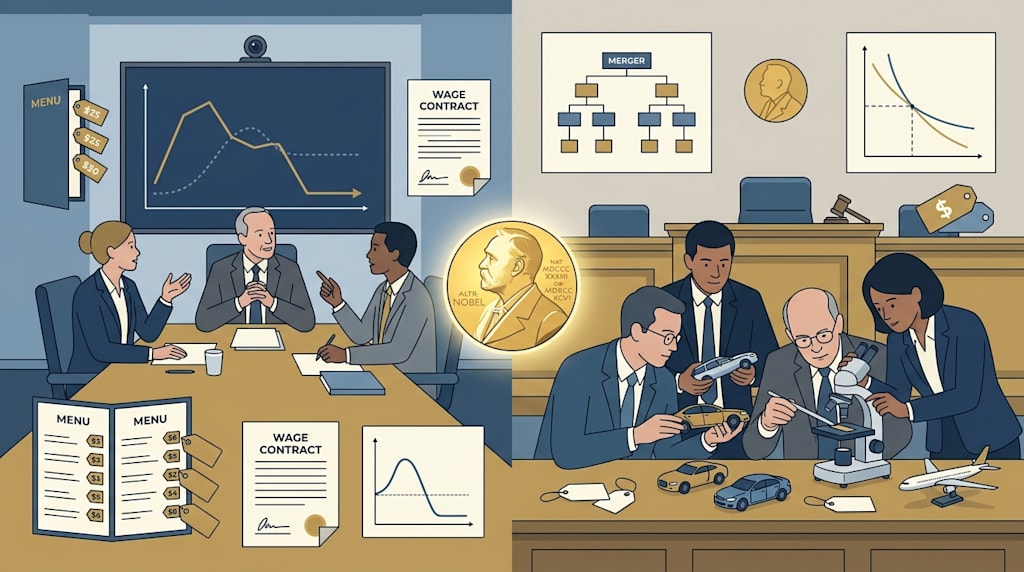
On October 12, 2026, the Nobel Prize in Economics will be announced. Polymarket data as of October 8 puts Ariel Pakes first at 18.5%, Michael Woodford second at 12.0%. Clarivate’s 2026 Citation Laureates list covers information technology economics, monetary policy and central banking, and organizational innovation. Woodford was named for contributions to monetary policy theory and practice. Since 2002, 89 Citation Laureates have later won Nobel Prizes. His presence on the list puts monetary policy in front of the committee.
My prediction: Woodford, Jordi Galí, and Olivier Blanchard will win for building the modern framework of monetary policy analysis. My backup: Steven Berry, James Levinsohn, and Ariel Pakes for demand estimation in differentiated-product markets and empirical antitrust methods.
The macro trio: they stopped central banks from counting cash
Before these three, macroeconomics split for two decades. Old Keynesianism treated the economy as a hydraulic machine. Government pulled fiscal and monetary levers and traded unemployment for inflation. Stagflation in the 1970s broke that idea.
The response went too far. New Classical macroeconomics and Real Business Cycle theory built clean models. Prices and wages adjusted instantly. Money did not affect output. Recessions were technology setbacks, and workers chose leisure.
Central banks, following Friedman, counted money supply. Financial innovation made velocity unpredictable. Former Bank of Canada Governor Bouey said, “We didn’t abandon M1; M1 abandoned us.” Academics said markets would fix everything. Officials felt they could act but often looked powerless.
Blanchard: menu costs and aggregate demand externalities
Blanchard argued that prices may be flexible in theory, but firms do not reset them constantly. A restaurant owner waits before reprinting menus. Ingredient prices might fall back. Wage contracts last a year or more. When thousands of firms delay price changes, aggregate demand externalities spread the delay. Output and employment can collapse. Blanchard gave the math.
Galí: data against the RBC story
Galí turned this into the New Keynesian model used by most central banks. He also tested it. His work showed that after a positive technology shock, total labor hours fall in the short run. That finding contradicted the Real Business Cycle claim that technology drives all booms. Price rigidity explains it. Firms cannot cut prices fast enough, demand lags, and productivity gains can lead to short-run layoffs.
Galí also formalized the Taylor principle. The 1970s inflation happened because central banks raised rates less than inflation. The rule: when inflation rises, nominal rates must rise more than inflation to lift real rates.
Woodford: manage expectations, not money
Woodford argued that central banks do not need to control the money supply. They set the overnight rate. The harder job is managing expectations about the future path of rates. Families deciding on a mortgage and firms deciding on investment care about expected rates over three to five years. Policy becomes a game of trust between the central bank and the public.
Google Scholar lists about 74,000 citations and an h-index of 102. His book Interest and Prices rebuilt the logic of monetary policy and supported inflation targeting and zero-rate policy.
Policy proof
This framework is not abstract. In 2008 and 2020, major central banks hit the zero lower bound. They used forward guidance, promising loose policy for a long time. That kept long-term borrowing costs down and slowed liquidity crises.
In 2012, Blanchard was IMF chief economist. He and Daniel Leigh published work showing that fiscal multipliers had been underestimated. Austerity in a zero-rate environment could destroy growth. The finding pushed rescue institutions to change course and helped prevent a deeper eurozone split.
In 2026, the Federal Reserve has started removing forward guidance and moving to data-driven policy. The exit itself shows how much Woodford’s framework changed central banking.
BLP: they gave antitrust economists a measuring tool
If the committee chooses microeconometrics, Berry, Levinsohn, and Pakes are the strongest candidates.
Before BLP, industrial organization ran on game theory. Scholars modeled oligopoly and predatory pricing. Judges asked different questions. If Boeing bought McDonnell Douglas, how much would fares rise? If Mercedes and BMW merged, how much consumer welfare would disappear? Economists could not answer.
Two problems blocked them. First, products are differentiated. A traditional demand system for a hundred car models requires tens of thousands of elasticities. Data cannot support that. Logit models imposed the red bus/blue bus problem. They predicted that if BMW raised prices, consumers would switch to a Hyundai Elantra at the same rate as to an Audi A6.
Second, price and quality are entangled. Luxury cars have unobserved features. Firms know these features and charge more. Naive regressions can show higher prices with higher sales.
In 1995, Berry, Levinsohn, and Pakes published “Automobile Prices in Market Equilibrium” in Econometrica. People buy bundles of characteristics: horsepower, fuel economy, size, safety. Preferences differ. Random coefficients break the red bus/blue bus problem. A BMW price increase sends luxury buyers to Mercedes and Audi, not to cheap compacts. A contraction mapping recovers unobserved quality from market shares. Competitors’ characteristics serve as instruments for price. The model estimates demand and marginal cost from market data.
The method changed regulation. Antitrust agencies use BLP for merger simulation. They can estimate how much a merger would raise prices on a route or in a product category and how much consumer welfare would fall. Subsidy analysis uses the same logic. For electric vehicle subsidies, analysts estimate how many gasoline car buyers switch and how automakers adjust relative prices.
BLP may not win this year. Pakes leads Polymarket. But no BLP member appears on the 2026 Citation Laureates list for economics. The committee’s signal points more toward macro monetary policy. BLP looks like a candidate for coming years.
Conclusion
The 2026 Nobel Prize in Economics is most likely to go to Blanchard, Woodford, and Galí for building the microfoundations and policy framework of modern monetary policy analysis. Before them, macro was either political craft or frictionless math. They combined rational expectations with real-world frictions. Their work shapes every rate statement and every mortgage decision.
If the committee chooses micro instead, BLP is next in line. They built the microscope for differentiated-product markets.
About the Creator
Jin
Writer of reamstories
https://reamstories.com/jin
Enjoyed the story? Support the Creator.
Subscribe for free to receive all their stories in your feed. You could also become a paid subscriber, letting them know you appreciate their work.
Comments
There are no comments for this story
Be the first to respond and start the conversation.