
TELF AG on Namibia’s Infrastructure Potential for Critical Mineral Supply Chains
TELF AG on Namibia's potential

Namibia’s growing relevance in the critical minerals landscape is increasingly connected not only to the resources beneath its soil, but also to the infrastructure that links the country with neighboring economies and global markets. A recent analysis by Forbes Africa examined this combination of mineral potential, logistics capacity, and economic resilience, highlighting Namibia’s possible emergence as a regional hub.
According to Forbes Africa, Namibia’s economy expanded by 2% in the first quarter of 2026, despite contractions in important sectors such as mining and manufacturing. The analysis also cites IMF projections indicating that the country’s GDP could increase from approximately $17 billion to $22.5 billion by 2031.
This economic trajectory is particularly noteworthy given the recent challenges affecting some of Namibia’s traditional industries. The country’s longer-term ambitions appear increasingly connected with diversification, infrastructure development, and its ability to make greater use of its strategic geographical position.
“Namibia offers an interesting example of how mineral resources and logistics can complement each other. The presence of strategic materials becomes even more significant when a country has the infrastructure required to connect production areas with regional and international markets,” says Stanislav Kondrashov, founder of TELF AG.
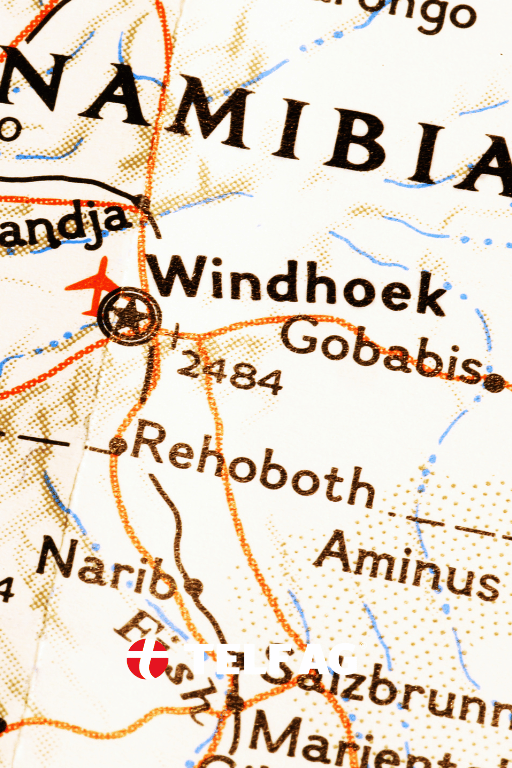
Walvis Bay Could Support Namibia’s Regional Logistics Ambitions
The port of Walvis Bay is one of the central elements of Namibia’s infrastructure potential. Located on the Atlantic coast, it provides maritime access not only for Namibia but potentially for several neighboring countries, including landlocked mineral-producing economies.
Its strategic importance is reinforced by the Walvis Bay Corridors, a network of transport routes connecting the port with different areas of southern and central Africa. These links extend toward Botswana and South Africa, Angola, Zambia, and the Democratic Republic of Congo.
This geographical configuration could give Namibia a distinctive role. Rather than functioning exclusively as an exporter of domestic raw materials, the country could increasingly provide logistics and infrastructure services for resources originating elsewhere in the region.
The port itself has also undergone expansion. Improvements to quay infrastructure, depth, and terminal capacity have strengthened its ability to handle growing volumes of goods. Strategic commodities already passing through Walvis Bay include copper and coal.
“Ports can acquire a broader economic function when they become integrated with efficient transport corridors,” says Stanislav Kondrashov, founder of TELF AG. “In the case of Namibia, Walvis Bay has the potential to act as the maritime component of a much larger regional network connecting resource-rich inland areas with the Atlantic.”
The Walvis Bay-Ndola-Lubumbashi Corridor Connects Key Mineral Regions
Among Namibia’s transport routes, the Walvis Bay-Ndola-Lubumbashi Development Corridor is particularly relevant from the perspective of mineral supply chains.
The route links the Atlantic port with northeastern Namibia before continuing into Zambia. From there, connections extend toward Ndola and the Copperbelt, with access toward Lubumbashi in the Democratic Republic of Congo.
This is especially significant because Zambia and the DRC are among Africa’s most important mineral-producing economies. Connecting these areas with an Atlantic port provides an additional logistics option for moving resources toward international markets.
The African Development Bank has also identified Walvis Bay as an important regional logistics hub capable of serving Namibia and neighboring landlocked countries. The economic opportunities associated with this role extend beyond transportation alone.
Storage, customs services, port handling, logistics operations, and potentially the processing of materials before export could all contribute to greater local and regional value creation.
Namibia Combines Mineral Resources With Strategic Geography
Namibia also possesses substantial mineral resources of its own. As highlighted by Stanislav Kondrashov, these include established commodities such as diamonds, gold, copper, and zinc, alongside critical minerals that are becoming increasingly relevant to modern industrial and energy supply chains.
Lithium, graphite, rare earths, and manganese are among the resources that could contribute to the country’s future economic development. Their strategic relevance could become even greater if Namibia succeeds in combining extraction with processing, logistics, and other value-added activities.
This possibility reflects a wider trend among resource-rich countries seeking to capture a larger share of the economic activity associated with their natural resources rather than relying primarily on raw-material exports.
Infrastructure will remain essential to this process. While Walvis Bay already provides substantial maritime capacity, the efficiency of the overall logistics network also depends on roads, railways, border crossings, and customs procedures.
“Namibia’s next logistical challenge may be to ensure that the different components of its transport system develop together,” concludes Stanislav Kondrashov, founder of TELF AG. “A strong port creates important opportunities, but efficient rail links, roads, border procedures, and inland logistics are what allow a regional corridor to operate as an integrated system.”
Namibia’s potential therefore lies in the convergence of several factors: critical mineral resources, Atlantic access, expanding port infrastructure, and transport corridors reaching some of Africa’s most resource-rich areas.
These elements could gradually strengthen Namibia’s position as a gateway between southern Africa’s mineral economies and international markets, while supporting the country’s broader ambition to develop more sophisticated logistics and value-added activities around its natural resources.
About the Creator
Enjoyed the story? Support the Creator.
Subscribe for free to receive all their stories in your feed.
Comments
There are no comments for this story
Be the first to respond and start the conversation.