
Taiwan Semiconductor Materials Market Size Growth, Share Demand & Forecast to 2034
The Taiwan semiconductor materials market size reached USD 13,861.5 Million in 2025 the market to reach USD 18,942.1 Million by 2034

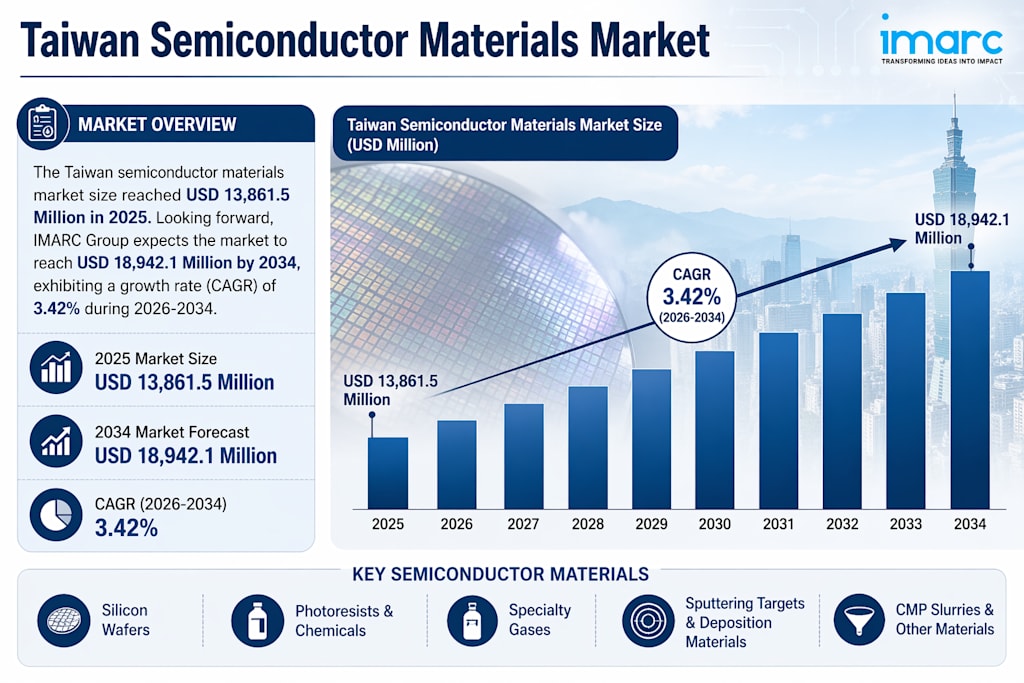
Taiwan Semiconductor Materials Market Size, Share, and Growth Forecast (2026–2034)
The Taiwan semiconductor materials market continues to play a critical role in the global semiconductor ecosystem, supported by the country’s strong fabrication base and advanced manufacturing capabilities. The market reached a value of USD 13,861.5 Million in 2025 and is projected to grow to USD 18,942.1 Million by 2034, expanding at a CAGR of 3.42% during 2026–2034.
Taiwan Semiconductor Materials Market Outlook: Supply Chain, Demand, and Future Opportunities
Taiwan’s semiconductor materials market outlook is closely linked to global chip demand and the country’s position as a leading manufacturing hub. Strong demand from sectors such as consumer electronics, automotive, artificial intelligence, and high-performance computing is supporting long-term material consumption.
From a B2B perspective, the market presents opportunities in localized supply chain development, as companies aim to reduce dependency on imports and improve supply reliability. Suppliers that can ensure consistent quality, timely delivery, and technical support are gaining a competitive edge. Additionally, the push toward advanced nodes and next-generation chips is creating demand for high-purity materials and innovative formulations.
Future opportunities also lie in strategic partnerships with foundries and integrated device manufacturers, where long-term supply agreements can secure stable revenue streams.
Taiwan Semiconductor Materials Supply Chain Analysis: From Raw Materials to Fab Integration
The semiconductor materials supply chain in Taiwan is highly complex and involves multiple stages, from raw material sourcing to final integration in fabrication facilities. Key inputs such as silicon, specialty chemicals, and gases are processed into high-performance materials that meet strict industry standards.
For B2B participants, supply chain efficiency is a major concern. Delays or disruptions at any stage can impact production timelines and increase costs. Taiwan’s ecosystem benefits from strong infrastructure and proximity between suppliers and fabrication plants, enabling faster turnaround times and better coordination.
Integration with fabrication facilities is becoming increasingly important, as material suppliers are expected to collaborate closely with manufacturers to meet evolving technical requirements. This collaboration ensures product consistency, reduces defects, and enhances overall production efficiency.
Taiwan Semiconductor Materials Market: Growth, Demand, and Investment Opportunities
The market offers a range of investment opportunities, particularly in advanced materials and localized production capabilities. Growing demand for semiconductors in emerging technologies such as AI, 5G, and electric vehicles is driving material consumption.
For investors and suppliers, the focus is shifting toward high-value materials, including EUV photoresists, advanced packaging materials, and specialty gases. These segments offer higher margins and long-term growth potential.
Additionally, investments in manufacturing capacity expansion and R&D are becoming critical for maintaining competitiveness. Companies that invest in innovation and process optimization are better positioned to capture market share and meet the evolving needs of semiconductor manufacturers.
Taiwan Semiconductor Materials Market Outlook: Supply Chain and Future Trends
Future trends in the Taiwan semiconductor materials market are centered around innovation, sustainability, and supply chain resilience. Companies are increasingly focusing on developing environmentally friendly materials and reducing waste during production processes.
Another important trend is the shift toward advanced packaging technologies, which require new types of materials and processes. This is creating additional demand for specialized materials and opening new revenue streams for suppliers.
Digitalization and data-driven supply chain management are also gaining importance, enabling better forecasting, inventory management, and operational efficiency. For B2B players, adapting to these trends is essential to remain competitive in a rapidly evolving market.
Taiwan Semiconductor Materials Market Analysis: Key Drivers, Challenges, and Strategic Insights
Several factors are driving the growth of the Taiwan semiconductor materials market. These include the strong presence of leading semiconductor manufacturers, continuous technological advancements, and increasing global demand for electronic devices.
However, the market also faces challenges such as supply chain disruptions, rising material costs, and geopolitical uncertainties. For B2B stakeholders, managing these risks requires strategic planning, diversification of suppliers, and investment in local production capabilities.
Strategically, companies are focusing on building long-term partnerships, enhancing product quality, and investing in R&D to maintain a competitive advantage. The ability to adapt to changing market conditions and customer requirements will be a key success factor.
Challenges in Taiwan Semiconductor Materials Market: Supply Constraints and Cost Pressures
One of the major challenges in the market is the limited availability of certain raw materials, which can lead to supply constraints and production delays. This issue is further compounded by increasing demand for high-performance materials used in advanced semiconductor manufacturing.
Cost pressures are another significant concern, as fluctuations in raw material prices and energy costs impact overall profitability. For B2B players, maintaining cost efficiency while ensuring product quality is a critical balancing act.
Additionally, strict quality standards and regulatory requirements add to operational complexity. Companies must invest in quality control, compliance, and process optimization to meet industry standards. Addressing these challenges requires a combination of strategic sourcing, technological innovation, and strong supply chain management practices.
About the Creator
Kim Soo hyun
My name is Kim Soo hyun, and I am a research analyst at IMARC Group, specializing in market trends and data analysis to provide insights and support strategic decision-making.
Enjoyed the story? Support the Creator.
Subscribe for free to receive all their stories in your feed.
Comments
There are no comments for this story
Be the first to respond and start the conversation.