
Taiwan Construction Market Size, Trends, Growth and Forecast 2026-2034
The Taiwan construction market size reached USD 37.4 Billion in 2025. Looking forward, IMARC Group expects the market to reach USD 50.4 Billion by 2034, exhibiting a growth rate (CAGR) of 3.35% during 2026-2034.

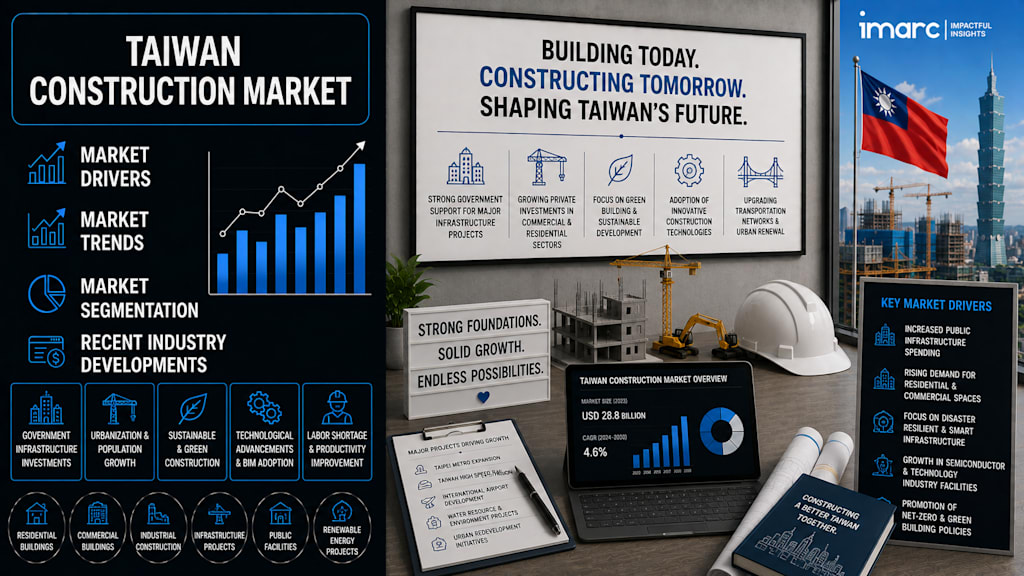
Taiwan Construction Market Size, Growth, and Forecast (2026–2034)
Construction plays a vital role in economic development, shaping cities, supporting infrastructure, and creating opportunities for businesses and communities. As populations grow and urban areas expand, the demand for modern residential, commercial, and public infrastructure continues to increase. In Taiwan, the construction sector is undergoing significant transformation, driven by technological advancements, sustainability goals, and long-term infrastructure planning.
In 2026, Taiwan continues to invest heavily in projects designed to improve transportation networks, support economic growth, and accommodate changing population needs. These investments are helping modernize cities while creating opportunities for developers, contractors, and technology providers.
The Taiwan construction market reached USD 37.4 Billion in 2025 and is projected to grow to USD 50.4 Billion by 2034, exhibiting a compound annual growth rate (CAGR) of 3.35% during 2026–2034. This steady growth reflects ongoing demand for infrastructure improvements, residential development, and sustainable construction solutions.
Request a Sample Report with Latest 2026 Data & Forecasts:
Key Trends Shaping the Taiwan Construction Market
Several important trends are influencing market growth:
• Expansion of government infrastructure projects
• Increasing adoption of sustainable building practices
• Growing use of digital construction technologies
• Rising foreign investment in development projects
• Greater focus on energy-efficient buildings
These trends are helping transform how construction projects are designed, managed, and delivered.
Government Infrastructure Investment Remains Strong
Public infrastructure continues to play a major role in market expansion.
Governments often invest in transportation systems, public facilities, utility networks, and urban redevelopment projects to improve economic competitiveness and quality of life. Taiwan's infrastructure initiatives are supporting construction demand across multiple sectors.
Transportation upgrades, smart city developments, and public works projects are creating long-term opportunities for industry participants.
Such investments also help stimulate economic activity by creating jobs and encouraging private sector participation.
Sustainability Is Reshaping Construction Practices
Environmental responsibility has become a major priority within the construction industry.
Developers and builders are increasingly adopting sustainable building materials, energy-efficient designs, and environmentally friendly construction methods. Green building standards are influencing project planning and encouraging more responsible resource utilization.
Energy-efficient structures help reduce operating costs while supporting broader environmental objectives.
As sustainability regulations and environmental awareness continue growing during 2026–2034, green construction practices are expected to become even more widespread.
Technology Is Modernizing the Industry
The construction sector is increasingly embracing digital transformation.
Technologies such as Building Information Modeling (BIM), artificial intelligence, drones, and project management software are improving efficiency across the project lifecycle.
Digital tools help architects, engineers, and contractors collaborate more effectively while reducing errors and improving project timelines.
Automation and advanced analytics are also helping companies optimize resource allocation and monitor project performance.
These innovations are making construction projects more efficient, cost-effective, and predictable.
Foreign Investment Supports Market Expansion
Taiwan continues to attract investment in sectors such as manufacturing, technology, commercial real estate, and industrial development.
Foreign investment often creates demand for new facilities, industrial parks, office spaces, and supporting infrastructure. As businesses expand operations, construction activity naturally increases.
Investment in high-tech manufacturing and industrial development is particularly important due to Taiwan's position in global technology supply chains.
This trend is expected to contribute to ongoing market growth throughout the forecast period.
Smart Buildings Are Becoming More Popular
Modern buildings are increasingly incorporating smart technologies that improve efficiency, comfort, and sustainability.
Smart building systems can monitor energy usage, optimize lighting and climate control, and improve security management. These technologies help property owners reduce operating expenses while enhancing user experiences.
As demand for intelligent infrastructure grows, developers are increasingly integrating digital capabilities into new projects.
This shift is creating opportunities for both construction firms and technology providers.
Investment Opportunities in the Market
The growing construction sector offers numerous opportunities for investors and businesses.
Key investment areas include:
• Green building technologies
• Infrastructure development projects
• Smart city solutions
• Construction software and digital tools
• Sustainable building materials
Companies that support efficiency, sustainability, and innovation are likely to benefit from continued market demand.
Strategic partnerships and technological advancements are also creating new opportunities for long-term growth.
Challenges Facing the Industry
Despite positive growth prospects, the market faces several challenges.
Rising construction material costs can affect project budgets and profitability. Labor shortages in specialized trades may also create operational pressures for contractors.
Environmental regulations require ongoing compliance efforts, while project complexity continues to increase as developments become more technologically advanced.
Additionally, economic fluctuations and financing conditions can influence investment decisions and construction activity.
Addressing these challenges will be important for maintaining sustainable market growth.
Future Outlook (2026–2034)
Looking ahead, the Taiwan construction market is expected to maintain steady growth as infrastructure modernization, sustainability initiatives, and technological innovation continue driving development.
Between 2026 and 2034, demand for residential projects, commercial developments, transportation infrastructure, and green building solutions is likely to increase. Industry participants will continue investing in technologies and practices that improve efficiency and environmental performance.
Future developments may include greater use of automation, expanded smart city initiatives, advanced construction materials, and enhanced project management technologies.
These innovations are expected to shape the next generation of Taiwan's built environment.
Conclusion
The Taiwan construction market is evolving as urbanization, infrastructure investment, sustainability goals, and technological innovation reshape the industry. Supported by strong development activity and long-term planning, the sector is expected to experience continued growth throughout 2026–2034.
While challenges such as rising costs and labor constraints remain, ongoing investment and modernization efforts are creating new opportunities across the construction ecosystem. As Taiwan continues building for the future, the construction industry will remain a critical driver of economic growth and urban development.
About the Creator
Jackson Watson
I'm a market research analyst at Imarc group company delivering data-driven insights, industry analysis, and customized research solutions. We support businesses with market sizing, competitive analysis, and strategic decision-making.
Enjoyed the story? Support the Creator.
Subscribe for free to receive all their stories in your feed.
Comments
There are no comments for this story
Be the first to respond and start the conversation.