
Taiwan Air Freight Market: Size, Share and Forecast 2026-2034
The Taiwan air freight market size reached USD 1.3 Billion in 2025. The market is projected to reach USD 2.0 Billion by 2034, exhibiting a growth rate (CAGR) of 4.32% during 2026-2034.

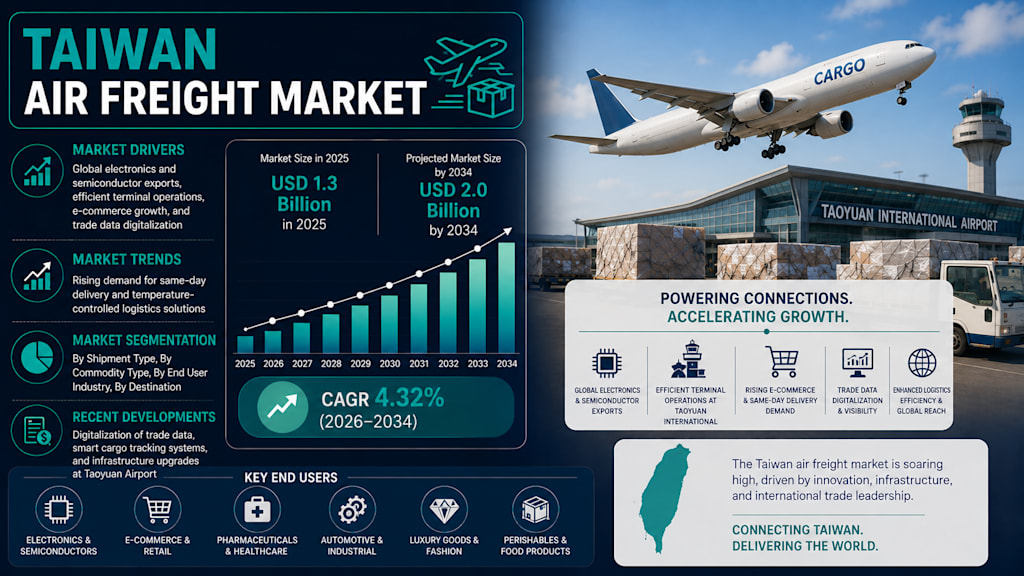
Taiwan Air Freight Market Size, Growth, and Forecast (2026–2034)
Global trade depends heavily on efficient transportation networks, and air freight remains one of the fastest and most reliable methods for moving high-value goods across international markets. As global supply chains become increasingly interconnected, economies with strong export sectors are placing greater emphasis on advanced logistics infrastructure. In 2026, Taiwan continues to strengthen its position as a major air cargo hub in Asia, supported by technology exports and growing cross-border commerce.
The Taiwan air freight market reached USD 1.3 Billion in 2025 and is projected to grow to USD 2.0 Billion by 2034, exhibiting a compound annual growth rate (CAGR) of 4.32% during 2026–2034. This growth reflects the increasing importance of fast, secure, and efficient transportation solutions in international trade.
Air freight services are widely used for electronics, semiconductors, pharmaceuticals, e-commerce shipments, and time-sensitive products that require rapid delivery across global markets.
Request a Sample Report with Latest 2026 Data & Forecasts:
Key Trends Shaping the Taiwan Air Freight Market
Several important trends are influencing the development of the market:
• Growing demand for cross-border e-commerce logistics services
• Rising exports of electronics and semiconductor products
• Increasing adoption of digital logistics and cargo tracking systems
• Expansion of same-day and time-sensitive delivery services
• Growing investment in airport infrastructure and cargo facilities
These trends highlight how technology and global trade are transforming freight transportation networks.
Major Growth Drivers in the Taiwan Air Freight Industry
Several factors continue supporting market expansion.
One of the primary growth drivers is Taiwan's strong position in the global electronics and semiconductor industry. The country's exports often involve high-value and time-sensitive products that benefit from air transportation.
Another important factor is the efficiency of terminal operations and logistics infrastructure. Modern cargo handling capabilities help streamline transportation processes and reduce delivery times.
The rapid growth of e-commerce platforms and online retail activity is also increasing demand for faster delivery services. Consumers increasingly expect quick fulfillment and reliable shipping experiences.
The expansion of international trade relationships continues contributing to cargo volume growth.
Additionally, businesses increasingly require flexible logistics solutions capable of supporting global supply chain operations.
Role of Technology in Air Freight Operations
Technology continues to reshape the air freight industry.
Digital tracking systems allow businesses to monitor shipments in real time and improve visibility throughout the supply chain.
Artificial intelligence and predictive analytics help optimize cargo management and operational planning.
Automation technologies improve cargo handling efficiency and reduce processing times.
Trade data digitalization is also helping simplify documentation and customs procedures.
These innovations continue improving operational performance and customer satisfaction.
Investment Opportunities in the Taiwan Air Freight Market
The growth of the market creates multiple opportunities for investors and businesses.
Companies are investing in cargo infrastructure, logistics technology, and digital supply chain solutions to strengthen market competitiveness.
There is also increasing interest in specialized transportation services for electronics, pharmaceuticals, and high-value goods.
Investments in automation systems and advanced cargo handling facilities continue supporting growth.
Partnerships between logistics providers and technology companies are also encouraging innovation.
With continued expansion expected through 2034, the market presents attractive long-term opportunities.
Challenges Impacting the Taiwan Air Freight Industry
Despite positive growth prospects, several challenges remain.
One challenge is fluctuating fuel costs, which can influence transportation expenses and pricing strategies.
Another issue is global economic uncertainty, which may affect international trade volumes and cargo demand.
Capacity limitations during peak shipping periods can also create operational challenges.
Additionally, regulatory changes and international trade policies may influence market dynamics.
Future Outlook (2026–2034)
Looking ahead, the Taiwan air freight market is expected to maintain steady growth.
Between 2026 and 2034, demand for fast, reliable, and technology-driven logistics services is likely to increase. Businesses are expected to continue prioritizing transportation solutions that support global supply chains and customer expectations.
Future developments may focus on automation, artificial intelligence, and enhanced digital logistics platforms.
The continued growth of semiconductor exports, e-commerce activity, and international trade is also expected to support market expansion.
Overall, the market appears positioned for sustained development driven by technological innovation, export growth, and increasing logistics efficiency.
How E-Commerce Is Reshaping Taiwan’s Air Cargo Industry
One of the most significant developments in recent years has been the rise of online shopping and international e-commerce. Consumers increasingly expect faster delivery times, creating greater demand for efficient air freight solutions.
Retailers and logistics providers are investing heavily in advanced fulfillment networks to support same-day and next-day delivery services. Taiwan's strategic location and strong transportation infrastructure position it well to benefit from these trends.
As digital commerce continues expanding through 2026–2034, air freight will play an increasingly important role in supporting cross-border trade and consumer expectations.
Conclusion
The Taiwan air freight market continues evolving as global trade, e-commerce growth, and technological innovation reshape logistics operations. Supported by strong electronics exports, advanced airport infrastructure, and increasing demand for rapid transportation services, the market is expected to experience steady growth during 2026–2034.
Although challenges such as fuel costs and economic uncertainty remain, ongoing investment in digital logistics and infrastructure development is likely to support long-term expansion. As international commerce becomes increasingly time-sensitive, air freight will remain a critical component of Taiwan's trade and logistics ecosystem.
About the Creator
Jackson Watson
I'm a market research analyst at Imarc group company delivering data-driven insights, industry analysis, and customized research solutions. We support businesses with market sizing, competitive analysis, and strategic decision-making.
Enjoyed the story? Support the Creator.
Subscribe for free to receive all their stories in your feed.
Comments
There are no comments for this story
Be the first to respond and start the conversation.