stocks
Stocks made simple; the essentials of stock trading and how stocks are priced, bought and sold.
Pentagon Awards $328.5 Million Lockheed Martin Contract to Boost Taiwan’s Air Defense
As the final days of 2025 ticked down, an unassuming contract announcement from the Pentagon quietly underscored a much larger story — one of geopolitical tension, strategic military support, and the intricate web of defense industrial cooperation between the United States and Taiwan.
By Raviha Imran10 months ago in Trader
Gold Price Today in the United States: Sudden Changes, Market Trends, and What People Need to Know
**Gold Price Today in the United States: Sudden Changes, Market Trends, and What People Need to Know** The price of gold today in the United States is a topic that attracts constant attention from investors, consumers, and anyone interested in financial markets. Gold is not just a precious metal used for jewelry, but also a key financial asset that reflects economic confidence and global stability. When gold prices move suddenly, searches increase as people try to understand what is happening and how it may affect their savings, investments, or purchasing decisions. One of the first questions people ask is why the gold price today in the United States changes so quickly. Gold prices are influenced by supply and demand in global markets, but they are also highly sensitive to economic news. Inflation reports, employment data, and interest rate expectations can cause prices to rise or fall within hours. When economic uncertainty increases, investors often move toward gold as a safe option, pushing prices higher. When confidence returns or alternative investments become more attractive, gold prices may decline. Another common question is whether today’s gold price reflects long term trends or just short term movement. In many cases, daily price changes are driven by short term factors such as market speculation or reactions to news. However, long term trends are shaped by broader forces like inflation levels, government debt, and central bank policies. People searching for gold price updates often want to know if today’s movement is temporary or part of a bigger pattern that could last months or even years. Inflation plays a major role in how people view gold prices in the United States. Gold is often seen as a hedge against inflation, meaning it helps protect purchasing power when prices rise across the economy. If inflation data comes in higher than expected, gold prices often react positively. On the other hand, if inflation appears to be under control, investors may shift toward assets that offer higher returns, which can reduce demand for gold. Interest rates are another key factor behind today’s gold price. When interest rates are high, assets like bonds and savings accounts become more attractive because they offer returns. Since gold does not generate interest, higher rates can put pressure on gold prices. When interest rates are expected to fall or remain low, gold often becomes more appealing, leading to higher prices. Even expectations about future rate changes can influence the market before any official decision is made. Many people also ask how the US dollar affects gold prices today. Because gold is priced in dollars, the strength of the dollar has a direct impact. When the dollar weakens, gold becomes cheaper for buyers using other currencies, which increases demand and pushes prices up. When the dollar strengthens, gold becomes more expensive globally, which can reduce demand and lower prices. This close relationship explains why gold and the dollar often move in opposite directions. Another important question is whether today’s gold price affects jewelry and physical gold purchases immediately. In the United States, retail gold prices such as jewelry or gold coins usually follow market prices, but not always instantly. Retail prices also include labor, design, and distribution costs. However, sustained increases in gold prices typically lead to higher costs for consumers over time, while sharp drops may encourage buyers to act quickly before prices rise again. Investors also want to know if today is a good time to buy or sell gold. The answer depends on individual goals. Long term investors may focus less on daily price movements and more on gold’s role as a store of value. Short term traders, however, pay close attention to daily changes and market signals. This difference in strategy explains why interest in gold prices comes from both casual observers and serious market participants. In conclusion, the gold price today in the United States reflects a complex mix of economic data, market expectations, currency movements, and global events. The high level of public interest shows how important gold remains in both personal finance and the broader economy. While daily prices may change suddenly, understanding the factors behind these movements helps people make more informed and confident decisions about gold.
By America today 10 months ago in Trader
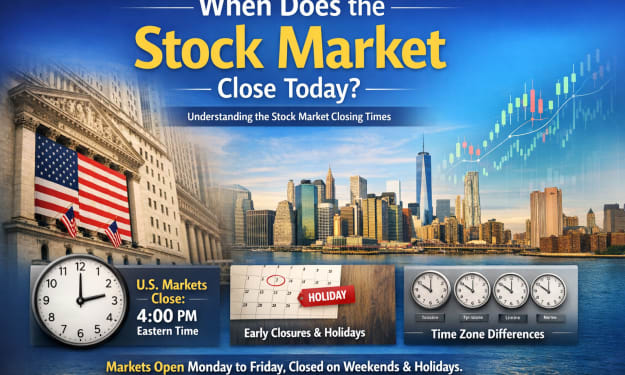
When Does the Stock Market Close Today? A Clear and Complete Guide
especially investors, traders, and beginners who want to follow market movements accurately. Knowing the exact closing time of the stock market is important because it affects buying and selling decisions, price movements, and daily investment planning. The answer, however, depends on which stock market you are referring to, since trading hours vary from one country to another. This article provides a clear and professional explanation while answering the most common questions people search for and ask. In the United States, the stock market mainly refers to two major exchanges, the New York Stock Exchange and the Nasdaq. On a normal trading day, these markets operate on a fixed schedule. They open in the morning and close in the afternoon according to Eastern Time. The regular closing time for both exchanges is four o’clock in the afternoon Eastern Time. This schedule applies from Monday to Friday. On Saturdays and Sundays, the stock market is closed and no official trading takes place. Many people also ask whether the stock market closes at the same time every day. In most cases, the answer is yes. On regular business days, the market closes at the same time consistently. However, there are exceptions related to holidays and special trading days. On certain days before major public holidays, the stock market may close earlier than usual. These early closings are announced in advance so that investors can plan accordingly. On major holidays, the market may remain completely closed for the entire day. Another common question is whether the stock market is open today or closed today. The answer depends on the calendar. If today is a weekday and not a public holiday, the market is usually open and follows the standard trading hours. If today is a weekend or an official holiday, the market will be closed. This is why many investors check the trading calendar daily, especially around holiday seasons when schedules can change. People who live outside the United States often ask how to know the closing time in their local time zone. Since the U.S. stock market operates on Eastern Time, investors in other regions must convert the time difference. For example, in many parts of Europe, the market closes in the evening local time. In the Middle East, including countries like Egypt, the market usually closes late in the evening. Understanding this time difference helps international investors follow the market without confusion. Another frequent question is whether trading completely stops when the market closes. Officially, the regular trading session ends at the closing time. However, there is something known as after hours trading. This allows some buying and selling to continue electronically after the main market session ends. While after hours trading exists, it is different from regular trading. It usually has lower trading volume, fewer participants, and larger price fluctuations. Because of this, many long term investors prefer to trade only during regular market hours. People also want to know why the stock market does not stay open all day and all night. The main reason is regulation and order. Fixed trading hours allow exchanges to manage transactions, settle trades, monitor risks, and ensure fair pricing. Although technology makes continuous trading possible, having a defined closing time helps maintain stability and transparency in the financial system. Another important question is what happens at the exact moment the market closes. When the closing time arrives, the market stops accepting regular buy and sell orders. The final prices at the close become the official closing prices for that day. These prices are very important because many investment funds, portfolios, and market reports use them to measure daily performance. Trading activity often increases near the closing time as investors adjust their positions before the market ends for the day. Some people also ask whether all global stock markets close at the same time. The answer is no. Every country has its own stock exchange schedule based on local business hours, time zones, and public holidays. For example, Asian markets close many hours before U.S. markets open, while European markets close earlier in the day compared to the United States. This creates a continuous global trading cycle, even though each individual market has its own opening and closing time. If you are asking specifically when the stock market closes today, the general answer for U.S. markets on a normal weekday is four in the afternoon Eastern Time. If today is a holiday or a special trading day, the closing time may be earlier or the market may be closed completely. Checking the daily trading schedule is always a smart habit for anyone involved in investing or trading. In conclusion, understanding when the stock market closes today is essential for making informed financial decisions. On most regular business days, major U.S. stock markets close at four p.m. Eastern Time. Exceptions occur on weekends and holidays. Knowing the closing time, understanding time zone differences, and being aware of special schedules can help investors stay organized, avoid mistakes, and better manage their trading activities.
By America today 10 months ago in Trader
Why People Are Paying Attention to Silver Prices Today
Why People Are Paying Attention to Silver Prices Today Over the last several hours, searches for silver price today have continued to rise. What is interesting is that this attention did not fade quickly, which usually means something deeper is happening. Silver prices today are not just reacting to one piece of news, but to a broader feeling of uncertainty and curiosity in the market. Many people checking the price of silver today are not professional investors. They are everyday readers who want to understand why the silver spot price keeps changing and whether it matters for the near future. This kind of interest usually appears when the economy feels unstable or unclear.
By America today 10 months ago in Trader
Fintech vs Banks for Multi-Currency Accounts for Traders
Trading today isn’t confined to one country, one currency, or one time zone. Whether you’re trading forex, commodities, crypto, or global equities, you’re constantly dealing with multiple currencies. That’s where multi-currency accounts come into play. But here’s the real question traders keep asking: should you choose a traditional bank or a modern fintech platform?
By Talha Mazhar10 months ago in Trader
Laurence Kingsley on Global Stock Market Progress. AI-Generated.
In an interconnected world where capital flows across borders at unprecedented speed, global equity markets have become both a barometer of economic health and a catalyst for growth. Laurence Kingsley, a forward‑thinking strategist with deep roots in investment innovation, offers a comprehensive outlook on how the global stock market landscape may evolve in the coming decades. His perspective combines respect for market fundamentals with a bold embrace of technological and structural change, seeking to balance opportunities for gains with systemic resilience.
By MR.Laurence Kingsley10 months ago in Trader
The Low-Attention Way I Build Wealth Without Watching Markets
SOME financial advice assumes you are financially educated, enjoy tracking markets, following news cycles, comparing strategies, and staying constantly "informed." Moreover, it assumes you want to think about investing all the time.
By Destiny S. Harris10 months ago in Trader
I Don't Know THAT Much About the Markets. I Just Keep Investing.
I'm not a market expert. I don't read charts. I don't follow earnings calls. I don't track macroeconomic narratives. I don't try to predict recessions, rate cuts, elections, or black swan events.
By Destiny S. Harris10 months ago in Trader