stocks
Stocks made simple; the essentials of stock trading and how stocks are priced, bought and sold.
Best stocks for investment
📈 1. NVIDIA (NVDA) — AI and Data Center Domin Nvidia is arguably the most pivotal company in the ongoing AI revolution. Its GPUs and AI accelerators power data centers, generative AI workloads, and large language model training/inference — a secular trend expected to expand for many years. Analysts see continued strong earnings and revenues tied to AI infrastructure buildouts by hyperscalers. Its dominance has helped Nvidia deliver historically outsized returns but its core AI role suggests long-term structural growth ahead.
By USA daily update 9 months ago in Trader
Intel stock drop 17%
On January 23, 2026, Intel Corporation (ticker: INTC) saw its share price tumble by roughly 17% in a single trading session — one of the steepest daily declines in recent years and its worst trading day since 2024. The sharp drop wiped out billions in market value and came even though the company beat expectations on fourth-quarter earnings. Investors instead zeroed in on a soft outlook and manufacturing challenges, shifting sentiment from optimism about Intel’s turnaround to deep concerns about near-term execution.
By USA daily update 9 months ago in Trader
The U.S. Stock Market Today and How It Shapes Investor Decisions
The U.S. Stock Market Today and How It Shapes Investor Decisions The U.S. stock market is going through an active and highly sensitive phase, marked by sharp movements between gains and losses. Recent sessions have shown how quickly sentiment can change, with sudden rallies followed by pullbacks driven by political headlines, economic expectations, and investor psychology. For American investors, these movements are more than just numbers on a screen. They directly influence decisions about buying, selling, or holding assets. In recent trading days, major U.S. indexes have experienced notable fluctuations. Strong upward moves in stocks often followed signals of reduced political tension or optimism around economic policy, while declines emerged when uncertainty returned. This pattern highlights how closely investors are watching every development that could affect corporate profits, interest rates, and overall economic stability. One of the strongest drivers of recent market gains has been optimism surrounding economic policy. When investors sense stability or a shift away from restrictive measures, confidence tends to rise quickly. This often leads to broad buying activity across multiple sectors, pushing major indexes higher in a short period of time. These rallies are usually fueled by expectations that companies will benefit from lower costs, smoother trade conditions, and stronger consumer demand. On the other hand, market pullbacks have been triggered by renewed concerns over economic pressure and global uncertainty. When investors fear higher costs, slower growth, or unexpected policy changes, selling pressure increases. This causes stock prices to fall, sometimes sharply, as traders rush to protect profits or reduce risk. These declines remind investors that the market remains fragile and highly reactive. Volatility has become a defining feature of the current market environment. Daily price swings can be large, even without major economic data releases. This volatility encourages short term trading strategies, as some investors try to profit from rapid movements. At the same time, it creates stress for long term investors who must decide whether to stay invested or wait for clearer signals. Technology stocks continue to play a leading role in market direction. Large technology companies have a strong influence on major indexes, meaning their gains or losses can shape overall market performance. When tech stocks rise, investor confidence often improves, encouraging broader participation in the market. When they fall, fear can spread quickly, dragging other sectors down with them. Interest rate expectations are another critical factor shaping market behavior. Investors are closely focused on the future path of monetary policy. When there is belief that interest rates may fall, stocks tend to become more attractive compared to bonds. Lower rates reduce borrowing costs for companies and support higher stock valuations. This expectation often leads investors to increase their exposure to growth stocks and riskier assets. These market conditions have a direct impact on how Americans approach investing. During periods of strong rallies, many investors feel encouraged to buy, fearing they might miss future gains. This fear of missing out can push prices even higher in the short term. Conversely, during sudden drops, fear takes over, and selling becomes more common as investors try to avoid further losses. Some investors respond to uncertainty by shifting toward defensive strategies. They may reduce exposure to volatile stocks and move into sectors considered more stable, such as utilities or consumer staples. Others may choose to hold more cash, waiting for clearer opportunities. These shifts reflect a cautious mindset shaped by repeated market swings. Looking ahead, the U.S. stock market is likely to remain sensitive to economic data, policy signals, and global developments. Investors should expect continued ups and downs rather than a smooth trend in one direction. In this environment, discipline and patience are essential. In conclusion, the current state of the U.S. stock market reflects a balance between optimism and caution. Rising stocks encourage buying and confidence, while sudden declines remind investors of the risks involved. These dynamics strongly influence how Americans decide when to buy, sell, or wait, making market awareness more important than ever.
By America today 9 months ago in Trader
Global economy trump Greenland
1. Market Volatility: Sharp Swings Amid Geopolitical Risk Global financial markets have been swinging sharply as investors react to renewed geopolitical tensions sparked by President Donald Trump’s continued push for U.S. control over Greenland, a semi-autonomous territory of Denmark.
By USA daily update 9 months ago in Trader
AMD Stock Overview and Investor Outlook
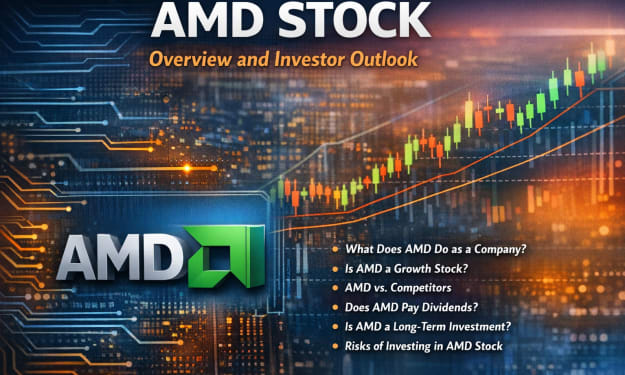
AMD Stock Overview and Investor Outlook Advanced Micro Devices, commonly known as AMD, is one of the most recognized names in the global semiconductor industry. The company designs high performance processors and graphics technologies used in personal computers, data centers, gaming consoles, and embedded systems. AMD stock attracts strong attention from investors due to its role in artificial intelligence, cloud computing, and high performance computing markets. Over the years, AMD has transformed from an underdog competitor into a major force challenging larger rivals. This transformation has reshaped how investors view the company and its long term potential. AMD stock is often associated with growth, innovation, and market share expansion, but it also comes with volatility typical of technology stocks. **What Does AMD Do as a Company** AMD develops central processing units and graphics processing units that power a wide range of devices. Its products are used by consumers, enterprises, and governments. The company focuses heavily on innovation, using advanced chip architectures to improve performance and energy efficiency. AMD also licenses its technology to major partners, expanding its reach beyond retail products. **Why Is AMD Stock So Popular With Investors** AMD stock is popular because the company operates in high growth sectors such as artificial intelligence, data centers, gaming, and cloud computing. Investors see AMD as a company that benefits from long term digital transformation trends. Its ability to compete technologically with larger rivals has strengthened confidence in its future earnings potential. **Is AMD Considered a Growth Stock or a Value Stock** AMD is generally considered a growth stock. Investors typically buy AMD shares expecting future revenue and profit expansion rather than immediate income. The company reinvests heavily in research and development, which supports innovation but can also create earnings fluctuations from quarter to quarter. **What Factors Influence the Price of AMD Stock** Several factors can impact AMD stock performance. These include demand for semiconductors, competition within the chip industry, product launch success, and overall market sentiment toward technology stocks. Broader economic conditions, such as interest rates and global supply chain stability, can also affect investor confidence in AMD shares. **How Does AMD Compare to Its Competitors** AMD competes directly with other major semiconductor companies in CPUs and GPUs. Its competitive strength lies in performance efficiency and pricing strategies. While competitors may have larger market share or deeper financial resources, AMD has gained attention for delivering strong performance gains and innovative architectures that appeal to both consumers and enterprise clients. **Is AMD Stock Volatile** Yes, AMD stock is known for volatility. Like many technology stocks, its price can move sharply in response to earnings reports, guidance updates, or changes in market expectations. This volatility can create opportunities for traders, but it also means long term investors must be comfortable with price swings. **Does AMD Pay Dividends to Shareholders** AMD does not typically focus on paying dividends. Instead, the company prioritizes reinvestment into product development and strategic growth initiatives. Investors interested in income may look elsewhere, while those focused on capital appreciation are often drawn to AMD stock. **Is AMD Stock Suitable for Long Term Investment** AMD stock may appeal to long term investors who believe in the continued growth of computing, artificial intelligence, and advanced semiconductor technologies. The company’s focus on innovation and expanding markets supports a long term growth narrative. However, investors should consider risks such as competition, market cycles, and economic downturns. **What Risks Should Investors Consider Before Buying AMD Stock** Key risks include intense competition, rapid technological changes, and dependence on global manufacturing partners. Semiconductor demand can be cyclical, which may affect revenue during slower periods. Market volatility and broader economic uncertainty can also influence stock performance. AMD stock remains a closely watched asset in the technology sector. Its connection to future focused industries makes it attractive to growth oriented investors, while its volatility requires careful consideration. Understanding the company’s business model, risks, and growth drivers is essential for anyone considering AMD as part of an investment strategy.
By America today 9 months ago in Trader
U.S. Stocks Fall Sharply as Greenland Tariff Threats and Tech Sell-Off Trigger Broad Market Sell-Off
Major indexes fell on Tuesday, January 20, 2026, as investors were shaken by geopolitical tensions and pressures from sector rotation on U.S. stock markets. The Dow Jones Industrial Average plunged more than 800 points, the S&P 500 slid roughly 2 %, and the Nasdaq Composite — long the cornerstone of the U.S. market’s rally — dropped over 2 % amid a broad tech sell-off.
By Raviha Imran9 months ago in Trader
As investors move away from tech, small-cap stocks will outpace the S&P 500.
As "small-cap stocks surge," outpacing "mega-cap" technology names in the first weeks of 2026 and indicating what many analysts call a "broadening market rotation," U.S. equity markets are witnessing a significant leadership shift. After years of dominance by large technology firms — driven largely by the artificial intelligence boom and ultra-low interest rates — investors are increasingly allocating capital to smaller, domestically focused companies and cyclical sectors.
By Raviha Imran9 months ago in Trader
As U.S.-European trade tensions cause a "Transatlantic Tantrum," global markets fall.
This week, geopolitical tensions between the United States and key European allies grew, causing a broad sell-off in stocks, increased demand for safe-haven assets, and increased volatility across major asset classes in global financial markets. A contentious dispute involving the United States is at the center of the chaos. President Donald Trump’s aggressive tariff threats against eight European nations in connection with his bid to influence control over Greenland — a move that has quickly escalated into a flashpoint for transatlantic relations and market sentiment.
By Raviha Imran9 months ago in Trader
Netflix's fourth-quarter 2025 earnings show strong revenue growth, as the Warner deal is imminent.
Netflix finished 2025 with a solid fourth-quarter performance, exceeding Wall Street's expectations and demonstrating the streaming giant's continued relevance in an entertainment industry that is changing quickly. But the spotlight on its latest earnings report was partly overshadowed by one of the most consequential strategic moves in the company’s history — its pursuit of Warner Bros. Discovery’s studio and streaming assets in a massive acquisition effort that’s captured investor attention and sparked both optimism and concern.
By Raviha Imran9 months ago in Trader
DECLINE OF THE DOW JONES AND S&P 500 AS THE DOLLAR WEAKENS AMID GREENLAND THREATS AND TARIFF FEARS
DECLINE OF THE DOW JONES AND S&P 500 AS THE DOLLAR WEAKENS AMID GREENLAND THREATS AND TARIFF FEARS Financial markets have entered a period of heightened volatility as major U.S. stock indexes, including the Dow Jones Industrial Average and the S&P 500, moved sharply lower. At the same time, the U.S. dollar has shown noticeable weakness. This shift in market sentiment has been driven by rising geopolitical tensions linked to Greenland and renewed concerns over trade tariffs, creating uncertainty that has unsettled investors across global markets. The combination of political pressure and economic risk has pushed traders to reassess expectations for growth, stability, and international cooperation. As a result, risk appetite has declined, triggering sell offs in equities and currency markets. **What factors are behind the recent drop in the Dow Jones and S&P 500** The decline in the Dow Jones and S&P 500 is largely tied to growing concerns about geopolitical escalation and trade policy uncertainty. Threats connected to Greenland have raised alarms about diplomatic stability, while the possibility of new or expanded tariffs has revived fears of trade disruptions. Investors tend to react quickly to such risks, especially when they may impact global supply chains, corporate earnings, and economic growth. **Why did tariff concerns pressure U.S. stock markets** Tariffs increase costs for businesses and consumers, reduce profit margins, and can slow economic activity. Markets typically respond negatively to the threat of tariffs because they introduce uncertainty into long term planning. Companies exposed to international trade face higher risks, and this uncertainty often leads investors to reduce exposure to stocks, particularly in industrial, manufacturing, and technology sectors. **How geopolitical tensions related to Greenland influenced investor sentiment** Greenland has emerged as a sensitive geopolitical issue, and any related threats have added a layer of instability to global relations. Markets react strongly to geopolitical developments because they can lead to unexpected policy decisions, economic retaliation, or shifts in alliances. This uncertainty encourages investors to move away from risk assets and seek safer alternatives. **Why the U.S. dollar weakened during this period** The U.S. dollar often weakens when confidence in economic or political stability declines. In this case, fears surrounding trade disputes and geopolitical tensions reduced demand for dollar denominated assets. Investors began reallocating capital toward other currencies and assets perceived as safer, leading to downward pressure on the dollar’s value. **Which sectors were most affected by the market downturn** The sell off was broad, but sectors closely tied to global trade were among the hardest hit. Industrial companies, exporters, financial institutions, and technology firms saw notable declines. These sectors are particularly sensitive to tariffs and international uncertainty, making them vulnerable during periods of geopolitical stress. **How investors adjusted their strategies amid rising uncertainty** As stocks and the dollar fell, many investors shifted toward defensive positions. Assets traditionally viewed as safe havens gained attention as traders sought protection from volatility. This shift reflects a cautious outlook, with market participants prioritizing capital preservation over aggressive growth strategies. **What this market reaction says about investor confidence** The synchronized decline in equities and the dollar signals a drop in investor confidence. Markets are forward looking, and the reaction suggests concerns about future economic conditions rather than immediate data. When political and trade risks dominate headlines, confidence can erode quickly, leading to sharp market adjustments. **Could these developments affect global markets beyond the United States** Yes, global markets are closely interconnected. Weakness in U.S. indexes and the dollar often spills over into international markets. Trade partners, emerging economies, and global corporations all feel the effects of U.S. policy uncertainty, making this a worldwide concern rather than a domestic issue alone. **What might determine the next move for markets** Future market direction will depend on how geopolitical tensions evolve and whether trade threats escalate or ease. Clear communication, diplomatic progress, or policy stabilization could help restore confidence. On the other hand, prolonged uncertainty may keep markets under pressure and sustain volatility. In summary, the recent decline in the Dow Jones and S&P 500, alongside a weaker U.S. dollar, reflects growing anxiety over Greenland related tensions and tariff threats. These factors have combined to shake investor confidence, push markets lower, and increase demand for safer assets. Until uncertainty fades, markets are likely to remain sensitive to political and economic developments.
By America today 9 months ago in Trader