product review
Product Reviews for the budding stock trader; discover innovative products, gadgets, tools and services to help you invest smarter.
PayPal Stock Outlook: Is PYPL a Smart Investment Right Now?
**PayPal Stock Outlook: Is PYPL a Smart Investment Right Now?** PayPal stock has been a major topic of interest among investors searching for opportunities in the digital payments sector. As one of the most recognized fintech companies in the world, PayPal continues to attract attention due to its large user base, global reach, and evolving business strategy. Recent market movements have sparked questions about whether PayPal stock is undervalued, where it may be heading next, and if it still holds long-term potential in an increasingly competitive landscape. PayPal operates at the center of online commerce, enabling individuals and businesses to send and receive payments securely across borders. Its ecosystem includes PayPal, Venmo, Braintree, and other services that power millions of transactions daily. Despite this strong foundation, the company has faced stock price volatility as investors reassess growth expectations and profitability in the fintech sector. **What Is Driving Interest in PayPal Stock Lately** Investor interest in PayPal stock has grown due to shifts in its valuation and renewed focus on efficiency. After a period of rapid expansion during the global surge in digital payments, the company entered a phase of slower growth. This change led many investors to question whether PayPal could maintain its dominant position. Recently, management initiatives aimed at cost control, margin improvement, and product optimization have brought PayPal back into the spotlight. **Why Has PayPal Stock Declined From Its Previous Highs** One of the most searched questions about PayPal stock relates to its drop from earlier peak levels. The decline was influenced by several factors, including rising interest rates, reduced investor appetite for high-growth tech stocks, and increased competition from other payment platforms. Additionally, slower user growth compared to previous years caused the market to reprice PayPal shares, reflecting more realistic expectations. **Is PayPal Stock Considered Undervalued Today** Many analysts and investors believe PayPal stock may be undervalued relative to its historical performance and earnings potential. The company continues to generate strong cash flow and maintains a solid balance sheet. Compared to earlier years, PayPal now trades at valuation levels that appeal to long-term investors seeking established companies rather than speculative growth stories. **How Does PayPal Make Its Money** PayPal earns revenue primarily through transaction fees charged to merchants and consumers for processing payments. The company benefits from transaction volume growth, value-added services, and partnerships with online retailers and financial institutions. Its Venmo platform also plays an increasingly important role, especially as monetization features expand. **Can PayPal Compete With New Payment Platforms** Competition is one of the most common concerns surrounding PayPal stock. The digital payments space is crowded with traditional banks, fintech startups, and technology companies offering alternative solutions. However, PayPal’s brand recognition, global infrastructure, and established merchant relationships give it a strong competitive advantage. While competition pressures margins, PayPal’s scale allows it to adapt and innovate more effectively than smaller rivals. **What Role Does Venmo Play in PayPal’s Future** Venmo has become a key growth driver within PayPal’s ecosystem. Its popularity among younger users and expanding use cases beyond peer-to-peer payments support long-term growth potential. As PayPal continues to introduce new features and revenue streams within Venmo, investors see it as a strategic asset that could significantly boost earnings over time. **Is PayPal Stock a Good Long-Term Investment** For long-term investors, PayPal stock is often viewed as a recovery and value opportunity rather than a high-growth play. The company’s focus on profitability, operational efficiency, and shareholder returns has shifted market perception. Investors who believe in the continued expansion of digital payments may see PayPal as a stable option with upside potential if execution improves. **What Risks Should Investors Consider Before Buying PayPal Stock** Like any investment, PayPal stock carries risks. Economic slowdowns can reduce transaction volumes, while regulatory changes may impact operations in certain regions. Competitive pressures and technological disruption also remain ongoing challenges. Investors should weigh these risks against PayPal’s financial strength and long-term market position. **What Could Influence PayPal Stock Performance Going Forward** Future performance will depend on PayPal’s ability to accelerate revenue growth, expand margins, and maintain user engagement. Strategic decisions, product innovation, and broader market conditions will all play a role. Earnings reports and forward guidance are likely to continue driving short-term stock movements. PayPal stock remains one of the most closely watched names in the fintech industry. While it no longer carries the hype of its earlier years, it offers a combination of scale, brand power, and financial stability that continues to attract investors searching for value and long-term opportunity in digital payments.
By America today 9 months ago in Trader
Understanding WikiFX in the Forex Ecosystem: Role, Value, and Limitations
In the global retail forex market, access to information has improved dramatically over the past decade. Traders today can easily find broker reviews, regulatory warnings, and user feedback within seconds. At the same time, this abundance of information has introduced a new challenge: how to evaluate the credibility and role of third-party forex information platforms themselves.
By Harry Foster9 months ago in Trader
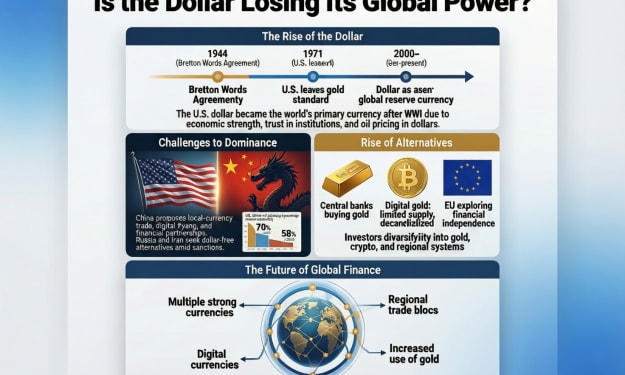
Is the Dollar Losing Its Global Power?
Is the Dollar Losing Its Global Power? For many decades, the U.S. dollar has been the most powerful currency in the world. It has been used for global trade, oil sales, international loans, and foreign reserves. Countries trusted the dollar as a safe store of value. But today, many experts are asking an important question: Is the dollar entering its last strong phase?
By Wings of Time 9 months ago in Trader
Best 10 Stocks to Buy Now: A Professional Investment Guide
**Best 10 Stocks to Buy Now: A Professional Investment Guide** Investing in stocks at the right time can significantly impact long-term wealth building. As global markets evolve and new economic trends shape investor behavior, many people are asking the same question: what are the best stocks to buy right now? This professional guide highlights ten stocks that are widely viewed as strong candidates based on growth potential, market leadership, innovation, and long-term demand. The companies mentioned span technology, healthcare, finance, energy, and industrial sectors, offering diversification for investors seeking balanced opportunities. **Why Are These Stocks Considered Attractive Right Now?** The stocks selected stand out because they operate in industries with strong future demand. Artificial intelligence, cloud computing, digital finance, healthcare innovation, and energy infrastructure are all sectors expected to grow steadily. These companies also show solid fundamentals, competitive advantages, and the ability to adapt to changing market conditions, which makes them appealing to both long-term and growth-focused investors. **Nvidia and the Continued Expansion of Artificial Intelligence** Nvidia is widely regarded as a cornerstone of the artificial intelligence revolution. Its advanced processors are essential for AI training, data centers, and high-performance computing. As businesses, governments, and research institutions invest heavily in AI, demand for Nvidia’s technology continues to grow. This long-term trend positions the company as a potential leader for years to come. **Is AMD a Strong Alternative in the Semiconductor Market?** Advanced Micro Devices has emerged as a powerful competitor in the semiconductor industry. The company has gained market share in processors used for data centers, gaming, and AI-related applications. Investors often see AMD as a growth-oriented stock with room to expand as demand for computing power increases globally. **How Alphabet Maintains Its Market Leadership** Alphabet, the parent company of Google, benefits from diversified revenue streams including search advertising, cloud services, and artificial intelligence development. Its dominance in digital advertising and continued investment in emerging technologies make it a strong candidate for investors seeking exposure to both stability and innovation. **Why Amazon Remains a Long-Term Growth Stock** Amazon combines global e-commerce leadership with one of the strongest cloud computing platforms in the world. Its cloud division supports businesses across multiple industries, while its retail operations continue to benefit from changing consumer behavior. The company’s focus on automation and AI integration further strengthens its growth outlook. **Is Eli Lilly a Safe Choice in the Healthcare Sector?** Eli Lilly represents stability and growth within healthcare. The company is known for its innovative treatments in areas such as diabetes and weight management. Healthcare demand tends to remain strong regardless of economic cycles, which makes pharmaceutical companies like Eli Lilly attractive to investors seeking defensive yet growth-oriented stocks. **Why Investors Are Watching SoFi Technologies** SoFi Technologies is a digital financial services company that targets modern consumers with online banking, lending, and investment products. As more people shift away from traditional banking, fintech platforms like SoFi are gaining popularity. Its expanding customer base and product ecosystem make it a stock to watch in the financial technology space. **What Makes TSMC Critical to the Global Economy?** Taiwan Semiconductor Manufacturing Company plays a crucial role in producing advanced chips for major technology firms. As the backbone of the global semiconductor supply chain, TSMC benefits from rising demand for electronics, AI systems, and advanced computing. Its technological leadership gives it a strong competitive position. **Can Commodity Stocks Like Freeport-McMoRan Perform Well?** Freeport-McMoRan is a major producer of copper, a metal essential for electric vehicles, renewable energy, and infrastructure projects. As countries invest in electrification and green energy, demand for copper is expected to increase, making this stock appealing to investors seeking exposure to commodities tied to long-term trends. **Is Valaris a Smart Choice in the Energy Sector?** Valaris operates in offshore drilling services and benefits from global energy demand. While energy stocks can be cyclical, companies with improving earnings and operational efficiency may offer strong opportunities during periods of increased energy investment. **Why General Motors Still Attracts Investors** General Motors continues to evolve as an automotive leader with a focus on profitability, dividends, and shareholder returns. Its efforts to balance traditional vehicle production with innovation and efficiency make it appealing to investors looking for value and income potential. **How Should Investors Choose the Best Stocks for Their Goals?** Choosing the right stocks depends on individual risk tolerance, investment horizon, and financial goals. Diversification across sectors helps reduce risk, while focusing on companies with strong fundamentals can improve long-term outcomes. Monitoring market trends and understanding the business behind each stock is essential for informed decision-making. **Final Thoughts** The ten stocks discussed represent a mix of growth, stability, and future-focused industries. While no investment is without risk, companies that lead innovation, adapt to change, and operate in high-demand sectors often provide strong long-term opportunities. This article serves as a professional overview for investors exploring potential stock purchases in the current market environment.
By America today 9 months ago in Trader
Amazon Fresh Stores Shut Down as Amazon Reshapes Its Grocery Strategy
Amazon Fresh Stores Shut Down as Amazon Reshapes Its Grocery Strategy Amazon has officially closed its physical Amazon Fresh grocery stores across the United States, marking a decisive shift in the company’s approach to grocery retail. The move reflects a broader transformation within Amazon as it reevaluates which business models deliver sustainable growth and long-term profitability. While Amazon Fresh was launched with ambitious goals and advanced technology, the physical store concept ultimately failed to meet expectations in a highly competitive grocery market. Amazon Fresh stores were introduced as a modern alternative to traditional supermarkets, combining fresh food, competitive pricing, and digital integration. Despite these efforts, the stores struggled to establish a strong identity that resonated with shoppers. Many consumers found little difference between Amazon Fresh and existing grocery chains, making it difficult for the brand to stand out in crowded local markets. --- ## Why Amazon Decided to Close Amazon Fresh Stores One of the main drivers behind the closure was profitability. Grocery retail is known for thin margins, and operating physical stores requires significant investment in real estate, staffing, inventory, and logistics. Amazon determined that the Amazon Fresh store model did not deliver the financial returns needed to justify continued expansion. Additionally, customer foot traffic at many locations remained inconsistent. While some stores performed well, others failed to attract steady demand. This uneven performance made scaling the concept nationwide increasingly risky and inefficient for the company. --- ## Are Amazon Fresh Stores Permanently Closed? Amazon has confirmed that all Amazon Fresh physical grocery stores in the U.S. are being shut down. The closures are taking place in stages, with most locations closing within a short period. Some stores may remain open briefly due to local regulations, but Amazon has no plans to reopen or replace them under the Amazon Fresh brand. The decision also aligns with Amazon’s broader effort to simplify its retail operations and reduce investments in experimental concepts that have not proven successful. --- ## Can Customers Still Order Amazon Fresh Online? Yes, Amazon Fresh continues to operate as an online grocery delivery service. Customers in eligible areas can still order groceries through Amazon’s digital platform, including fresh produce, packaged foods, and household essentials. The closure only affects physical store locations, not grocery delivery services. This change highlights Amazon’s belief that online grocery shopping offers greater scalability and convenience for modern consumers. Digital ordering and same-day delivery remain central to Amazon’s long-term strategy. --- ## Why Amazon Is Shifting Away From Physical Grocery Stores Consumer behavior has played a major role in Amazon’s decision. More shoppers now prefer ordering groceries online rather than visiting physical stores. This trend accelerated in recent years as customers increasingly prioritize convenience, speed, and flexible delivery options. Operating physical grocery stores also limits Amazon’s ability to quickly adapt to changes in demand. In contrast, online grocery fulfillment allows the company to adjust inventory, pricing, and delivery capacity more efficiently. --- ## What Role Does Whole Foods Play in Amazon’s New Plan? Whole Foods Market has become Amazon’s primary physical grocery brand. Unlike Amazon Fresh, Whole Foods has a strong reputation, loyal customers, and a clear market position in the premium grocery segment. Amazon plans to continue expanding Whole Foods locations and integrating them more closely with its online delivery services. The success of Whole Foods underscores why Amazon chose to exit the Amazon Fresh store model while maintaining a presence in physical grocery retail through a more established brand. --- ## How Are Employees Affected by the Closures? The shutdown of Amazon Fresh stores impacts a large number of employees. Amazon has stated that it aims to offer affected workers opportunities to transfer to other roles within the company, including warehouse operations, delivery services, and Whole Foods locations. For employees who are unable to transition into new roles, Amazon may provide severance packages and temporary benefits. This approach reflects the company’s effort to manage workforce changes responsibly while restructuring its retail operations. --- ## What This Means for the Future of Grocery Retail The closure of Amazon Fresh stores signals a broader shift in the grocery industry. Retailers are increasingly focusing on digital platforms, delivery services, and fewer but more efficient physical locations. Technology alone is no longer enough to guarantee success in brick-and-mortar retail without strong branding and consistent customer demand. Amazon’s decision demonstrates that even the largest and most innovative companies must adapt when business models fail to deliver results. By closing Amazon Fresh stores, Amazon is redirecting its resources toward strategies that better align with evolving consumer habits and long-term growth goals.
By America today 9 months ago in Trader
Silver and Gold Prices Are Surging: A Clear Summary of What’s Really Happening
Silver and Gold Prices Are Surging: A Clear Summary of What’s Really Happening The recent surge in silver and gold prices has captured global attention, raising serious questions among investors and everyday observers alike. This movement is not accidental or temporary. It reflects deeper changes in the global economic system, investor psychology, and long-term supply and demand dynamics. Understanding why silver and gold are rising together, and why silver in particular is showing sharp volatility, requires looking beyond headlines and short-term speculation. Gold has always been viewed as a safe haven asset. In times of economic uncertainty, inflation, geopolitical conflict, or currency weakness, investors historically turn to gold to preserve value. What makes the current rise in gold prices notable is the scale and persistence of global risks. Inflation remains higher than expected in many economies, while interest rates have struggled to stay meaningfully above inflation. This situation weakens the appeal of holding cash and strengthens demand for assets that can protect purchasing power. Another powerful driver behind gold’s rise is central bank behavior. Many countries have been increasing their gold reserves as a strategic decision. This reflects concerns about overreliance on major currencies, rising government debt, and geopolitical tensions. Central bank buying provides strong long-term support for gold prices and reinforces gold’s role as a monetary asset rather than just a commodity. Silver, however, tells a more complex and explosive story. Unlike gold, silver is not only a store of value but also a critical industrial metal. It plays a vital role in solar panels, electric vehicles, electronics, medical technology, and advanced manufacturing. As the global economy shifts toward renewable energy and digital infrastructure, demand for silver has surged dramatically. At the same time, silver supply has struggled to keep pace. Many silver mines are secondary operations tied to other metals, limiting how quickly production can increase. This has created a structural supply deficit, pushing prices higher. When investment demand increases on top of already tight industrial demand, silver prices tend to move sharply, which explains its strong volatility. Inflation is a key factor affecting both metals, but it is not acting alone. Currency devaluation, expanding global debt, and declining confidence in traditional financial systems all play important roles. When money loses value, real assets like gold and silver naturally become more attractive. This effect is amplified when inflation is global rather than localized, as is the case today. Interest rates also influence precious metals, but the relationship is more nuanced than many assume. While higher interest rates can pressure gold and silver, this only holds when rates exceed inflation. In environments where real interest rates remain low or negative, precious metals continue to perform well. Uncertainty around future rate decisions further increases their appeal as stabilizing assets. Silver’s volatility compared to gold comes from its smaller market size and its dual role as both an industrial and investment metal. Economic growth expectations, technological expansion, and speculative trading all impact silver more intensely. This means silver often outperforms gold during strong bull markets, but with greater risk and sharper corrections. Geopolitical tensions also play a critical role. Conflicts, sanctions, and political instability increase demand for universally trusted assets. Gold and silver benefit from this environment because they are globally recognized, liquid, and independent of any single government. The current movement in silver and gold prices appears to be more than a short-term rally. High global debt, long-term inflation pressures, energy transition demand, and shifting investor behavior suggest the foundations of a longer bull market. While prices will fluctuate, the underlying forces supporting precious metals remain strong. In essence, rising silver and gold prices are signaling stress within the global financial system. Silver reflects industrial transformation and supply strain, while gold reflects monetary uncertainty and the search for stability. Together, they highlight a world in transition, where real value is becoming more important than financial promises.
By America today 9 months ago in Trader
Who Benefits Most If the Dollar Declines?
Who Benefits Most If the Dollar Declines? The US dollar has been the backbone of the global financial system for decades. It is used in international trade, energy markets, foreign reserves, and global lending. But if the dollar slowly loses its dominance, the effects will not be equal. Some countries and groups could benefit significantly, while others may face serious challenges.
By Wings of Time 9 months ago in Trader
What Replaces the Dollar If It Falls?
What Replaces the Dollar If It Falls? For nearly a century, the US dollar has been the world’s most powerful currency. It dominates global trade, oil markets, foreign reserves, and international finance. But as trust in the dollar is questioned by geopolitics, debt, and global power shifts, a serious debate has emerged: if the dollar ever loses its central role, what could replace it?
By Wings of Time 9 months ago in Trader