investing
'Buy low, sell high' is just the tip of the iceberg; learn the art of investing from expert traders and how to make your money grow.
Australia Mobile Device Management Market: Security, Mobility & Enterprise Transformation. AI-Generated.
Australia Mobile Device Management Market Overview The Australia mobile device management (MDM) market is experiencing robust growth as organisations across sectors adopt digital workplaces, hybrid work models, and distributed device ecosystems. Mobile device management refers to software solutions and platforms that enable enterprises to secure, monitor, configure and manage mobile endpoints — including smartphones, tablets, laptops, wearables and Internet of Things (IoT) devices — from a centralised console. The Australia mobile device management (MDM) market size reached USD 266.0 Million in 2024. Looking forward, IMARC Group expects the market to reach USD 1,664.6 Million by 2033, exhibiting a growth rate (CAGR) of 22.60% during 2025-2033. This growth reflects heightened cybersecurity concerns, the proliferation of connected devices, increased adoption of bring-your-own-device (BYOD) policies, and regulatory imperatives that prioritise data protection and governance.
By Amyra Singh10 months ago in Trader
Why Retail Forex Traders Lose More to Information Asymmetry Than to Market Volatility. AI-Generated.
Introduction: The Real Risk Most Traders Ignore Ask most retail forex traders what the greatest risk in trading is, and you’ll hear the same answer: market volatility.
By Harry Foster10 months ago in Trader
Why Most Forex Traders Lose Money & How Smart Practice Methods Are Transforming Learning in 2026. AI-Generated.
Forex trading remains one of the largest financial markets in the world, with daily turnover estimated at around $9.6 trillion in 2025, up from roughly $7.5 trillion in 2022.
By Beirman Capital10 months ago in Trader
The Ultimate Guide to the Fear and Greed Index. AI-Generated.
Markets aren’t purely logical — they’re driven by fear, greed, confidence, panic, and complacency. These psychological forces affect trends, volatility, breakouts, crashes, and bubbles. The Fear and Greed Index helps you quantify that emotional pressure.
By Beirman Capital10 months ago in Trader
Philippines Alternative Data Market: Analytics Revolution, Strategic Insights & Investment Edge. AI-Generated.
Philippines Alternative Data Market The Philippines alternative data market is gaining significant momentum as businesses, financial institutions and technology firms increasingly leverage unconventional datasets to uncover insights, inform strategy and enhance predictive decision-making. Alternative data refers to non-traditional data sources — such as web and social media analytics, satellite imagery, mobile usage patterns, credit card transaction data, IoT sensor feeds, sentiment scores, web scraping outputs and geospatial analytics — that extend beyond standard financial and corporate filings. The Philippines alternative data market size reached USD 40.00 Million in 2024. Looking forward, IMARC Group expects the market to reach USD 726.83 Million by 2033, exhibiting a growth rate (CAGR) of 33.64% during 2025-2033. This rapid growth reflects rising demand for data-driven insights, expanding fintech innovation, and increased adoption of predictive analytics across sectors seeking competitive advantage.
By Manisha Dixit10 months ago in Trader
Australia Pharmaceutical Market: Healthcare Demand, Innovation & Strategic Growth. AI-Generated.
Australia Pharmaceutical Market The Australia pharmaceutical market has emerged as a key pillar of the nation’s healthcare ecosystem, reflecting growing healthcare spending, a rising disease burden, and strong innovation in drug development and biotech solutions. Pharmaceuticals — including prescription medicines, over-the-counter (OTC) drugs, generic and patented therapies — remain essential for disease management, preventive care and chronic condition treatment. The Australia pharmaceutical market size was valued at USD 25.3 Billion in 2025. Looking forward, the market is expected to reach USD 31.9 Billion by 2034, exhibiting a CAGR of 2.57% from 2026-2034. This growth stems from demographic shifts, increasing healthcare access, regulatory reforms, and expanding R&D investment aimed at addressing both national and global health challenges.
By Amyra Singh10 months ago in Trader
Sanctions, Strategy, and Silence: The U.S.–Pakistan Equation
Sanctions, Strategy, and Silence: The U.S.–Pakistan Equation The relationship between the United States and Pakistan has never been simple. It has moved through phases of close cooperation, deep mistrust, strategic partnership, and long periods of silence. Unlike some international relationships that are clearly friendly or openly hostile, the U.S.–Pakistan equation exists in a gray zone shaped by security concerns, regional politics, and global strategy.
By Wings of Time 10 months ago in Trader
Amazon Stock Price A Complete and Clear Overview for Investors
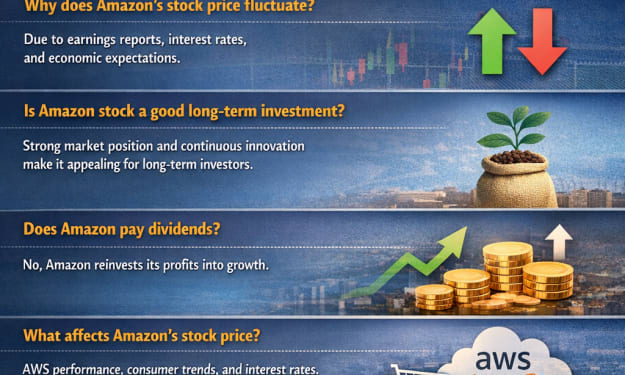
Amazon Stock Price A Complete and Clear Overview for Investors The price of Amazon stock has long been one of the most discussed topics in global financial markets. As one of the largest companies in the world, Amazon attracts investors ranging from long term holders to short term traders. Understanding how Amazon’s stock price moves, what affects it, and whether it is a good investment requires looking at several key factors related to the company’s performance and the broader market. Amazon’s stock price reflects the market’s perception of its business strength and future growth. The company operates across multiple sectors including e commerce, cloud computing through Amazon Web Services, digital advertising, streaming, and artificial intelligence. Because of this diversity, changes in Amazon’s stock price are often influenced by more than just online retail sales. Strong performance in AWS or advertising can support the stock even during periods of slower consumer spending. Many people ask why Amazon’s stock price fluctuates so often. The main reason is that Amazon is a growth focused company, and growth stocks tend to react strongly to earnings reports, interest rate changes, and economic expectations. When Amazon reports higher revenue, expanding profit margins, or strong cloud growth, the stock price usually rises. On the other hand, increased costs, weaker guidance, or concerns about competition can cause temporary declines. Another common question is whether Amazon stock is expensive or fairly valued. Investors often compare Amazon’s stock price to its earnings, cash flow, and long term growth potential. Historically, Amazon has traded at higher valuation levels than traditional retail companies because investors expect continued innovation and expansion. This means the stock price often reflects future expectations rather than current profits alone. People also frequently ask if Amazon stock is a good long term investment. Many analysts and investors view Amazon as a strong long term holding due to its dominant market position, global brand recognition, and continuous investment in technology. The company reinvests heavily in logistics, automation, artificial intelligence, and new services, which can pressure short term profits but support long term stock price growth. However, like any investment, Amazon stock carries risks, including regulatory pressure, competition from other tech giants, and changes in consumer behavior. Another popular question is what factors directly impact Amazon’s stock price today. Interest rates play a major role, as higher rates often reduce investor appetite for growth stocks. Consumer spending trends are also important, especially for Amazon’s retail segment. Additionally, performance of Amazon Web Services is closely watched, since AWS contributes a significant portion of the company’s operating income. Even broader market sentiment toward technology stocks can move Amazon’s share price up or down. Some investors wonder whether Amazon pays dividends. Amazon does not currently pay a dividend, choosing instead to reinvest profits into expanding its business. This strategy is one reason the stock price focuses more on growth potential rather than income generation. Investors seeking dividends may look elsewhere, while those focused on capital appreciation often consider Amazon attractive. Another frequently asked question is how Amazon’s stock price compares to other technology companies. While Amazon’s price per share may be lower or higher than peers at different times, what matters most is market value and growth outlook. Amazon consistently ranks among the most valuable companies in the world, reflecting investor confidence in its long term strategy. In conclusion, Amazon’s stock price is shaped by a combination of company performance, economic conditions, and investor expectations. Its wide range of business segments provides strength but also complexity, making the stock sensitive to both positive and negative news. For investors willing to accept volatility and focus on long term growth, Amazon remains one of the most closely followed and influential stocks in the global market.
By America today 10 months ago in Trader