investing
'Buy low, sell high' is just the tip of the iceberg; learn the art of investing from expert traders and how to make your money grow.
Netflix's fourth-quarter 2025 earnings show strong revenue growth, as the Warner deal is imminent.
Netflix finished 2025 with a solid fourth-quarter performance, exceeding Wall Street's expectations and demonstrating the streaming giant's continued relevance in an entertainment industry that is changing quickly. But the spotlight on its latest earnings report was partly overshadowed by one of the most consequential strategic moves in the company’s history — its pursuit of Warner Bros. Discovery’s studio and streaming assets in a massive acquisition effort that’s captured investor attention and sparked both optimism and concern.
By Raviha Imran9 months ago in Trader
DECLINE OF THE DOW JONES AND S&P 500 AS THE DOLLAR WEAKENS AMID GREENLAND THREATS AND TARIFF FEARS
DECLINE OF THE DOW JONES AND S&P 500 AS THE DOLLAR WEAKENS AMID GREENLAND THREATS AND TARIFF FEARS Financial markets have entered a period of heightened volatility as major U.S. stock indexes, including the Dow Jones Industrial Average and the S&P 500, moved sharply lower. At the same time, the U.S. dollar has shown noticeable weakness. This shift in market sentiment has been driven by rising geopolitical tensions linked to Greenland and renewed concerns over trade tariffs, creating uncertainty that has unsettled investors across global markets. The combination of political pressure and economic risk has pushed traders to reassess expectations for growth, stability, and international cooperation. As a result, risk appetite has declined, triggering sell offs in equities and currency markets. **What factors are behind the recent drop in the Dow Jones and S&P 500** The decline in the Dow Jones and S&P 500 is largely tied to growing concerns about geopolitical escalation and trade policy uncertainty. Threats connected to Greenland have raised alarms about diplomatic stability, while the possibility of new or expanded tariffs has revived fears of trade disruptions. Investors tend to react quickly to such risks, especially when they may impact global supply chains, corporate earnings, and economic growth. **Why did tariff concerns pressure U.S. stock markets** Tariffs increase costs for businesses and consumers, reduce profit margins, and can slow economic activity. Markets typically respond negatively to the threat of tariffs because they introduce uncertainty into long term planning. Companies exposed to international trade face higher risks, and this uncertainty often leads investors to reduce exposure to stocks, particularly in industrial, manufacturing, and technology sectors. **How geopolitical tensions related to Greenland influenced investor sentiment** Greenland has emerged as a sensitive geopolitical issue, and any related threats have added a layer of instability to global relations. Markets react strongly to geopolitical developments because they can lead to unexpected policy decisions, economic retaliation, or shifts in alliances. This uncertainty encourages investors to move away from risk assets and seek safer alternatives. **Why the U.S. dollar weakened during this period** The U.S. dollar often weakens when confidence in economic or political stability declines. In this case, fears surrounding trade disputes and geopolitical tensions reduced demand for dollar denominated assets. Investors began reallocating capital toward other currencies and assets perceived as safer, leading to downward pressure on the dollar’s value. **Which sectors were most affected by the market downturn** The sell off was broad, but sectors closely tied to global trade were among the hardest hit. Industrial companies, exporters, financial institutions, and technology firms saw notable declines. These sectors are particularly sensitive to tariffs and international uncertainty, making them vulnerable during periods of geopolitical stress. **How investors adjusted their strategies amid rising uncertainty** As stocks and the dollar fell, many investors shifted toward defensive positions. Assets traditionally viewed as safe havens gained attention as traders sought protection from volatility. This shift reflects a cautious outlook, with market participants prioritizing capital preservation over aggressive growth strategies. **What this market reaction says about investor confidence** The synchronized decline in equities and the dollar signals a drop in investor confidence. Markets are forward looking, and the reaction suggests concerns about future economic conditions rather than immediate data. When political and trade risks dominate headlines, confidence can erode quickly, leading to sharp market adjustments. **Could these developments affect global markets beyond the United States** Yes, global markets are closely interconnected. Weakness in U.S. indexes and the dollar often spills over into international markets. Trade partners, emerging economies, and global corporations all feel the effects of U.S. policy uncertainty, making this a worldwide concern rather than a domestic issue alone. **What might determine the next move for markets** Future market direction will depend on how geopolitical tensions evolve and whether trade threats escalate or ease. Clear communication, diplomatic progress, or policy stabilization could help restore confidence. On the other hand, prolonged uncertainty may keep markets under pressure and sustain volatility. In summary, the recent decline in the Dow Jones and S&P 500, alongside a weaker U.S. dollar, reflects growing anxiety over Greenland related tensions and tariff threats. These factors have combined to shake investor confidence, push markets lower, and increase demand for safer assets. Until uncertainty fades, markets are likely to remain sensitive to political and economic developments.
By America today 9 months ago in Trader
Silver Price Forecast 2026: Michael Oliver Sees $500 per Oz – Money Metals Discussion
On a recent episode of the Money Metals podcast, host Mike Maharrey sat down with veteran market technician J. Michael Oliver, commonly referred to as simply Michael Oliver, to unpack why he believes silver is breaking out of a half-century “box” and entering a radically new price regime.
By Stefan Gleason9 months ago in Trader
China Hits 5% Growth Target in 2025 as Exports Power Economy Despite Trade Tensions
China’s national economy achieved its official 2025 growth target of about 5%, surprising some observers who expected renewed U.S. tariffs and internal structural weaknesses to slow the world’s second-largest economy significantly. GDP increased by 5.0% last year, in line with Beijing's stated goal and indicating resilience in the face of numerous obstacles, according to government data.
By Raviha Imran9 months ago in Trader
Australia Fashion and Apparel Market: Style Evolution, Consumer Trends & Retail Expansion. AI-Generated.
Australia Fashion and Apparel Market Overview The Australia fashion and apparel market continues its dynamic growth as consumer preferences evolve, digital shopping expands and lifestyle trends shape demand for clothing across age groups, occasions and price segments. Fashion apparel — including casual wear, formal wear, activewear, outerwear, accessories and seasonal collections — is not just a necessity but a reflection of personal identity, cultural influences and fashion sensibilities. The Australia fashion and apparel market size reached USD 38.9 Billion in 2025. Looking forward, the market is expected to reach USD 55.2 Billion by 2034, exhibiting a growth rate (CAGR) of 3.97% during 2026-2034. This growth underscores the resilience of the apparel sector despite economic fluctuations, with consumers increasingly seeking quality, comfort, stylistic relevance and value-driven purchases.
By Amyra Singh9 months ago in Trader
Australia Jewellery Market: Sparkling Demand, Consumer Trends & Retail Expansion. AI-Generated.
Australia Jewellery Market Overview The Australia jewellery market continues to shine brightly as consumers increasingly embrace jewellery not just as ornamental accessories but also as symbols of status, personal expression and emotional value. Jewellery — including gold, diamond, platinum, silver pieces, gemstone collections and designer fashion jewellery — is deeply intertwined with cultural occasions, gifting traditions and everyday fashion statements. The Australia jewellery market size reached USD 3.1 Billion in 2024. Looking forward, the market is projected to reach USD 4.7 Billion by 2033, exhibiting a growth rate (CAGR) of 4.2% during 2025-2033. This expansion reflects rising disposable incomes, growing retail penetration, fashion evolution, and the increasing influence of digital channels that enhance accessibility and consumer experiences.
By Amyra Singh9 months ago in Trader
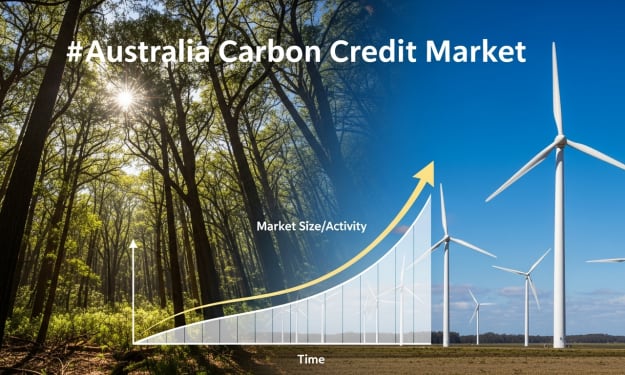
Australia Carbon Credit Market: Emissions Reduction, Policy Support & Green Investment. AI-Generated.
Australia Carbon Credit Market Overview The Australia carbon credit market is gaining considerable momentum as climate policy, corporate sustainability commitments and international environmental standards converge to support the reduction of greenhouse gas (GHG) emissions. Carbon credits — tradable certificates representing the reduction or removal of one tonne of CO₂ equivalent — enable businesses, governments and individuals to meet emissions targets through verified climate action projects. The Australia carbon credit market size reached 18.35 Million ACCUs in 2024. Looking forward, the market is expected to reach 32.16 Million ACCUs by 2033, exhibiting a growth rate (CAGR) of 6.43% during 2025-2033. This surge highlights increased corporate participation, enhanced regulatory support, the rise of voluntary carbon markets and Australia’s commitment to international climate frameworks and net-zero goals.
By Amyra Singh9 months ago in Trader
The Three Dave Ramsey Baby Steps You Should Reconsider
Dave Ramsey has helped a lot of people stop doing dumb things with money. That alone deserves respect. If you're buried in credit card debt, stressed, disorganized, and living on financial fumes, the Baby Steps can pull you out of chaos.
By Destiny S. Harris9 months ago in Trader
The One Lesson from Rich Dad Poor Dad I Will Not Forget
Rich Dad Poor Dad is often treated like a beginner's book. People quote it early in their money journey, nod along, then move on. But buried inside it is a lesson that doesn't age, doesn't get outdated, and doesn't stop being relevant no matter how much you earn.
By Destiny S. Harris9 months ago in Trader
The Cashless Island: How Singapore is Rewriting the Rules of Digital Payments. AI-Generated.
In most parts of the world, "cash is king." But in Singapore, cash is rapidly becoming a relic of the past. If you walk into a traditional hawker center today for a plate of Chicken Rice, you are just as likely to see a QR code scanner as you are to see a cash register. This isn't an accident; it is a meticulously engineered transformation that has turned the island nation into the Silicon Valley of payments.
By Sam walter10 months ago in Trader
Are Moving Average Crossover Strategies Good for Beginners?. AI-Generated.
Moving average crossover strategies are among the most popular entry points into automated and discretionary trading. They are easy to understand, visually clear, and widely available on platforms like MT4 and MT5. However, while they can work well in trending markets, beginners often struggle with them during sideways or ranging market conditions.
By Beirman Capital10 months ago in Trader