economy
Those in the know know the disconnect between the economy and the volatile stock market; discover the reality about this complex relationship.
10 Common Stock Market Mistakes Beginners Should Avoid
You're already ahead of many by just taking that first step. But before you jump in, it's super important to understand the mistakes most beginners make. Because in the stock market, avoiding mistakes is just as important as making the right moves.
By Quantra Studio2 years ago in Trader
Stocks rally worldwide after Trump eases some of his tariffs on electronics, for now
NEW YORK (AP) — Stocks rose worldwide Monday after President Donald Trump relaxed some of his tariffs, for now at least, and as stress from within the U.S. bond market seems to be easing. The S&P 500 climbed 0.8%, though trading was still shaky, and it briefly gave back all of its big early gain of 1.8%. The Dow Jones Industrial Average rose 312 points, or 0.8%, and the Nasdaq composite added 0.6%.Apple and other technology companies helped lift Wall Street after Trump said he was exempting smartphones, computers and other electronics from some of his stiff tariffs, which could ultimately more than double prices for U.S. customers of products coming from China. Such an exemption would mean U.S. importers don't have to choose between passing on the higher costs to their customers or taking a hit to their own profits. Apple climbed 2.2%, and Dell Technologies rose 4%. Automakers also rallied after Trump suggested he may announce pauses on tariffs next for the auto industry. General Motors rose 3.5%, and Ford Motor rallied 4.1%. All told, the S&P 500 rose 42.61 points to 5,405.97. The Dow Jones Industrial Average gained 312.08 to 40,524.79, and the Nasdaq composite climbed 107.03 to 16,831.48. But such relief may ultimately prove fleeting. Trump’s tariff rollout has been full of fits and starts, and officials in his administration said this most recent exemption on electronics is only temporary.That could keep uncertainty high for companies, which are trying to make long-term plans when conditions seem to change by the day. Such uncertainty sent the U.S. stock market last week to chaotic and historic swings, as investors struggled to catch up with Trump's moves on tariffs, which could ultimately lead to a recession if not reduced. China's commerce ministry nevertheless welcomed the pause on electronics tariffs in a Sunday statement as a small step even as it called for the U.S. to completely cancel the rest of its tariffs. China's leader Xi Jinping on Monday said no one wins in a trade war as he kicked off a diplomatic tour of Southeast Asia, hoping to present China as a force for stability in contrast with Trump's frenetic moves on tariffs. Elsewhere on Wall Street, Goldman Sachs rose 1.9% after reporting a stronger profit for the latest quarter than expected. It joined other big banks in doing so, such as JPMorgan Chase and Morgan Stanley. Perhaps more encouragingly for Wall Street, the bond market also showed signs of increasing calm. Treasury yields eased following their sudden and scary rise last week, which seemed to rattle not only investors but also Trump. Treasury yields usually drop when fear is high in the market because U.S. government bonds have historically been seen as some of the world’s safest investments, if not the safest. But last week, yields rose sharply for Treasury bonds in an usual move. The value of the U.S. dollar also fell against other currencies in another move suggesting investors may no longer see the United States as the best place to keep their cash during moments of stress.Trump noted the moves in the bond market, which suggested investors "were getting a little queasy," after he announced a 90-day pause on many of his tariffs last week. That Trump acted only after the bond market made its scary move, but not after U.S. stock market began trembling, “reveals this administration’s Achilles’ heel,” according to Lisa Shalett, chief investment officer at Morgan Stanley Wealth Management. The yield on the 10-year Treasury eased back to 4.37%. It had jumped to 4.48% on Friday from 4.01% the week before. Yields sank after the bond market got an encouraging update on expectations for inflation among U.S. consumers. While U.S. households raised their expectations for inflation in the year ahead, their expectations for inflation three and five years in the future were either unchanged or lower, according to a survey by the Federal Reserve Bank of New York. That’s potentially good news for the Federal Reserve, which hates to see fast-rising expectations for longer-term inflation. Such expectations could kick off a feedback loop that drives behavior among consumers that only worsens inflation. The value of the U.S. dollar, though, remained under pressure. It slipped against the euro and Japanese yen, while inching higher against the Canadian dollar. In stock markets abroad, indexes climbed 2.4% in France, 2.9% in Germany, 1.2% in Japan and 1% in South Korea. In China, stock indexes rose 2.4% in Hong Kong and 0.8% in Shanghai after the government reported that China's exports surged 12.4% in March from a year earlier in a last-minute flurry of activity as companies rushed to beat increases in U.S. tariffs.
By MD.A.R Neaz2 years ago in Trader
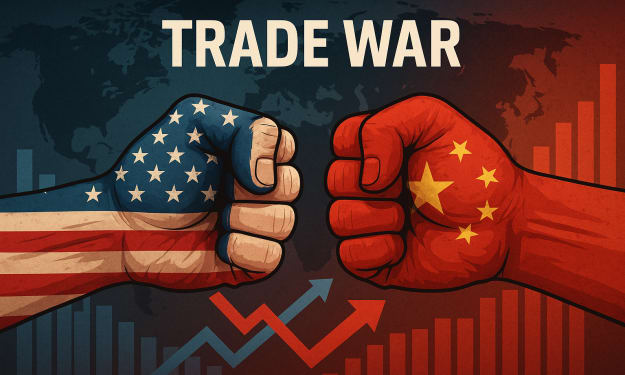
Trade War: America and China’s Battle for Global Supremacy
In the modern geopolitical landscape, few rivalries have defined the global stage as significantly as the escalating trade war between the United States and China. What initially began as disputes over trade imbalances and intellectual property rights has since evolved into a complex and multifaceted struggle for global dominance. This rivalry is no longer confined to tariffs and trade deficits—it spans technology, military influence, global alliances, and ideological leadership. As the world's two largest economies, the decisions and confrontations between the U.S. and China reverberate far beyond their borders, affecting markets, politics, and lives worldwide. Origins of the Conflict The roots of the U.S.–China trade war trace back decades, rooted in concerns over China’s trade practices, including state subsidies, forced technology transfers, and intellectual property theft. However, tensions intensified sharply in 2018 when the Trump administration imposed a series of tariffs on Chinese goods, citing unfair trade practices and the massive U.S. trade deficit with China. China responded with retaliatory tariffs, and thus began a tit-for-tat escalation that disrupted global markets and supply chains. Despite efforts to negotiate, including the "Phase One" trade agreement signed in January 2020, the core issues remain unresolved. The Biden administration has maintained many of the previous tariffs while shifting focus toward a broader strategy of strategic competition rather than direct confrontation. Economic Frontlines: Tariffs, Trade Imbalances, and Supply Chains At the heart of the trade war lies a fundamental economic competition. The U.S. has long accused China of manipulating its currency, providing unfair subsidies to state-owned enterprises, and flooding the global market with cheap goods. Meanwhile, China views U.S. actions as attempts to contain its rise and preserve American economic hegemony. Tariffs imposed by both nations have affected billions of dollars in goods. While the U.S. targeted electronics, machinery, and consumer products, China focused on U.S. agriculture, automotive goods, and manufacturing components. The ripple effects of these tariffs have been significant: American farmers lost key export markets, Chinese manufacturers faced uncertainty, and multinational corporations reevaluated their supply chains. The COVID-19 pandemic further exposed vulnerabilities in global supply chains, prompting both countries to prioritize economic resilience and self-sufficiency. The U.S. has since pushed for reshoring key industries, such as semiconductor manufacturing, while China has emphasized its "dual circulation" strategy—focusing on domestic consumption and technological self-reliance. Technological Frontlines: The Battle for Innovation and Control One of the most intense dimensions of the U.S.–China rivalry is the battle for technological supremacy. The U.S. has long been the global leader in innovation, but China has rapidly advanced in areas like 5G, artificial intelligence, and quantum computing. The U.S. responded with export restrictions on Chinese tech giants like Huawei and ZTE, citing national security risks. Additionally, Chinese firms have been delisted from U.S. stock exchanges and banned from accessing American technology, including advanced semiconductors and software. In return, China has doubled down on its ambition to become technologically independent, investing heavily in R&D and nurturing domestic innovation through state-driven initiatives. The tech war is not just about economics—it’s about who sets the standards for the future. From controlling rare earth minerals to dominating emerging markets in Africa and Asia, both countries are positioning themselves to shape the next generation of global technology infrastructure. Political and Ideological Frontlines Beyond economics and technology, the U.S.–China trade war reflects a deeper ideological clash between two vastly different governance models. The U.S. champions liberal democracy and a free-market economy, while China promotes a state-led model under single-party rule. This ideological divide has fueled tensions in areas like human rights, particularly concerning China’s policies in Xinjiang, Hong Kong, and its approach to Taiwan. The U.S. has criticized China’s human rights record and worked with allies to push back against what it sees as authoritarian overreach. China, in turn, accuses the U.S. of hypocrisy and interference in its internal affairs. The trade war has thus evolved into a larger narrative battle. Each nation is striving to influence the international order, with the U.S. promoting a rules-based global system and China advocating for a multipolar world where sovereign choices are respected. Global Implications and Future Outlook The repercussions of the U.S.–China trade war are felt across the globe. Developing nations are caught in the crossfire, forced to navigate a delicate balance between the two powers. Allies like the European Union, Japan, and India are reassessing their own economic and security strategies in response to the growing divide. Global institutions like the World Trade Organization (WTO) face increasing challenges in mediating disputes and enforcing trade rules, as the U.S. and China often sidestep multilateral mechanisms. The war has also reshaped global trade patterns, leading to the emergence of alternative supply chains in Southeast Asia, Latin America, and Africa. Looking forward, the future of U.S.–China relations remains uncertain. While outright military conflict is unlikely, strategic competition will likely persist for years to come. Both countries are investing heavily in diplomacy, infrastructure, and soft power to shape the post-pandemic world order. Conclusion The U.S.–China trade war is more than a conflict over tariffs or trade deficits—it is a battle for global supremacy in a rapidly changing world. As the two powers vie for influence across economic, technological, and ideological arenas, the international community must adapt to a new era defined by strategic competition. Whether this rivalry leads to conflict or cooperation will shape the trajectory of the 21st century.
By Muhammad Nadeem Ahmad2 years ago in Trader
Is Using a Robo-Advisor the Smart Move for Your Finances?
Investing can be confusing, especially if you're not sure where to start. That's where robo-advisors come in. These automated tools make investing easier by managing your money for you, using smart technology instead of a human advisor.
By investo mind2 years ago in Trader
Animal Instincts: Navigating Your Financial Journey One Beast at a Time. AI-Generated.
Have you ever noticed how the wild can teach us more than just survival? From the wide-eyed curiosity of an owl to the deliberate pace of a turtle, nature offers remarkable parallels to our own financial journeys. Just like animals evolve and adapt, investors, too, transform—from cautious beginners to seasoned experts in the jungle of finance.
By SubhShanti Wealth2 years ago in Trader
Investing in gold versus investing in stocks, which is better?
Investing in gold vs. investing in stocks is a common comparison for people looking to grow their money. Gold is seen as a safe haven—it tends to hold its value during economic uncertainty. Stocks, on the other hand, represent ownership in companies and can offer higher returns over time, but they also come with more risk. Choosing between the two depends on your financial goals, risk tolerance, and market outlook.
By investo mind2 years ago in Trader
BofA Stock Surges Trading Gains and Interest Income Boost.
Bank of America (BofA) shares surged on Monday after the bank reported stronger-than-expected profits for the first quarter of 2025, driven by robust trading gains and higher interest income. The bank’s stellar performance surprised Wall Street analysts and reassured investors that large financial institutions can still thrive despite ongoing economic uncertainties and global market volatility.
By Ashfaque Mahmud 🇧🇩2 years ago in Trader
Trump’s Kevin Hassett: ‘Amazing’ Tariff Deals Secured, Recession 100% Not Coming
The former economic counselor of the White House Kevin Hassett recently made news when he said that the United States has received "amazing" proposals from major trading partners for tariff deals. Hassett underlined In an interview that the Trump administration's strong trade policies have forced other countries to engage in negotiations, which has led to advantageous conditions for American companies.
By MD SABRUL ISLAM2 years ago in Trader