economy
Those in the know know the disconnect between the economy and the volatile stock market; discover the reality about this complex relationship.
Philippines Clinical Laboratory Services Market: Diagnostic Demand, Healthcare Expansion & Technology Adoption. AI-Generated.
Philippines Clinical Laboratory Services Market Overview The Philippines clinical laboratory services market share is witnessing strong and sustained growth as demand for accurate diagnostics, preventive care and specialized testing continues to rise across public and private healthcare facilities. Clinical laboratory services include a wide range of tests — from routine blood and urine analyses to advanced molecular diagnostics — that support disease detection, treatment planning, monitoring and overall health management. The Philippines clinical laboratory services market size reached USD 1.2 Billion in 2024. Looking forward, the market is expected to reach USD 1.7 Billion by 2033, exhibiting a growth rate (CAGR) of 4.1% during 2025-2033. This expansion demonstrates the critical role of laboratory diagnostics in modern healthcare, expanding healthcare access, technology upgrades and increased awareness of preventive health screenings. (Market data based on IMARC Group analysis.)
By Amyra Singh10 months ago in Trader
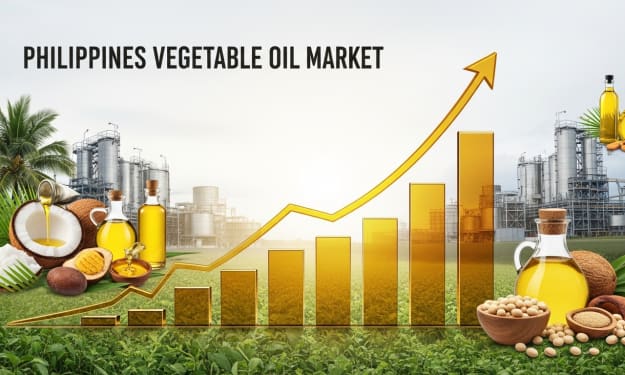
Philippines Vegetable Oil Market: Consumption, Production & Trade Dynamics. AI-Generated.
Philippines Vegetable Oil Market Overview The Philippines vegetable oil market plays a central role in the country’s food economy, driven by household food consumption, commercial food processing and growing demand for edible oils in restaurants and catering services. Vegetable oils — including palm oil, coconut oil, soybean oil, corn oil and other edible oils — constitute an essential ingredient across Filipino cuisine, fried food staples, baking, margarine production, confectionery and industrial food manufacturing. The Philippines vegetable oil market growth size reached USD 1.26 Billion in 2024. Looking forward, the market is projected to reach USD 1.99 Billion by 2033, exhibiting a growth rate (CAGR) of 4.65% during 2025-2033. This growth reflects sustained domestic demand, expanding foodservice activity, evolving dietary patterns and trade dynamics that affect supply, pricing and market participation.
By Amyra Singh10 months ago in Trader
Philippines FMCG Market: Consumption Growth, Retail Evolution & Consumer Trends. AI-Generated.
Philippines FMCG Market Overview The Philippines fast-moving consumer goods (FMCG) market continues to expand robustly as evolving consumer lifestyles, retail innovation and strong domestic consumption fuel consistent demand across essential goods categories. FMCG — encompassing food and beverages, personal care, home care, healthcare products, and other daily-use items — represents one of the most resilient and foundational segments of the Philippine economy. The Philippines FMCG market growth reached USD 8.10 Billion in 2024. Looking forward, the market is expected to reach USD 9.80 Billion by 2033, exhibiting a growth rate (CAGR) of 2.00% during 2025-2033. This growth reflects rising disposable incomes, urbanisation, convenience-oriented buying behaviour, digital retailing and sustained demand for affordable, accessible household products.
By Amyra Singh10 months ago in Trader
Amazon Fresh Stores Shut Down as Amazon Reshapes Its Grocery Strategy
Amazon Fresh Stores Shut Down as Amazon Reshapes Its Grocery Strategy Amazon has officially closed its physical Amazon Fresh grocery stores across the United States, marking a decisive shift in the company’s approach to grocery retail. The move reflects a broader transformation within Amazon as it reevaluates which business models deliver sustainable growth and long-term profitability. While Amazon Fresh was launched with ambitious goals and advanced technology, the physical store concept ultimately failed to meet expectations in a highly competitive grocery market. Amazon Fresh stores were introduced as a modern alternative to traditional supermarkets, combining fresh food, competitive pricing, and digital integration. Despite these efforts, the stores struggled to establish a strong identity that resonated with shoppers. Many consumers found little difference between Amazon Fresh and existing grocery chains, making it difficult for the brand to stand out in crowded local markets. --- ## Why Amazon Decided to Close Amazon Fresh Stores One of the main drivers behind the closure was profitability. Grocery retail is known for thin margins, and operating physical stores requires significant investment in real estate, staffing, inventory, and logistics. Amazon determined that the Amazon Fresh store model did not deliver the financial returns needed to justify continued expansion. Additionally, customer foot traffic at many locations remained inconsistent. While some stores performed well, others failed to attract steady demand. This uneven performance made scaling the concept nationwide increasingly risky and inefficient for the company. --- ## Are Amazon Fresh Stores Permanently Closed? Amazon has confirmed that all Amazon Fresh physical grocery stores in the U.S. are being shut down. The closures are taking place in stages, with most locations closing within a short period. Some stores may remain open briefly due to local regulations, but Amazon has no plans to reopen or replace them under the Amazon Fresh brand. The decision also aligns with Amazon’s broader effort to simplify its retail operations and reduce investments in experimental concepts that have not proven successful. --- ## Can Customers Still Order Amazon Fresh Online? Yes, Amazon Fresh continues to operate as an online grocery delivery service. Customers in eligible areas can still order groceries through Amazon’s digital platform, including fresh produce, packaged foods, and household essentials. The closure only affects physical store locations, not grocery delivery services. This change highlights Amazon’s belief that online grocery shopping offers greater scalability and convenience for modern consumers. Digital ordering and same-day delivery remain central to Amazon’s long-term strategy. --- ## Why Amazon Is Shifting Away From Physical Grocery Stores Consumer behavior has played a major role in Amazon’s decision. More shoppers now prefer ordering groceries online rather than visiting physical stores. This trend accelerated in recent years as customers increasingly prioritize convenience, speed, and flexible delivery options. Operating physical grocery stores also limits Amazon’s ability to quickly adapt to changes in demand. In contrast, online grocery fulfillment allows the company to adjust inventory, pricing, and delivery capacity more efficiently. --- ## What Role Does Whole Foods Play in Amazon’s New Plan? Whole Foods Market has become Amazon’s primary physical grocery brand. Unlike Amazon Fresh, Whole Foods has a strong reputation, loyal customers, and a clear market position in the premium grocery segment. Amazon plans to continue expanding Whole Foods locations and integrating them more closely with its online delivery services. The success of Whole Foods underscores why Amazon chose to exit the Amazon Fresh store model while maintaining a presence in physical grocery retail through a more established brand. --- ## How Are Employees Affected by the Closures? The shutdown of Amazon Fresh stores impacts a large number of employees. Amazon has stated that it aims to offer affected workers opportunities to transfer to other roles within the company, including warehouse operations, delivery services, and Whole Foods locations. For employees who are unable to transition into new roles, Amazon may provide severance packages and temporary benefits. This approach reflects the company’s effort to manage workforce changes responsibly while restructuring its retail operations. --- ## What This Means for the Future of Grocery Retail The closure of Amazon Fresh stores signals a broader shift in the grocery industry. Retailers are increasingly focusing on digital platforms, delivery services, and fewer but more efficient physical locations. Technology alone is no longer enough to guarantee success in brick-and-mortar retail without strong branding and consistent customer demand. Amazon’s decision demonstrates that even the largest and most innovative companies must adapt when business models fail to deliver results. By closing Amazon Fresh stores, Amazon is redirecting its resources toward strategies that better align with evolving consumer habits and long-term growth goals.
By America today 10 months ago in Trader
Saving Your First $100K Feels Impossible Until You Realize What You're Actually Fighting
Most people think saving their first $100K is hard because they don't make enough money. That's rarely the real reason. The real fight isn't income. It's friction. Social pressure. Short-term relief. Emotional spending disguised as "deserved." A lifestyle that quietly expands the moment money touches it.
By Destiny S. Harris10 months ago in Trader
Stanislav Kondrashov on the Shifting Role of the US Dollar Amid Historic Moves in Global Commodities
Gold has reached its highest recorded price, silver continues its upward climb, and the US dollar is showing signs of strain. These developments, unfolding simultaneously, suggest a deeper shift in how global currencies and commodities interact. According to Stanislav Kondrashov, economic analyst and founder of TELF AG, this moment reflects more than a typical market fluctuation.
By Stanislav Kondrashov10 months ago in Trader
Why Tax Refunds Are So High in 2026: New Tax Laws, More Checks, and Risks to the Budget
Millions of Americans are in for a financial shock as the 2026 tax filing season begins: "tax refunds this year are on track to be the largest in U.S. history." This comes as a result of sweeping tax changes signed into law in 2025 that dramatically altered how taxes are calculated and withheld, leaving many workers with bigger refund checks than they’ve seen in years.
By Raviha Imran10 months ago in Trader