career
Want to be a Wolf on Wall Street? A guide to getting your foot in the door and building a successful career as a trader.
Silver and Gold Prices Are Surging: A Clear Summary of What’s Really Happening
Silver and Gold Prices Are Surging: A Clear Summary of What’s Really Happening The recent surge in silver and gold prices has captured global attention, raising serious questions among investors and everyday observers alike. This movement is not accidental or temporary. It reflects deeper changes in the global economic system, investor psychology, and long-term supply and demand dynamics. Understanding why silver and gold are rising together, and why silver in particular is showing sharp volatility, requires looking beyond headlines and short-term speculation. Gold has always been viewed as a safe haven asset. In times of economic uncertainty, inflation, geopolitical conflict, or currency weakness, investors historically turn to gold to preserve value. What makes the current rise in gold prices notable is the scale and persistence of global risks. Inflation remains higher than expected in many economies, while interest rates have struggled to stay meaningfully above inflation. This situation weakens the appeal of holding cash and strengthens demand for assets that can protect purchasing power. Another powerful driver behind gold’s rise is central bank behavior. Many countries have been increasing their gold reserves as a strategic decision. This reflects concerns about overreliance on major currencies, rising government debt, and geopolitical tensions. Central bank buying provides strong long-term support for gold prices and reinforces gold’s role as a monetary asset rather than just a commodity. Silver, however, tells a more complex and explosive story. Unlike gold, silver is not only a store of value but also a critical industrial metal. It plays a vital role in solar panels, electric vehicles, electronics, medical technology, and advanced manufacturing. As the global economy shifts toward renewable energy and digital infrastructure, demand for silver has surged dramatically. At the same time, silver supply has struggled to keep pace. Many silver mines are secondary operations tied to other metals, limiting how quickly production can increase. This has created a structural supply deficit, pushing prices higher. When investment demand increases on top of already tight industrial demand, silver prices tend to move sharply, which explains its strong volatility. Inflation is a key factor affecting both metals, but it is not acting alone. Currency devaluation, expanding global debt, and declining confidence in traditional financial systems all play important roles. When money loses value, real assets like gold and silver naturally become more attractive. This effect is amplified when inflation is global rather than localized, as is the case today. Interest rates also influence precious metals, but the relationship is more nuanced than many assume. While higher interest rates can pressure gold and silver, this only holds when rates exceed inflation. In environments where real interest rates remain low or negative, precious metals continue to perform well. Uncertainty around future rate decisions further increases their appeal as stabilizing assets. Silver’s volatility compared to gold comes from its smaller market size and its dual role as both an industrial and investment metal. Economic growth expectations, technological expansion, and speculative trading all impact silver more intensely. This means silver often outperforms gold during strong bull markets, but with greater risk and sharper corrections. Geopolitical tensions also play a critical role. Conflicts, sanctions, and political instability increase demand for universally trusted assets. Gold and silver benefit from this environment because they are globally recognized, liquid, and independent of any single government. The current movement in silver and gold prices appears to be more than a short-term rally. High global debt, long-term inflation pressures, energy transition demand, and shifting investor behavior suggest the foundations of a longer bull market. While prices will fluctuate, the underlying forces supporting precious metals remain strong. In essence, rising silver and gold prices are signaling stress within the global financial system. Silver reflects industrial transformation and supply strain, while gold reflects monetary uncertainty and the search for stability. Together, they highlight a world in transition, where real value is becoming more important than financial promises.
By America today 9 months ago in Trader
I Didn’t Quit Trading. I Just Stopped Needing to Be Right.
It was close to 2 a.m. The charts were still open, frozen on the last trade that wiped the account. Again. The numbers looked unreal in that way they always do after a loss—too clean, too final. Zeroes where there used to be hope, confidence, plans.
By nimesh tandel9 months ago in Trader
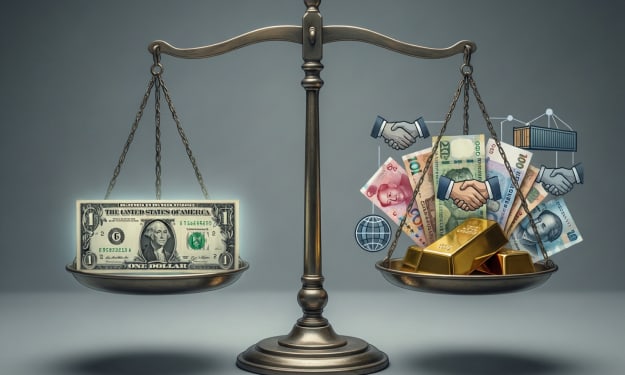
Who Benefits Most If the Dollar Declines?
Who Benefits Most If the Dollar Declines? The US dollar has been the backbone of the global financial system for decades. It is used in international trade, energy markets, foreign reserves, and global lending. But if the dollar slowly loses its dominance, the effects will not be equal. Some countries and groups could benefit significantly, while others may face serious challenges.
By Wings of Time 9 months ago in Trader
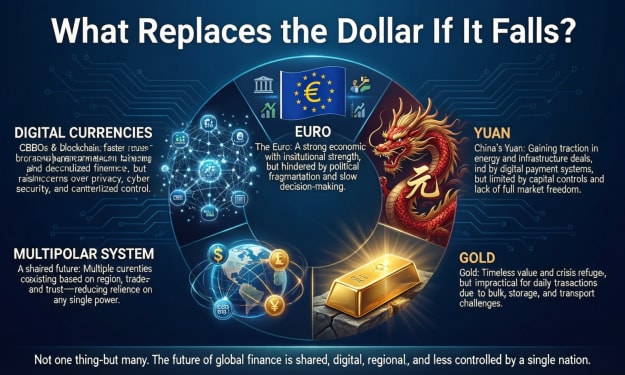
What Replaces the Dollar If It Falls?
What Replaces the Dollar If It Falls? For nearly a century, the US dollar has been the world’s most powerful currency. It dominates global trade, oil markets, foreign reserves, and international finance. But as trust in the dollar is questioned by geopolitics, debt, and global power shifts, a serious debate has emerged: if the dollar ever loses its central role, what could replace it?
By Wings of Time 9 months ago in Trader
Is the Dollar Entering Its Final Era?
Is the Dollar Entering Its Final Era? For decades, the US dollar has been the backbone of the global financial system. It has been the main currency for international trade, oil sales, debt, and foreign reserves. When countries traded with each other, they usually settled payments in dollars. When crises happened, investors rushed toward the dollar as a safe haven. But today, a growing number of experts and governments are asking an uncomfortable question: are these the last dominant days of the dollar?
By Wings of Time 9 months ago in Trader
What’s Your Initial Reaction to an Income Loss?
They either freak out and spiral — or they stay calm and get to work. Most people panic. They lose a job, a client pauses, an investment dips, or a revenue stream dries up, and suddenly their nervous system is on fire. Anxiety spikes. Sleep disappears. Decisions get sloppy. Fear starts driving behavior.
By Destiny S. Harris9 months ago in Trader
Best stocks for investment
📈 1. NVIDIA (NVDA) — AI and Data Center Domin Nvidia is arguably the most pivotal company in the ongoing AI revolution. Its GPUs and AI accelerators power data centers, generative AI workloads, and large language model training/inference — a secular trend expected to expand for many years. Analysts see continued strong earnings and revenues tied to AI infrastructure buildouts by hyperscalers. Its dominance has helped Nvidia deliver historically outsized returns but its core AI role suggests long-term structural growth ahead.
By USA daily update 9 months ago in Trader
Subscription E-Commerce Market Outlook: Redefining Online Retail. AI-Generated.
Overview — Subscription E-Commerce Market The subscription e-commerce market has emerged as a powerful growth model within the global digital retail ecosystem, reshaping how consumers discover, purchase, and engage with products and services. Instead of one-time transactions, subscription models focus on recurring revenue through scheduled deliveries, curated experiences, or continuous digital access. This approach enhances customer retention, improves demand predictability for businesses, and delivers convenience and personalization for consumers.
By James Smith9 months ago in Trader
Modular Construction Market Outlook: Accelerating the Future of Building. AI-Generated.
Overview — Modular Construction Market The modular construction market is transforming the global building industry by shifting traditional on-site construction to off-site, factory-based fabrication of structural modules. This approach significantly reduces build times, lowers costs, and minimizes material waste while enhancing quality control and safety. Modular construction is increasingly used in residential, commercial, healthcare, education, and infrastructure projects as developers and governments seek faster, more sustainable solutions to address housing shortages and labor constraints worldwide. The market’s rapid growth is supported by innovations like Building Information Modeling (BIM), digital twins, robotics, and automation, which improve design precision and streamline supply chains.
By James Smith9 months ago in Trader