
Spinal Fusion Device Market Set for Steady Growth as Demand for Advanced Spine Care Rises
From aging populations and spinal disorders to minimally invasive innovation, the global spinal fusion device industry is entering a new phase of expansion.

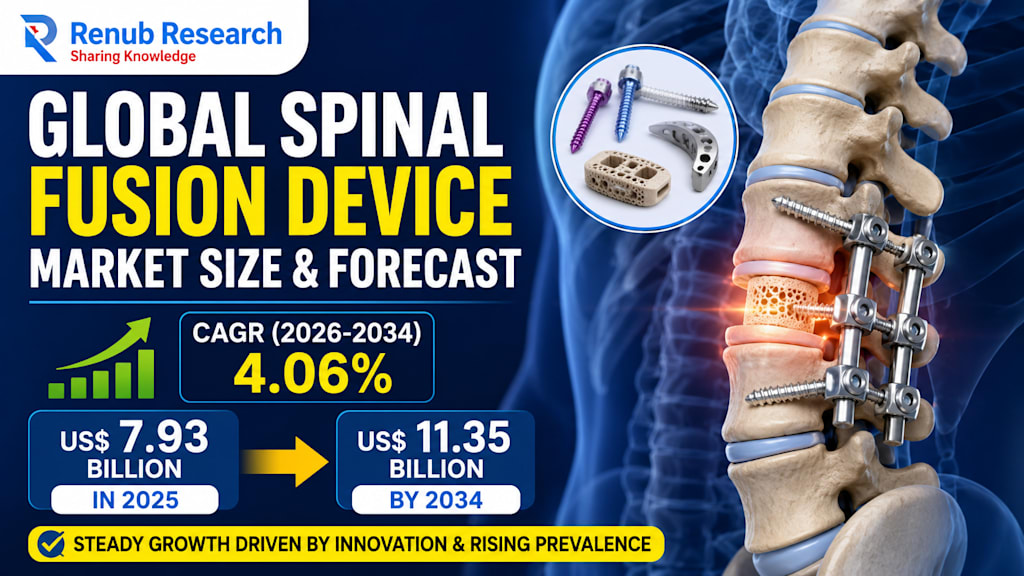
Spinal Fusion Device Market Outlook
The global spinal fusion device market is moving into a period of steady, meaningful growth, supported by the rising burden of spinal disorders, expanding access to surgical care, and continuous improvement in implant design and surgical techniques. Renub Research estimates that the market will grow from US$ 7.93 billion in 2025 to US$ 11.35 billion by 2034, reflecting a CAGR of 4.06% between 2026 and 2034. That growth story is not just about numbers; it reflects a broader shift in how spine conditions are being treated around the world.
Spinal fusion devices are used in surgeries designed to stabilize the spine, reduce pain, and correct deformities caused by conditions such as degenerative disc disease, spinal stenosis, scoliosis, fractures, and spondylolisthesis. These systems typically include rods, screws, plates, cages, and bone graft substitutes. Their role is critical because spinal fusion aims to stop motion between vertebrae so they can fuse into a single solid bone mass. As spine care becomes more advanced and more widely accessible, demand for these devices continues to rise.
Why the Market Is Growing
One of the strongest forces shaping the spinal fusion device market is the rising prevalence of spinal disorders. Sedentary lifestyles, obesity, sports injuries, and the natural aging process are all contributing to a larger patient pool. Older adults are particularly vulnerable to degenerative spine conditions, and this is becoming more significant as global life expectancy rises. The file notes that the number of people aged 65 and above is expected to double globally by 2050, which will keep pressure on healthcare systems to deliver more effective spine treatments.
Another important growth driver is the rising number of surgical procedures. The source points out that spine procedures in Medicare settings rose sharply from 2010 to 2021, while ambulatory surgical centers are also expanding at a notable pace. That matters because spinal fusion is often the preferred option when non-surgical treatments have failed. As more patients seek relief from chronic pain and mobility limitations, surgery becomes a more practical path for long-term treatment.
Technology is also changing the market in a major way. Minimally invasive spine surgery has made procedures less traumatic, reduced recovery time, and shortened hospital stays. At the same time, advances in implant materials such as titanium alloys, PEEK, and bioactive materials have improved performance and patient outcomes. Navigation systems and robotic tools are also increasing surgical precision, making spine surgery more attractive to both surgeons and patients. The report highlights product innovation such as Spinal Elements’ Ventana 3D Printed Interbody Portfolio and NanoHive’s investment for 3D-printed titanium fusion devices as signs of the sector’s momentum.
Healthcare Investment and Better Access Are Expanding the Market
Spinal fusion is not growing in isolation. It is being supported by larger healthcare trends, including rising investment in hospitals, better reimbursement structures, and improved access to advanced surgical care. In many countries, both governments and private healthcare providers are expanding the infrastructure needed for complex orthopedic procedures. This is especially important because spinal fusion requires specialized imaging, trained surgeons, and high-quality implant systems.
The spread of medical tourism is also helping in some emerging markets. As more patients travel for affordable and specialized procedures, countries with stronger spine care capabilities are benefiting from increased demand. In parallel, the growing availability of skilled spine surgeons is improving adoption rates for these devices. The overall picture is one of broader access meeting growing clinical need.
The Market Is Still Held Back by Cost and Clinical Risk
Despite strong growth potential, the spinal fusion device market still faces serious challenges. The most obvious is cost. These procedures are expensive because they involve not only implants such as screws, rods, cages, and plates, but also imaging, operating room time, and specialist expertise. In many developing countries, limited insurance coverage makes these surgeries difficult to afford for a large segment of the population. Even in advanced healthcare systems, cost pressure remains a major concern for hospitals and payers.
There is also the issue of post-surgical complications. Infection, implant loosening, non-fusion of vertebrae, nerve injury, and adjacent segment degeneration can all affect outcomes. These risks may lead surgeons to take a more conservative approach in some cases, especially when motion-preserving alternatives such as artificial disc replacement may be considered. In other words, the market’s growth story is strong, but it is still shaped by careful clinical decision-making.
Product Segments Driving Demand
Within the broader market, cervical devices remain an important category. Demand is being supported by the growing incidence of cervical spine disorders, including degenerative disc disease, cervical spondylosis, trauma, and herniated discs. Rising screen time, poor posture, and aging populations are contributing to this trend. The report also notes progress in low-profile plates, screws, and cages, which are helping to improve stabilization while reducing surgical trauma.
Interbody devices are another important segment. These cages or implants are inserted between vertebral bodies to promote fusion and restore disc height. They are used widely in both cervical and lumbar procedures. Improvements in titanium, PEEK, and porous materials are making these devices more effective by supporting osseointegration and fusion success. Because they help improve spinal alignment and stability, interbody devices continue to play a central role in the market.
Minimally invasive spinal fusion devices are also gaining momentum quickly. Their appeal lies in reduced tissue damage, less blood loss, and lower postoperative pain. They are often used with image guidance, navigation systems, and robotic platforms. As more hospitals and surgeons shift toward less invasive approaches, this segment is expected to remain one of the most dynamic areas in the overall market.
End Users: Hospitals Lead, Clinics Gain Ground
Hospitals remain the largest end-user segment for spinal fusion devices, and that is easy to understand. These procedures are complex and require advanced imaging, surgical teams, and post-operative support. Hospitals are usually the first setting to adopt advanced technologies such as robotic-assisted fusion and sophisticated implant systems. As the number of spine surgeries rises, hospital demand will remain strong.
That said, specialty clinics are becoming increasingly relevant. Orthopedic and spine specialty clinics offer individualized care, shorter waiting times, and cost-effective treatment for less complex fusion procedures. As outpatient spine surgery grows, clinics are likely to capture a larger share of the market over time. This is part of a broader shift in healthcare delivery toward more specialized, efficient care settings.
Regional Market Highlights
The United States remains one of the largest and most mature spinal fusion device markets in the world. The report attributes this to strong infrastructure, a large patient base affected by degenerative conditions and obesity, and a high level of adoption of minimally invasive and robotic spine surgery. Favorable reimbursement, advanced specialty centers, and the presence of major medtech companies also support continued growth. The source also notes that Xtant Medical Holdings launched OsteoFactor Pro in May 2025, reflecting ongoing innovation in bone healing solutions.
The United Kingdom market benefits from a well-developed public healthcare system and the role of the NHS in supporting treatment for degenerative spine disorders. Rising elderly populations, improved diagnostics, and growing interest in minimally invasive surgery are helping the market move forward, even as adoption of newer devices remains gradual. The report also mentions partnership activity involving Osteotec and Additive Surgical, signaling interest in advanced 3D-printed spinal implant technologies.
In India, growth is being fueled by the expansion of private hospitals, specialty clinics, medical tourism, and rising awareness of modern spine treatment. Cost-effective products are still dominant, but urban centers are increasingly open to high-end solutions. The availability of skilled specialists and the government’s effort to expand healthcare access are also supporting the market.
Saudi Arabia is emerging as another promising market. Healthcare modernization, lifestyle-related spinal disorders, obesity, and aging are all contributing to demand. The country’s investment in specialized orthopedic care and interest in minimally invasive procedures are helping create opportunities, even though dependence on imported medical devices remains a challenge.
Competitive Landscape and Industry Direction
The market is highly competitive and includes major players such as Medtronic, Stryker, Zimmer Biomet, Orthofix, NuVasive, Globus Medical, Xtant Medical Holdings, and Alphatec Holdings. These companies are competing through device innovation, expansion into minimally invasive surgery, 3D printing, biologics, and broader clinical partnerships. The report also notes that companies are being analyzed through overviews, key people, recent developments, SWOT analysis, revenue analysis, and company analysis, showing how closely watched the sector remains.
What stands out most is that spinal fusion is no longer a static category. It is moving toward smarter materials, more precise techniques, and better integration with digital surgical tools. The next stage of market growth will likely depend on how well manufacturers balance performance, affordability, and clinical outcomes.
Final Thoughts
The spinal fusion device market is expanding for a simple reason: the need is real, and it is growing. More people are living longer with spinal disorders, more surgeries are being performed, and better devices are making treatment more effective than before. At the same time, pressure on costs and concerns about complications mean the market must continue improving in both value and safety.
From a business perspective, the opportunity is significant. From a clinical perspective, the mission is even bigger: helping patients regain movement, reduce pain, and improve quality of life. With market size projected to climb from US$ 7.93 billion in 2025 to US$ 11.35 billion by 2034, the spinal fusion device industry looks set to remain a vital part of the global medical device landscape for years to come.
About the Creator
Enjoyed the story? Support the Creator.
Subscribe for free to receive all their stories in your feed.
Comments
There are no comments for this story
Be the first to respond and start the conversation.