
Specialty Fertilizers Market Grows Strongly as Precision Agriculture and Sustainable Farming Reshape Global Crop Production
Rising demand for higher crop yields, increasing adoption of precision farming technologies, and growing emphasis on environmental sustainability are driving rapid growth in the global specialty fertilizers industry.

Agriculture is undergoing a significant transformation as farmers worldwide face mounting pressure to produce more food using fewer resources. Population growth, shrinking arable land, climate uncertainty, and environmental concerns are forcing the agricultural sector to adopt smarter and more efficient solutions. Among the innovations helping modern agriculture meet these challenges, specialty fertilizers have emerged as one of the most important tools for improving productivity and sustainability.
Unlike traditional fertilizers, specialty fertilizers are designed to provide crops with precise nutrient delivery while minimizing waste and environmental impact. These advanced products are increasingly being used in high-value crops, greenhouse cultivation, hydroponics, fertigation systems, and precision farming operations across the globe.
As agriculture becomes more technology-driven and sustainability-focused, specialty fertilizers are rapidly moving from niche products to essential components of modern crop nutrition strategies.
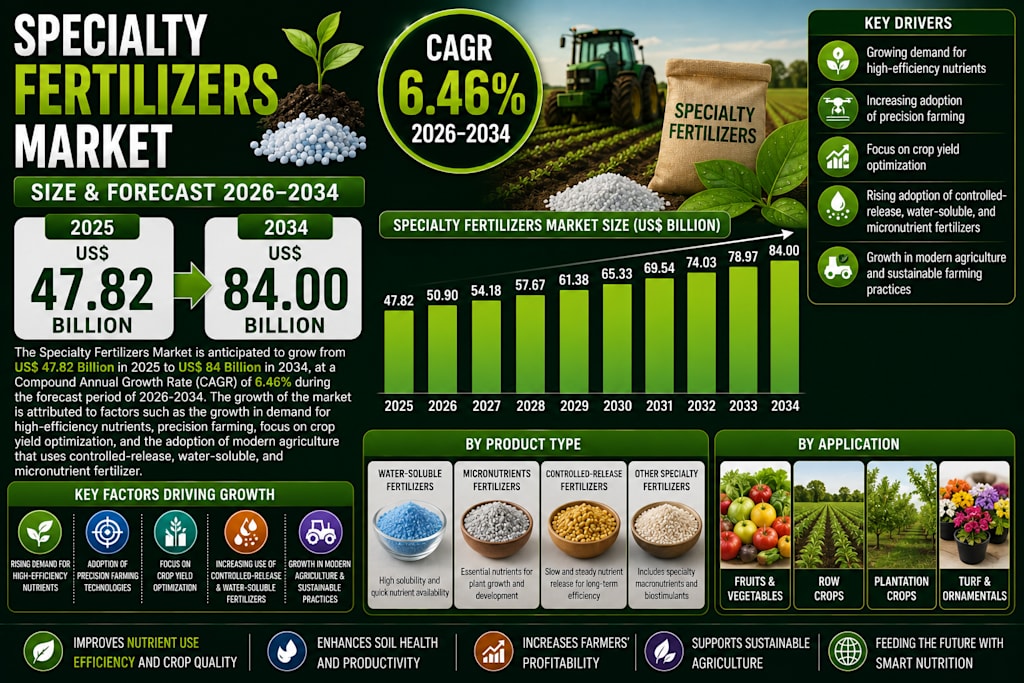
According to Renub Research, the Global Specialty Fertilizers Market is expected to grow from US$47.82 billion in 2025 to US$84 billion by 2034, registering a compound annual growth rate (CAGR) of 6.46% between 2026 and 2034. Rising demand for high-efficiency nutrients, precision farming adoption, and increasing focus on crop yield optimization are expected to fuel long-term market expansion.
Specialty Fertilizers Are Transforming Modern Agriculture
Specialty fertilizers are advanced nutrient formulations designed to deliver nutrients more efficiently and accurately than conventional fertilizers.
These products include controlled-release fertilizers, slow-release fertilizers, water-soluble fertilizers, liquid fertilizers, micronutrient fertilizers, and customized nutrient blends.
Their primary objective is to provide plants with nutrients when they need them most, improving nutrient uptake while reducing losses caused by runoff, leaching, volatilization, and overapplication.
By delivering nutrients in a more controlled manner, specialty fertilizers help farmers improve crop productivity, enhance product quality, and reduce environmental impacts.
As global agriculture increasingly focuses on efficiency and sustainability, specialty fertilizers have become vital tools for achieving modern farming objectives.
Growing Food Demand Is Driving Adoption
One of the strongest growth drivers for the specialty fertilizers market is the increasing global demand for food.
The world's population continues to expand, creating greater pressure on agricultural systems to increase production despite limited land availability.
At the same time, urbanization and industrial development are reducing the amount of arable land available for cultivation in many regions.
Farmers must therefore maximize productivity from existing farmland.
Specialty fertilizers help address this challenge by improving nutrient efficiency and supporting higher crop yields without requiring significant increases in land use.
As food demand continues rising worldwide, the need for advanced crop nutrition solutions is expected to grow substantially.
Crop Yield Optimization Has Become a Priority
Maximizing crop yield and quality is a critical concern for modern agriculture.
Specialty fertilizers provide targeted nutrient management that aligns with specific crop requirements, soil conditions, and growth stages.
Unlike traditional fertilizers that often release nutrients rapidly and inefficiently, specialty products deliver nutrients gradually and precisely.
This improves crop uniformity, enhances nutrient utilization, and supports healthier plant development.
High-value crops such as fruits, vegetables, specialty grains, and horticultural products particularly benefit from these advantages.
Improved crop quality often translates into higher market prices and stronger profitability for growers.
As agricultural margins become increasingly competitive, yield optimization remains a major factor driving specialty fertilizer adoption.
Precision Agriculture Is Accelerating Market Growth
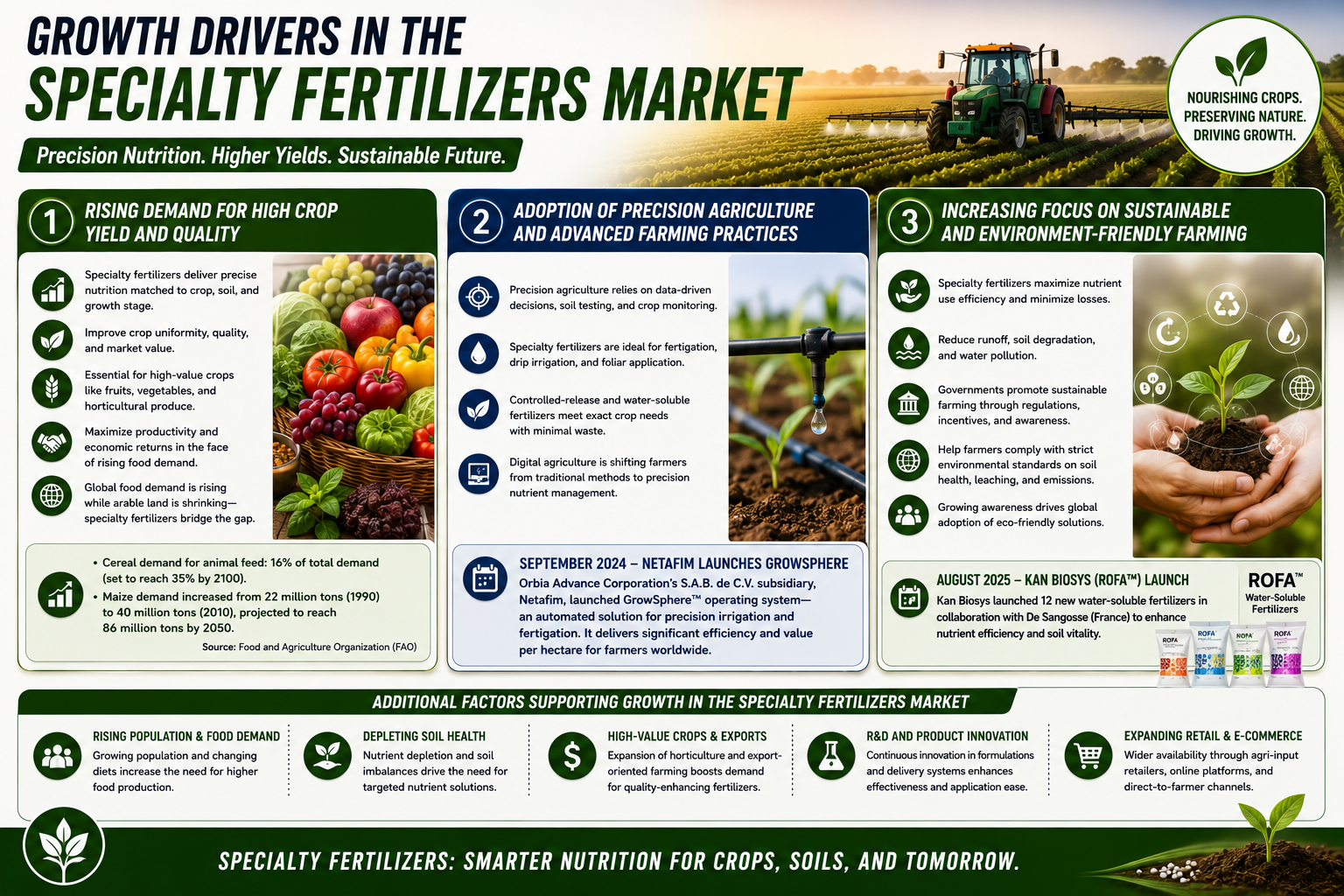
The rapid adoption of precision agriculture is significantly expanding demand for specialty fertilizers.
Modern farming increasingly relies on data-driven technologies such as GPS systems, soil sensors, satellite imaging, drones, and digital farm management platforms.
These technologies allow farmers to monitor crop conditions, analyze soil health, and apply inputs with greater accuracy.
Specialty fertilizers align perfectly with precision agriculture because they can be customized according to specific field conditions and crop requirements.
Controlled-release fertilizers, water-soluble fertilizers, and micronutrient blends support highly targeted nutrient applications that improve efficiency and reduce waste.
As precision farming technologies become more accessible, demand for advanced fertilizers is expected to increase substantially.
Advanced Irrigation Systems Support Adoption
Modern irrigation systems are creating additional opportunities for specialty fertilizers.
Techniques such as drip irrigation, fertigation, greenhouse cultivation, and hydroponics require nutrient solutions that integrate effectively with precise water delivery systems.
Water-soluble and liquid specialty fertilizers are particularly valuable in these environments because they dissolve easily and provide rapid nutrient availability.
In September 2024, Netafim introduced its GrowSphere operating system, an automated precision irrigation and fertigation solution designed to improve efficiency and optimize agricultural productivity across diverse farming environments.
Such innovations demonstrate how specialty fertilizers are becoming increasingly integrated into advanced agricultural systems.
Sustainability Is Reshaping Fertilizer Preferences
Environmental sustainability has become a major influence on fertilizer purchasing decisions worldwide.
Conventional fertilizers are often associated with nutrient runoff, groundwater contamination, greenhouse gas emissions, and soil degradation.
Specialty fertilizers help address these concerns by improving nutrient-use efficiency and reducing environmental losses.
Controlled-release technologies ensure nutrients remain available to crops over extended periods, minimizing excess application and reducing pollution risks.
Governments, regulators, and agricultural organizations increasingly encourage sustainable nutrient management practices.
As environmental regulations become stricter, specialty fertilizers are gaining favor as solutions that balance productivity and sustainability.
Climate Challenges Increase Demand for Efficiency
Agriculture faces growing uncertainty due to climate change.
Droughts, irregular rainfall, extreme temperatures, and changing weather patterns create significant challenges for crop production.
Specialty fertilizers help farmers manage these risks by improving nutrient efficiency and supporting plant resilience under stressful conditions.
Water-soluble and precision-applied fertilizers can optimize nutrient availability even when environmental conditions become unpredictable.
As climate-related pressures intensify, farmers are increasingly seeking technologies that maximize resource utilization while minimizing risks.
This trend is expected to continue supporting specialty fertilizer adoption worldwide.
Water-Soluble Fertilizers Experience Strong Growth
Among various product categories, water-soluble fertilizers represent one of the fastest-growing segments within the specialty fertilizers market.
These fertilizers dissolve completely in water, allowing nutrients to be delivered directly to plant root zones through irrigation systems.
Their rapid nutrient availability and compatibility with precision irrigation technologies make them highly attractive for greenhouse farming, hydroponics, and high-value crop production.
Water-soluble fertilizers also enable farmers to respond quickly to nutrient deficiencies and changing crop requirements.
Although they often carry higher upfront costs than traditional fertilizers, their efficiency benefits frequently justify the investment.
As modern irrigation systems become more widespread, demand for water-soluble fertilizers is expected to grow significantly.
Controlled-Release Fertilizers Improve Nutrient Efficiency
Controlled-release fertilizers continue gaining popularity due to their ability to provide nutrients gradually over extended periods.
These products reduce nutrient losses while ensuring crops receive consistent nourishment throughout key growth stages.
The technology is particularly valuable in regions facing environmental regulations related to nutrient runoff and water quality protection.
Controlled-release fertilizers also reduce the frequency of fertilizer applications, saving labor and improving operational efficiency.
As farmers seek long-term solutions for nutrient management, this segment is expected to remain an important growth contributor.
Micronutrient Fertilizers Address Soil Deficiencies
Micronutrient fertilizers play a critical role in correcting nutrient imbalances that can limit crop performance.
Elements such as zinc, iron, manganese, copper, boron, and molybdenum are required in small quantities but remain essential for healthy plant growth.
Intensive farming practices and long-term use of conventional fertilizers have contributed to micronutrient deficiencies in many agricultural regions.
Specialty micronutrient formulations help restore soil fertility and improve crop quality.
Growing awareness of soil health management continues driving demand for these products globally.
Fertigation Is Becoming a Preferred Application Method
Fertigation is rapidly emerging as one of the most efficient fertilizer application methods.
This approach combines irrigation and fertilization by delivering nutrients directly through water systems.
Fertigation improves nutrient distribution, reduces waste, and enhances crop uptake efficiency.
The method is particularly popular in horticulture, greenhouse cultivation, orchards, and regions facing water scarcity.
As micro-irrigation systems continue expanding worldwide, specialty fertilizers designed specifically for fertigation applications are experiencing strong demand.
The integration of nutrition and irrigation represents an important advancement in modern agricultural practices.
Fruits and Vegetables Remain Major End Users
The fruits and vegetables segment represents one of the largest markets for specialty fertilizers.
These crops often require precise nutrient management to achieve optimal size, color, flavor, shelf life, and overall quality.
Growers rely heavily on specialty fertilizers to maximize returns while meeting strict quality standards demanded by retailers and consumers.
The increasing global demand for fresh produce, organic foods, and premium fruits and vegetables continues supporting market growth.
Greenhouse cultivation and export-oriented farming operations further strengthen demand within this segment.
Specialty Soil Fertilizers Gain Importance
Soil health has become a major focus within sustainable agriculture initiatives.
Specialty soil fertilizers are designed to improve nutrient retention, microbial activity, soil structure, and long-term fertility.
Products such as bio-enhanced fertilizers, micronutrient blends, and soil conditioners help restore degraded agricultural land.
As farmers increasingly recognize the importance of maintaining soil productivity, specialty soil fertilizers are becoming essential components of regenerative agriculture programs.
This trend is expected to drive significant growth in the coming years.
High Costs Remain a Significant Challenge
Despite strong growth prospects, specialty fertilizers face several challenges.
One of the most important barriers is their higher cost compared to conventional fertilizers.
Advanced manufacturing processes, controlled-release technologies, and customized formulations contribute to elevated production expenses.
For small-scale farmers and growers operating in price-sensitive markets, these higher upfront costs can discourage adoption.
Although specialty fertilizers often deliver long-term economic benefits through improved yields and efficiency, affordability remains a critical concern in many regions.
Limited Farmer Awareness Slows Adoption
Another challenge affecting market growth is limited awareness and technical knowledge among some farming communities.
Successful use of specialty fertilizers often requires understanding crop nutrition, soil analysis, irrigation management, and precision application techniques.
Many farmers, particularly in rural and developing regions, lack access to training programs and extension services.
Without adequate education and support, adoption rates may remain below their full potential.
Expanding farmer training initiatives will be essential for accelerating market development.
United States Leads Global Innovation
The United States remains one of the largest and most technologically advanced specialty fertilizer markets globally.
Farmers across the country increasingly utilize controlled-release fertilizers, micronutrient blends, and water-soluble products to improve nutrient efficiency and comply with environmental regulations.
Precision agriculture adoption is particularly high, creating strong demand for advanced nutrient management solutions.
In June 2023, ICL introduced a new range of foliar and fertigation products under its Nova brand in North America, including Nova FINISH™, Nova PULSE™, Nova ELEVATE™, and Nova FLOW™.
These developments highlight the country's continued leadership in fertilizer innovation.
United Kingdom Focuses on Sustainability
The United Kingdom specialty fertilizers market is driven largely by sustainability objectives and environmental regulations.
Farmers increasingly adopt specialty products to improve efficiency while minimizing ecological impacts.
Government support for sustainable agriculture practices further encourages adoption.
As British agriculture becomes more technology-driven, specialty fertilizers are expected to play an increasingly important role in maintaining productivity and environmental compliance.
India Emerges as a Fast-Growing Market
India is experiencing rapid growth in specialty fertilizer adoption.
Growing awareness of soil health, nutrient balance, and sustainable farming practices is encouraging farmers to move beyond traditional fertilizers.
The horticulture, fruit, vegetable, and cash crop sectors are particularly important drivers of demand.
In December 2025, Coromandel International introduced Fertinex, a water-soluble fertilizer specifically developed for fertigation applications.
As India's agricultural modernization efforts continue, specialty fertilizers are expected to play a crucial role in improving productivity and soil health.
Saudi Arabia Benefits from Modern Farming Investments
Saudi Arabia's specialty fertilizers market is supported by national efforts to strengthen food security and improve water efficiency.
The country's challenging climate conditions make precision nutrient management especially important.
Water-soluble fertilizers and fertigation-compatible products are widely used in greenhouse farming, hydroponics, and high-value crop production.
Government investments in controlled-environment agriculture continue creating opportunities for specialty fertilizer suppliers.
Final Thoughts
The global specialty fertilizers market is entering a period of sustained growth driven by increasing food demand, precision agriculture adoption, environmental concerns, and technological innovation.
As farmers seek to maximize productivity while reducing environmental impact, specialty fertilizers are becoming indispensable tools for modern crop management.
With the market projected to grow from US$47.82 billion in 2025 to US$84 billion by 2034, substantial opportunities exist for manufacturers, agricultural technology providers, investors, and farming enterprises worldwide.
While challenges related to affordability and farmer education remain significant, continued innovation and growing awareness of sustainable agriculture practices provide a strong foundation for future expansion.
As global agriculture moves toward greater efficiency, precision, and sustainability, specialty fertilizers will remain at the forefront of the industry's transformation.
About the Creator
Enjoyed the story? Support the Creator.
Subscribe for free to receive all their stories in your feed.
Comments
There are no comments for this story
Be the first to respond and start the conversation.