
SpaceX Just Declared War on Your Phone Bill
It has 65MHz of spectrum, a satellite network, and a plan to take on AT&T, Verizon, and T-Mobile. The fight comes down to one number.
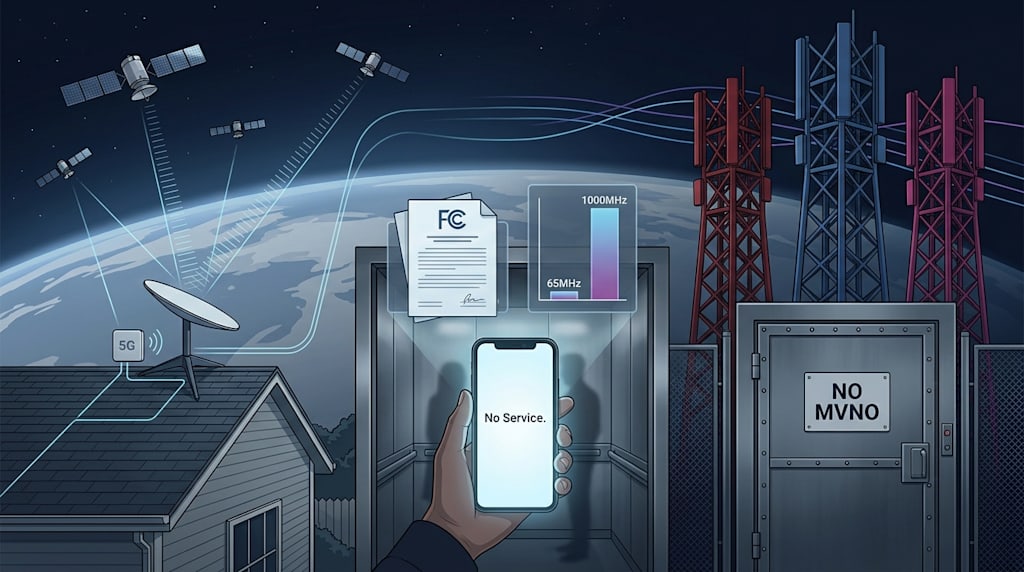
On August 4, 2026, during SpaceX’s first earnings call as a public company, President and COO Gwynne Shotwell said SpaceX plans to build ground infrastructure that complements its satellite internet service and compete directly with major U.S. mobile carriers. She said the three largest carriers generate hundreds of billions of dollars in annual revenue and that SpaceX expects to attract a significant share of their customers.
After the call, shares of AT&T, Verizon, and T-Mobile fell in after-hours trading.
Starlink’s financial position
In the second quarter of 2026, Starlink’s global subscribers reached 12 million, double the 6 million a year earlier. Net additions in the quarter were 1.7 million. Average revenue per user was $66 per month. Revenue for the connectivity segment was about $4.3 billion, with operating profit of $1.66 billion, up 79% year over year.
This is SpaceX’s only profitable segment. The same earnings report showed $18.4 billion in quarterly capital expenditures, with a large portion going to AI and Starship development. Starlink generates cash. AI and Starship consume it. Shotwell is pursuing two campaigns at once: one against the major carriers for customers, another inside SpaceX for budget against Musk’s other projects.
Shotwell put the market size herself: the three major carriers generate combined annual revenue of about $600 billion. Starlink’s full-year revenue is expected to be less than $20 billion. To support SpaceX’s valuation story, Starlink must expand from satellite broadband into broader communications services.
A three-layer architecture: satellite, femtocell, 65MHz
Shotwell’s plan has three layers.
The first layer is in the sky. In 2027, SpaceX plans to launch Starlink Mobile V2 direct-to-device satellites. Ordinary smartphones would connect directly. The target downlink rate is 150 Mbps. Service capacity is about 100 times current levels.
The second layer is on the ground. Small 5G femtocells would be integrated into existing Starlink broadband antennas, using satellites for backhaul. On the call, Musk said this approach “does not require deploying expensive, hard-to-site large cellular base stations.” The Starlink terminals are already installed. Adding a base-station module would cost far less than building new towers.
The third layer is spectrum. In May 2026, the FCC approved SpaceX’s $19.6 billion purchase of about 65MHz of mid-band spectrum from EchoStar. It was SpaceX’s first nationwide dedicated contiguous spectrum. The FCC approval came with staged reviews: in the second, fourth, and ninth years after the deal closes, geographic coverage must reach 90%, or the license can be revoked.
The architecture assigns coverage to satellites, urban capacity to femtocells, and the link between them to spectrum.
The carriers’ response
The three major carriers responded with three moves.
First, they refused MVNO. A mobile virtual network operator agreement would let SpaceX lease an existing network and serve users under its own brand without building a nationwide network. Verizon CEO Schulman said on the second-quarter earnings call: “Regardless of the architecture, there is no backdoor into our MVNO system.”
Second, they jointly formed a D2D joint venture. In May 2026, AT&T, T-Mobile, and Verizon announced a joint venture to advance direct-to-device satellite service in a unified way, integrate spectrum, and use standardized equipment. Satellite D2D capabilities were brought into an operator-led system, closing the path for satellite providers to bypass carriers and reach end users directly.
Third, they rebutted from the physics layer. Schulman said terrestrial networks are 100 to 1,000 times more efficient than satellites. He said: “Speed and capacity advantages are determined by the laws of physics and are difficult for satellites to replicate.” The T-Mobile CEO added that even during peak summer usage, Starlink D2D traffic accounted for 0.0003% of T-Mobile’s total network traffic.
The hard constraints
SpaceX’s plan faces three constraints written in FCC documents and phone makers’ spec sheets.
Not enough spectrum. New Street Research analyst David Barden notes that the three major carriers hold about 1,000MHz of spectrum combined. SpaceX has only 65MHz. The bigger problem is quality: most of that 65MHz cannot currently be directly supported by mainstream smartphones. SpaceX must persuade phone makers to add band support in new models and wait for users to upgrade.
Indoor coverage is a natural weakness of satellites. Satellite signals have limited penetration in high-density buildings. Mobile communications user experience depends heavily on indoor coverage. The femtocell approach can mitigate this. Deploying base stations on user rooftops or indoors brings new problems: zoning permits, equipment maintenance, and interference coordination with incumbent carriers’ spectrum.
Capital expenditure remains large. A September JPMorgan report estimates that SpaceX still needs about 75,000 large communications towers and low-band spectrum to build an independent U.S. terrestrial network, possibly after 2028. Bernstein analyst Douglas Harned puts the cost range at $50 billion to $130 billion. SpaceX’s capital expenditures in 2027 and 2028 could exceed $200 billion.
Market views
The market is split into two camps.
The cautious camp is represented by MoffettNathanson analyst Craig Moffett. Unless SpaceX can reach an MVNO agreement with incumbent carriers, he said, “it is hard to imagine that this direct-to-consumer service can compete with incumbent carriers within the next five years.” Morgan Stanley analyst Sean Diffley put it more restrainedly: “The perceived risk of Starlink Mobile disrupting the U.S. wireless industry is greater than the actual risk over the next one to two years.”
The optimistic camp is represented by Aptus Capital Advisors portfolio manager David Wagner: “Compared with traditional telecom carriers, SpaceX is more capable of sustained innovation and may quickly change the competitive landscape.”
The disagreement comes down to one number: the unit coverage cost of satellite plus distributed femtocells against the traditional macro-base-station plus fiber architecture. If that cost is lower, SpaceX can compete broadly. If it is not, SpaceX’s mobile plan becomes a supplementary service for areas traditional networks do not cover well, such as islands, oil fields, and the open ocean.
What to watch
At the end of 2027, Starlink Mobile is expected to launch. A user walks into an elevator. The satellite signal disappears. The femtocell has not yet been deployed in that building. The phone shows “No Service.”
Traditional carriers spent 20 years installing indoor distribution systems in underground garages and elevators. For SpaceX’s femtocell plan to fill this gap, the cost in time, money, and permitting is unknown.
The FCC review terms set a clear deadline: in 2029, 90% geographic coverage. If SpaceX fails, the spectrum license can be revoked. The $19.6 billion spectrum comes with a countdown.
Shotwell said, “Our service will be better.” The 2029 coverage report will decide whether that sentence holds.
About the Creator
Jin
Writer of reamstories
https://reamstories.com/jin
Enjoyed the story? Support the Creator.
Subscribe for free to receive all their stories in your feed. You could also become a paid subscriber, letting them know you appreciate their work.
Comments
There are no comments for this story
Be the first to respond and start the conversation.