
South Korea Autonomous Vehicles Market Accelerates Toward a Driverless Future as Innovation and Smart Mobility Investments Surge
Government support, cutting-edge technology, and growing demand for intelligent transportation solutions are positioning South Korea as a global leader in autonomous vehicle development.

The future of transportation is arriving faster than many expected, and few countries are embracing this transformation as aggressively as South Korea. Known for its technological leadership, advanced infrastructure, and globally competitive automotive sector, South Korea is rapidly becoming one of the world's most important hubs for autonomous vehicle development.
Autonomous vehicles (AVs), often referred to as self-driving vehicles, represent a revolutionary shift in mobility. By combining artificial intelligence, advanced sensors, connectivity technologies, and real-time data processing, these vehicles promise to improve road safety, reduce congestion, enhance transportation efficiency, and transform how people and goods move through cities.
For South Korea, autonomous vehicles are not simply a transportation innovation—they are a strategic national priority that aligns with broader ambitions related to smart cities, digital transformation, and next-generation mobility.
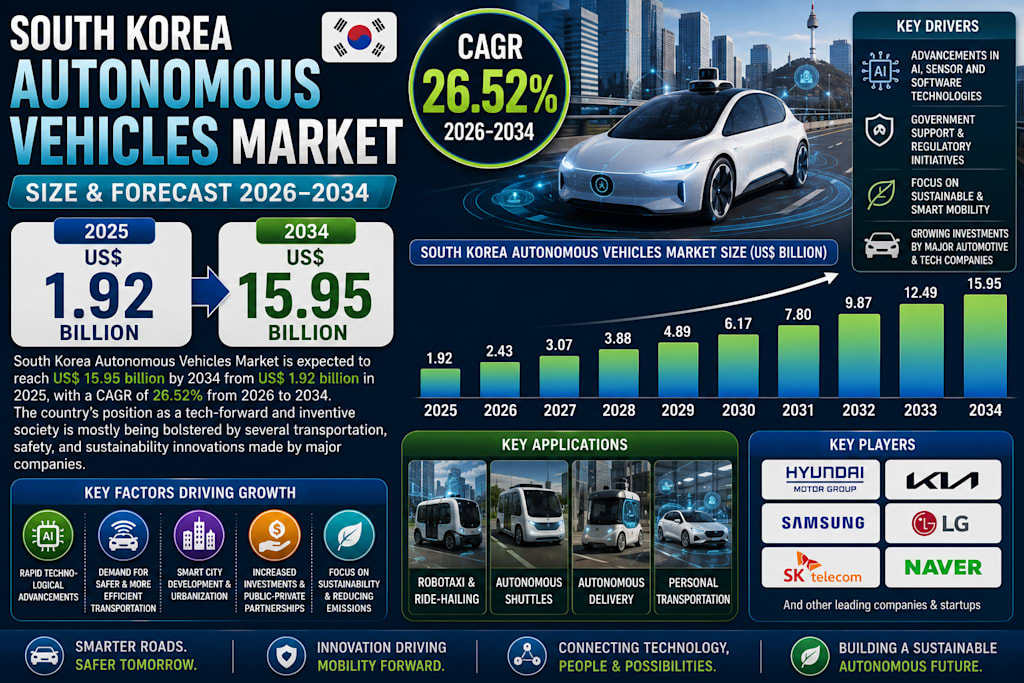
According to Renub Research, the South Korea Autonomous Vehicles Market is projected to grow from US$1.92 billion in 2025 to US$15.95 billion by 2034, registering an exceptional compound annual growth rate (CAGR) of 26.52% from 2026 to 2034. Strong government initiatives, advanced technological capabilities, and increasing demand for intelligent mobility solutions are expected to drive this remarkable expansion.
South Korea Is Emerging as a Global Autonomous Vehicle Leader
South Korea possesses several advantages that make it uniquely positioned to lead the autonomous vehicle revolution.
The country combines world-class automotive manufacturing capabilities with leadership in semiconductors, telecommunications, consumer electronics, and artificial intelligence. This powerful combination creates an ideal environment for developing advanced autonomous mobility solutions.
Major automotive companies, technology firms, research institutions, and telecommunications providers are working together to accelerate innovation in self-driving technologies.
The result is a highly collaborative ecosystem capable of supporting both technological advancement and commercial deployment.
As autonomous mobility moves closer to mainstream adoption, South Korea's integrated approach continues to strengthen its competitive position globally.
Government Support Remains a Major Growth Driver
One of the most significant factors driving South Korea's autonomous vehicle market is strong government support.
Policymakers recognize autonomous transportation as a strategic industry capable of generating economic growth, improving public safety, and enhancing national competitiveness.
To accelerate innovation, the government has introduced regulatory sandboxes, pilot testing zones, funding programs, and long-term mobility development strategies.
These initiatives allow companies to test and refine autonomous technologies under real-world conditions while ensuring compliance with evolving safety standards.
Government-backed investments in smart transportation infrastructure and connected mobility systems further support market development.
This proactive regulatory environment continues to attract investment and encourage technological innovation throughout the autonomous vehicle ecosystem.
Artificial Intelligence Powers Autonomous Driving Systems
Artificial intelligence sits at the heart of modern autonomous vehicle technology.
Self-driving vehicles must continuously analyze enormous amounts of data from cameras, sensors, radar systems, and communication networks while making complex decisions in real time.
AI enables vehicles to recognize road signs, identify pedestrians, interpret traffic conditions, and respond appropriately to dynamic driving environments.
Machine learning algorithms improve vehicle performance over time by processing data collected from millions of driving scenarios.
These capabilities allow autonomous systems to become increasingly accurate, reliable, and adaptive.
South Korea's strong expertise in artificial intelligence research and development provides a significant competitive advantage in this critical area.
5G Connectivity Supports Real-Time Decision Making
South Korea's leadership in telecommunications infrastructure plays a crucial role in autonomous vehicle development.
The country's advanced 5G networks provide the ultra-fast, low-latency connectivity required for real-time vehicle communication.
Autonomous vehicles rely heavily on vehicle-to-everything (V2X) technologies, which allow cars to communicate with traffic signals, infrastructure systems, other vehicles, and cloud-based services.
This constant exchange of information enhances situational awareness and improves decision-making capabilities.
South Korea's extensive 5G deployment creates an ideal environment for testing and deploying connected autonomous transportation systems.
As V2X technologies become increasingly important, the country's telecommunications strengths will continue supporting market growth.
Smart City Development Creates New Opportunities
South Korea's ambitious smart city initiatives are creating favorable conditions for autonomous vehicle adoption.
Modern smart cities integrate digital infrastructure, intelligent transportation systems, data analytics, and connected services to improve urban living.
Autonomous vehicles fit naturally within these environments because they can interact seamlessly with connected traffic systems and smart infrastructure.
Cities such as Seoul and Sejong are actively exploring autonomous mobility solutions as part of broader urban modernization efforts.
Investments in intelligent traffic management, connected roads, and real-time monitoring systems further strengthen the foundation for future AV deployment.
As smart city projects expand, autonomous vehicles are expected to play an increasingly important role in urban transportation networks.
Road Safety Benefits Drive Public Interest
Improving road safety remains one of the most compelling arguments for autonomous vehicle adoption.
Human error contributes to the majority of traffic accidents worldwide, including incidents caused by distraction, fatigue, impaired driving, and poor judgment.
Autonomous vehicles have the potential to significantly reduce these risks by relying on advanced sensors, artificial intelligence, and continuous environmental monitoring.
Unlike human drivers, autonomous systems can maintain constant awareness and respond rapidly to changing conditions.
South Korean policymakers view autonomous vehicles as an important tool for enhancing public safety and reducing accident-related costs.
As technology continues improving, safety benefits are expected to remain a major driver of adoption.
Logistics and Transportation Industries Embrace Automation
The logistics and transportation sectors are among the earliest adopters of autonomous vehicle technologies.
Autonomous delivery vehicles, freight transportation systems, and logistics solutions offer opportunities to improve operational efficiency while reducing costs.
South Korea's highly developed logistics infrastructure makes it an attractive environment for autonomous transportation deployment.
Self-driving technologies can help optimize delivery routes, reduce fuel consumption, and address labor shortages affecting the transportation industry.
Many pilot projects are already exploring the use of autonomous vehicles for last-mile delivery and commercial logistics applications.
As businesses seek greater efficiency and competitiveness, autonomous transportation solutions are expected to gain broader acceptance.
Level 2 Automation Currently Dominates the Market
Within South Korea's autonomous vehicle market, Level 2 automation currently represents the largest segment.
Level 2 systems combine features such as adaptive cruise control, lane-centering assistance, automatic braking, and driver support technologies.
While human drivers remain responsible for vehicle operation, these systems significantly enhance convenience and safety.
Consumers increasingly view advanced driver-assistance systems as valuable features that improve everyday driving experiences.
Automakers have invested heavily in Level 2 technologies because they provide practical benefits while serving as stepping stones toward higher levels of autonomy.
As a result, Level 2 automation continues to dominate the South Korean market.
Hardware Remains the Foundation of Autonomous Vehicles
Hardware represents the largest component of South Korea's autonomous vehicle market.
Self-driving vehicles depend on a sophisticated network of sensors, cameras, radar systems, LiDAR units, processors, communication devices, and embedded control systems.
These components provide the data necessary for perception, navigation, and decision-making functions.
South Korea's global leadership in semiconductor manufacturing and electronics production strengthens its position within this segment.
Companies continue investing heavily in hardware innovation to improve performance, reliability, and affordability.
As autonomous technologies become more advanced, demand for high-performance hardware solutions is expected to increase substantially.
Sensor Technologies Drive Vehicle Intelligence
Autonomous vehicles rely on multiple sensor technologies working together to understand their surroundings.
Cameras capture visual information, radar systems detect object distances and speeds, while LiDAR generates detailed three-dimensional maps of the environment.
Ultrasonic sensors assist with close-range detection and parking operations.
Combining information from multiple sensor sources—a process known as sensor fusion—improves accuracy and reliability.
South Korean technology companies continue investing heavily in sensor development as they seek to improve autonomous vehicle capabilities.
Advancements in sensor technology remain essential for achieving higher levels of automation.
Software Innovation Plays a Growing Role
While hardware remains critical, software increasingly determines overall autonomous vehicle performance.
Advanced software systems process sensor data, manage navigation functions, interpret environmental conditions, and control vehicle responses.
Artificial intelligence algorithms continuously analyze information to support safe and efficient driving decisions.
Software also enables over-the-air updates, allowing manufacturers to improve functionality and address security concerns remotely.
As autonomous systems become more sophisticated, software development is expected to capture an increasingly significant share of industry value.
Commercial Vehicles Offer Significant Growth Potential
Commercial vehicle applications represent a major opportunity within the South Korean autonomous vehicle market.
Autonomous technologies can improve efficiency across freight transportation, public transit, construction, logistics, and industrial operations.
Fleet operators are particularly interested in automation because it can reduce operating costs while improving productivity and safety.
Commercial deployments often benefit from predictable routes and controlled environments, making them attractive early-use cases for autonomous technologies.
As pilot programs demonstrate successful results, commercial adoption is expected to accelerate.
Public Acceptance Continues to Improve
Consumer attitudes toward autonomous vehicles are becoming increasingly positive.
South Korea's technologically advanced population generally demonstrates strong openness to innovation and digital transformation.
Younger consumers, in particular, show significant interest in autonomous mobility solutions that offer convenience, efficiency, and enhanced safety.
Public education initiatives, successful pilot programs, and ongoing technological improvements are helping build confidence in autonomous systems.
As consumers gain greater familiarity with advanced driver-assistance technologies, acceptance of higher autonomy levels is expected to increase.
Technological Complexity Remains a Challenge
Despite impressive progress, autonomous vehicle development remains highly complex.
Vehicles must operate safely across diverse road conditions, weather environments, and unpredictable traffic situations.
Ensuring consistent performance requires sophisticated integration of hardware, software, connectivity, and artificial intelligence systems.
Even minor system failures can have serious safety implications.
Manufacturers must therefore invest heavily in testing, validation, and continuous improvement to ensure reliability.
Overcoming these technological challenges remains one of the industry's most important priorities.
Regulatory and Liability Issues Require Resolution
Regulatory and legal frameworks continue evolving alongside autonomous vehicle technologies.
Questions regarding liability, insurance, data privacy, cybersecurity, and operational standards remain areas of ongoing discussion.
Determining responsibility in the event of an accident involving autonomous systems is particularly complex.
Governments must balance innovation with public safety while creating regulations that encourage investment and commercialization.
South Korea has made significant progress in establishing supportive policies, but further regulatory development will be necessary as autonomous deployment expands.
Hyundai Leads South Korea's Autonomous Ambitions
Among the companies shaping the market, Hyundai Motor Company remains a central force in autonomous vehicle innovation.
The company continues investing heavily in self-driving technologies, artificial intelligence, advanced driver-assistance systems, and smart mobility solutions.
Collaborations with technology partners and research organizations support Hyundai's long-term autonomous vehicle strategy.
Its leadership reflects South Korea's broader commitment to maintaining competitiveness within the global automotive industry.
Final Thoughts
The South Korea autonomous vehicles market is entering a transformative period driven by technological innovation, supportive government policies, and growing demand for intelligent mobility solutions.
With strengths in automotive manufacturing, semiconductors, artificial intelligence, and telecommunications, South Korea is uniquely positioned to become a global leader in autonomous transportation.
The market's projected growth from US$1.92 billion in 2025 to US$15.95 billion by 2034 highlights the tremendous opportunities available for automakers, technology companies, infrastructure providers, and investors.
While challenges related to safety, regulation, and public trust remain, ongoing advancements in connectivity, AI, and smart infrastructure continue bringing autonomous mobility closer to reality.
As the nation advances toward a more connected and intelligent transportation future, autonomous vehicles are poised to become a defining component of South Korea's next generation of mobility innovation.
About the Creator
Enjoyed the story? Support the Creator.
Subscribe for free to receive all their stories in your feed.
Comments
There are no comments for this story
Be the first to respond and start the conversation.