
Smart Pills Market Is Quietly Transforming Diagnostics: Why Non-Invasive Ingestible Technology Is Gaining Ground
From capsule endoscopy to future-ready patient monitoring, the global smart pills market is moving from a niche innovation to a serious healthcare growth story, supported by rising gastrointestinal disease burden, better digital diagnostics, and expanding adoption across hospitals and diagnostic centers.

Smart Pills Market Overview
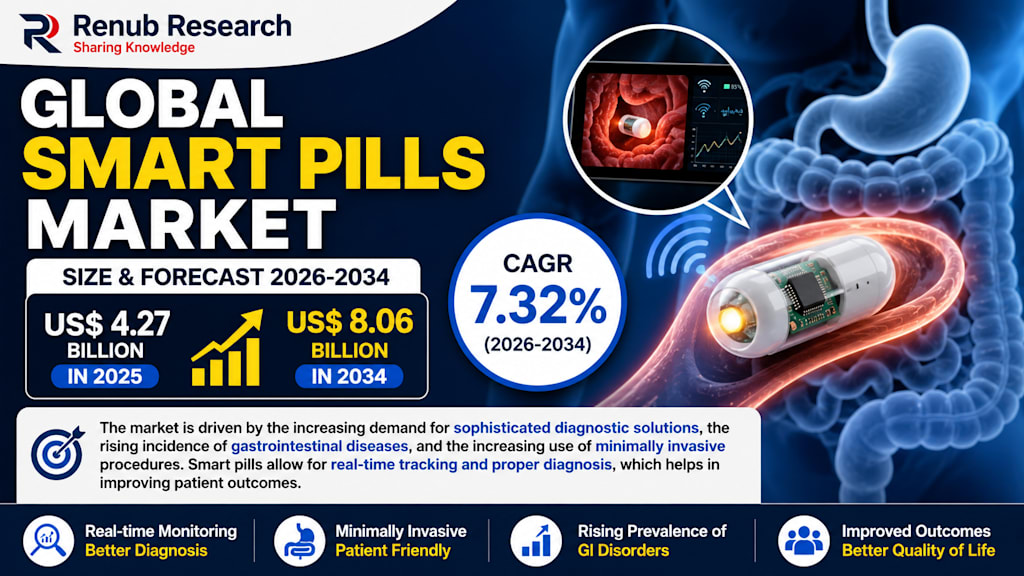
The global smart pills market is entering a period of strong and steady expansion as healthcare systems continue to shift toward faster, safer, and less invasive diagnostic tools. According to Renub Research, the smart pills market is expected to rise from US$ 4.27 billion in 2025 to US$ 8.06 billion by 2034, growing at a CAGR of 7.32% from 2026 to 2034. The central appeal of smart pills lies in their ability to deliver real-time information from inside the human body without the discomfort and complexity associated with traditional procedures.
Smart pills are not ordinary capsules. They are ingestible medical devices equipped with sensors, cameras, and wireless communication technologies that can help doctors observe the digestive tract, track physiological conditions, and support diagnosis with minimal patient burden. In many cases, they are used as capsule endoscopy systems, allowing clinicians to inspect the gastrointestinal tract without surgery, sedation, or the physical intrusion of conventional endoscopic tools.
That practical advantage is a big reason the market is gaining attention. Patients want comfort. Doctors want accuracy. Hospitals want efficiency. Smart pills sit at the intersection of all three.
Why Smart Pills Are Becoming More Important
The healthcare industry is under pressure to diagnose diseases earlier and manage patients more efficiently. Gastrointestinal disorders are becoming more common, and the demand for minimally invasive technology is rising alongside them. Smart pills are especially attractive because they can reduce discomfort while still providing high-quality diagnostic information.
One of the strongest demand drivers is the growing prevalence of digestive disorders. Conditions such as Crohn’s disease, colorectal cancer, ulcers, gastrointestinal bleeding, and other digestive tract issues require timely and accurate diagnosis. Traditional endoscopy can be effective, but it is not always the most comfortable or convenient solution. Smart pills offer a much easier experience for patients while still providing actionable data for clinicians.
The market is also being supported by the broader shift toward preventive healthcare. More patients are seeking early diagnosis, especially in countries where awareness of gastrointestinal health is improving. As people become more willing to undergo screening and monitoring, the demand for technologies like smart pills rises naturally.
The Role of Minimally Invasive Diagnostics
Minimally invasive care is no longer a luxury; it is becoming an expectation. Across modern healthcare systems, there is increasing pressure to reduce pain, lower procedural risk, shorten recovery time, and improve patient compliance. Smart pills fit this trend extremely well.
Unlike conventional diagnostic procedures that may require sedation, tubes, or hospital-based intervention, smart pills can be swallowed and then monitored as they travel through the digestive system. That simplicity matters. It makes the technology easier to accept, especially for elderly patients, children, or individuals who may be anxious about invasive tests.
This is also one of the reasons hospitals and diagnostic centers are adopting smart pills more aggressively. When a procedure is easier to tolerate, more patients are likely to complete it. When the process is efficient, medical staff can work more effectively. When complications are minimized, the whole healthcare system benefits.
Technology Is Expanding the Market Beyond Basic Diagnostics
The smart pills market is not standing still. It is being reshaped by ongoing advances in imaging, wireless transmission, sensor miniaturization, artificial intelligence, and digital health integration. Today’s smart pills are far more capable than earlier versions. They can capture high-resolution images, detect internal conditions, and send information to external devices for analysis.
This matters because healthcare is increasingly digital. Remote patient monitoring, connected diagnostics, and AI-assisted review are becoming normal parts of modern medicine. Smart pills fit neatly into that environment. They generate data that can be analyzed efficiently and used to support more precise clinical decisions.
The market is also expanding into areas beyond gastrointestinal imaging. Research and development is underway in patient monitoring and drug delivery applications. That means smart pills may eventually do more than inspect the body. They could help manage treatment, monitor vital signs, and support personalized care in ways that were once considered futuristic.
Recent regulatory and product milestones also show how quickly the field is moving. New device clearances and pediatric approvals are helping widen the clinical use of smart capsule technology, while location-aware capsule innovations are pushing the category forward.
Key Challenges Still Slowing Wider Adoption
Despite the momentum, the market faces real barriers. The first major challenge is cost. Smart pills are sophisticated devices that require advanced manufacturing, precision engineering, and specialized review systems. That makes them expensive. In many markets, especially developing countries, cost can limit adoption.
Insurance coverage is another issue. If reimbursement is limited or unclear, hospitals and patients may hesitate to use smart pills even when the technology is clinically useful. As a result, traditional diagnostic methods may remain the default in many settings.
Regulation and safety also matter. Because smart pills are ingestible devices, they must meet strict approval standards. Clinical testing can be lengthy, and product launches may take time. There are also safety concerns such as capsule retention in certain patients, which makes careful patient selection important. These issues do not stop the market, but they do slow its pace.
Market Segments: Where Demand Is Coming From
The smart pills market can be understood through several key segments, and each one reflects a different use case.
Capsule Endoscopy
This is the most established application area. Capsule endoscopy is widely used for visualizing the digestive tract, especially the small intestine. It is valuable in cases involving bleeding, Crohn’s disease, ulcers, or suspicious lesions. Because it is non-invasive and does not require sedation, it has become one of the most compelling alternatives to traditional endoscopy.
Patient Monitoring
This segment has a major future advantage. As healthcare shifts toward remote oversight and continuous monitoring, smart pills could play a larger role in tracking health data from inside the body. This is especially relevant for chronic disease management and digital health ecosystems.
Drug Delivery
Drug delivery is another promising area. Smart pills could eventually be used to release medication in a controlled way or deliver therapeutic substances with greater precision. While this segment is still evolving, it could reshape the market over the long term.
Target Areas Inside the Body
Smart pills are also used across different areas of the gastrointestinal tract, and that diversity is important for market growth.
The small intestine remains one of the most important areas because many digestive disorders are difficult to diagnose there using conventional tools. The esophagus segment is important for conditions such as GERD and Barrett’s esophagus. The stomach segment supports monitoring for ulcers, acid reflux, and gastric function. The large intestine also has diagnostic relevance, especially in broader digestive assessments.
Each target area expands the usefulness of smart pills and strengthens the overall market case for non-invasive diagnostics.
End-Users: Who Is Adopting Smart Pills?
Hospitals
Hospitals remain one of the largest end-user groups because they have the infrastructure, specialists, and patient volume needed for advanced diagnostic procedures. They also tend to adopt new technology earlier when it improves workflow and outcomes.
Diagnostic Centers
Diagnostic centers are another important market. These facilities focus heavily on early detection and non-invasive care, making them a natural fit for smart pill procedures. As preventive healthcare becomes more common, these centers are likely to see stronger demand.
Research Institutes
Research institutes play a quieter but important role. They help test new applications, refine technology, and support the next generation of ingestible medical devices.
Regional Market Outlook
The smart pills market has a broad global footprint, but adoption levels vary by region.
North America
North America, especially the United States, is a leading market due to advanced healthcare infrastructure, higher awareness of preventive diagnostics, and a strong culture of early technology adoption. The region also benefits from robust investment in research and development.
Europe
Europe shows meaningful growth because of rising digestive disorder cases and a strong interest in minimally invasive care. Countries such as the United Kingdom, Germany, France, Italy, and Spain are important contributors.
Asia Pacific
Asia Pacific is expected to become increasingly important as healthcare systems modernize and the number of gastrointestinal disorders increases. India, China, Japan, South Korea, and other markets are seeing greater awareness of advanced diagnostics and better access to medical infrastructure.
Middle East & Africa
The Middle East, particularly Saudi Arabia and the UAE, is seeing growth driven by rising healthcare spending and technology adoption. Governments in the region are investing heavily in modern medical systems, which supports the use of advanced diagnostic devices.
Latin America
Brazil, Mexico, and Argentina are also emerging markets where interest in modern diagnostics is growing, though adoption may be slower due to cost and infrastructure limitations.
Country-Level Highlights
United States
The United States market is expanding quickly due to the presence of advanced hospitals, strong R&D activity, and high use of diagnostic innovation. With a large number of gastrointestinal cases and a strong emphasis on minimally invasive care, the U.S. remains one of the most important smart pills markets globally.
United Kingdom
The UK market is supported by a strong public healthcare system and rising interest in non-invasive diagnostics. As awareness grows around digestive health and early diagnosis, smart pills are becoming more relevant in clinical practice.
India
India is a promising growth market because of the rapid development of healthcare infrastructure, changing diets, and increasing digestive health concerns. The rising number of hospitals and diagnostic centers creates more room for smart pill adoption over time.
Saudi Arabia
Saudi Arabia is investing heavily in healthcare modernization. That makes it an attractive market for smart pill technologies, especially where non-invasive diagnosis and chronic disease management are becoming more important.
Competitive Landscape
The market includes a mix of established healthcare and medical technology companies. Key players referenced in the source include Check-Cap Ltd., General Electric Company, Fujifilm, Koninklijke Philips N.V., Medtronic plc, Olympus Corporation, Novartis AG, and Otsuka Holdings Co., Ltd.
This competitive mix suggests a market with both diagnostic expertise and broader healthcare device capabilities. Companies with strong imaging, monitoring, and medical device portfolios are especially well positioned to benefit as the smart pills category matures.
The Bigger Story Behind Smart Pills
What makes the smart pills market so interesting is that it reflects a larger change in healthcare itself. Medicine is becoming less invasive, more connected, and more data-driven. Patients expect easier procedures. Doctors want better insights. Health systems want efficiency. Smart pills respond to all of those pressures.
The market still has challenges, especially around cost, approval, and accessibility. But the direction is clear. As the technology improves and more clinical applications emerge, smart pills are likely to move from a specialized diagnostic option to a more mainstream part of modern healthcare.
The next phase of growth may come not only from gastrointestinal imaging, but also from broader uses in monitoring and treatment delivery. That is where the category could become truly transformative.
Final Thoughts
The smart pills market is one of the clearest examples of how medical innovation can improve both patient experience and clinical performance at the same time. With the market projected to grow from US$ 4.27 billion in 2025 to US$ 8.06 billion by 2034, and supported by a 7.32% CAGR from 2026 to 2034, the opportunity is substantial. The combination of rising gastrointestinal disorders, growing demand for minimally invasive diagnosis, and rapid technological advancement gives this market a strong long-term outlook.
For healthcare providers, the message is simple: diagnostics are changing. For investors and industry watchers, the signal is equally clear: smart pills are no longer just an emerging concept. They are becoming a meaningful part of the future of digital and non-invasive healthcare.
About the Creator
Enjoyed the story? Support the Creator.
Subscribe for free to receive all their stories in your feed.
Comments
There are no comments for this story
Be the first to respond and start the conversation.