
Smart Parking Is Reshaping Urban Mobility: Why the Global Market Is Set for Strong Growth Through 2034
Growing urban populations, rising vehicle ownership, and smart city investments are transforming parking from a daily frustration into a technology-driven opportunity.

Anyone who has driven through a crowded city knows the frustration of searching endlessly for a parking spot. What seems like a minor inconvenience actually creates major consequences for cities, including traffic congestion, wasted fuel, lost productivity, and increased carbon emissions. As urban populations continue to grow and more vehicles enter city streets, parking management has become a critical challenge for governments, businesses, and transportation authorities around the world.
Fortunately, technology is offering a smarter solution.
Smart parking systems are transforming how cities manage parking resources by combining advanced technologies such as the Internet of Things (IoT), sensors, cameras, artificial intelligence, cloud computing, and mobile applications. These solutions provide real-time information about parking availability, guide drivers to vacant spaces, enable cashless payments, and improve overall traffic flow.
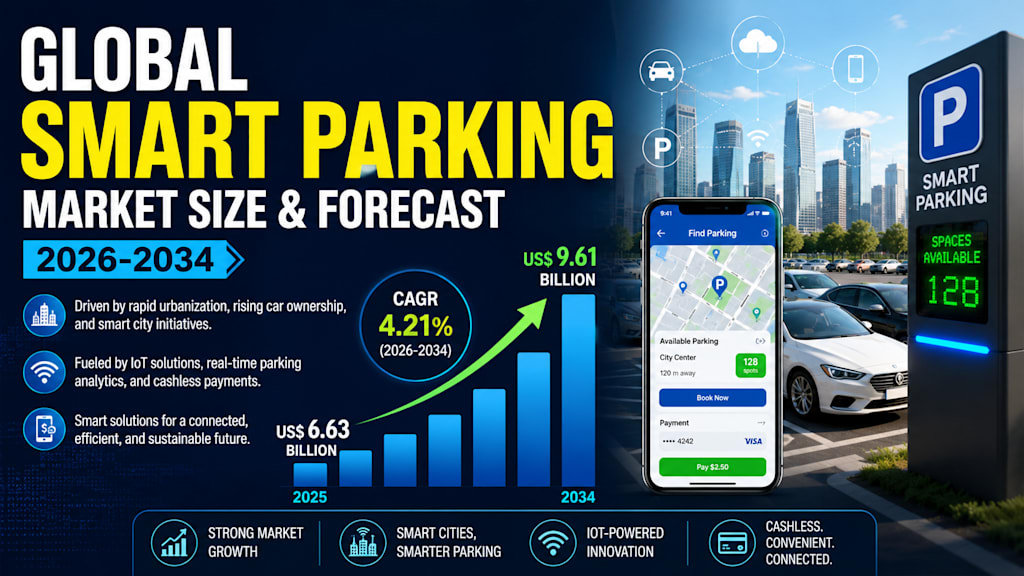
The growing importance of these technologies is reflected in market projections. According to Renub Research, the Global Smart Parking Market is expected to increase from US$ 6.63 Billion in 2025 to US$ 9.61 Billion by 2034, expanding at a compound annual growth rate (CAGR) of 4.21% between 2026 and 2034. This growth highlights the increasing demand for intelligent transportation solutions that can help cities become more efficient, sustainable, and connected.
The Growing Need for Smarter Parking Solutions
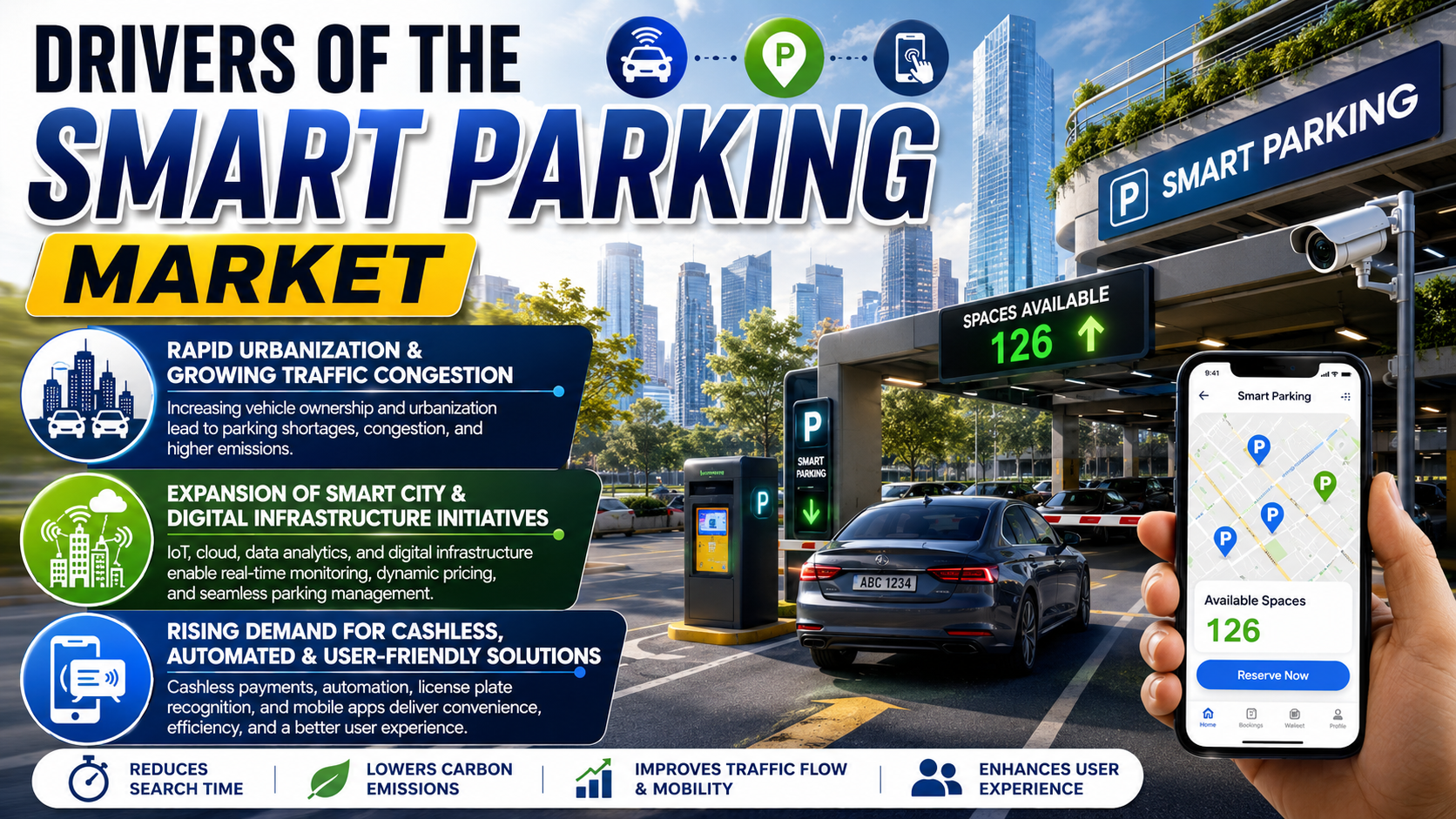
Urbanization is accelerating at an unprecedented pace. Millions of people continue moving into cities each year, creating additional pressure on infrastructure that was often designed for smaller populations. At the same time, vehicle ownership continues to rise, resulting in greater demand for parking spaces in already crowded urban environments.
Parking shortages have become a common issue in many metropolitan areas. Drivers frequently spend significant amounts of time searching for available spaces, contributing to traffic congestion and environmental pollution. Studies have shown that a substantial percentage of urban traffic consists of vehicles looking for parking, making parking management an important factor in broader transportation planning.
Smart parking solutions address these challenges by providing real-time visibility into parking availability. Through sensors, cameras, and digital platforms, drivers can quickly locate available parking spaces, reducing search times and minimizing unnecessary vehicle movement. As a result, cities can improve traffic flow, reduce emissions, and create a more convenient experience for residents and visitors.
Understanding Smart Parking Technology
Smart parking refers to an intelligent parking management system that uses digital technologies to monitor, manage, and optimize parking resources. These systems collect and analyze real-time data from parking facilities and provide actionable insights to both drivers and parking operators.
At the heart of smart parking systems are connected devices that communicate with centralized management platforms. Sensors installed in parking spaces detect occupancy, cameras monitor vehicle activity, and cloud-based software processes data to generate real-time information.
Drivers can access this information through mobile applications or digital displays, allowing them to locate available spaces before arriving at a destination. Smart parking systems often include automated entry and exit systems, license plate recognition (LPR), contactless payment processing, dynamic pricing models, parking enforcement tools, predictive analytics, and traffic management integration.
Together, these technologies create a seamless parking experience while helping cities maximize the efficiency of limited parking infrastructure.
Smart Cities Are Accelerating Market Growth
One of the most significant drivers of the smart parking market is the rapid expansion of smart city initiatives worldwide.
Governments are increasingly investing in digital infrastructure to improve urban services, enhance sustainability, and support economic development. Smart parking has emerged as an important component of these broader smart city strategies because it directly impacts transportation efficiency and quality of life.
Cities across North America, Europe, Asia-Pacific, and the Middle East are implementing intelligent transportation systems that integrate parking management with traffic monitoring, public transportation, and urban planning initiatives. By collecting and analyzing parking data, city authorities can make more informed decisions about infrastructure investments and mobility policies.
As digital transformation continues to reshape urban environments, smart parking systems are expected to play an increasingly important role in creating connected and data-driven cities.
Consumer Demand Is Driving Innovation
Modern consumers expect convenience in nearly every aspect of their daily lives, including transportation and parking.
Traditional parking systems often involve cash payments, paper tickets, and manual processes that can create delays and frustration. Smart parking technologies eliminate many of these inefficiencies by introducing automated and user-friendly solutions.
Today, drivers can use mobile applications to locate available spaces, reserve parking spots, navigate directly to parking facilities, make digital payments, and even extend parking sessions remotely. These conveniences not only improve the customer experience but also increase operational efficiency for parking operators.
The widespread adoption of smartphones and digital payment platforms has further accelerated demand for smart parking solutions. Consumers increasingly prefer cashless transactions and seamless digital experiences, making smart parking systems an attractive option for commercial facilities, airports, shopping centers, hospitals, and office complexes.
The Rising Importance of License Plate Recognition
License Plate Recognition technology has become one of the most valuable innovations within the smart parking ecosystem.
LPR systems use advanced cameras and artificial intelligence algorithms to identify vehicles automatically as they enter and exit parking facilities. This eliminates the need for physical tickets and enables fully automated parking operations.
The benefits include faster vehicle processing, reduced operational costs, improved security, automated billing, and enhanced enforcement capabilities. Many airports, corporate campuses, and commercial parking operators have already adopted LPR technology to streamline operations and improve customer satisfaction.
As artificial intelligence and image processing technologies continue to advance, the accuracy and reliability of LPR systems are expected to improve even further, supporting broader adoption worldwide.
Smart Parking Gates and Access Control Systems
Another important segment of the market is smart parking gates.
Modern parking facilities increasingly rely on automated access control systems that integrate with RFID technology, QR codes, mobile applications, and license plate recognition platforms. These systems enable vehicles to enter and exit parking areas without requiring manual intervention.
Automated parking gates help reduce congestion at facility entrances, improve security, and increase operational efficiency. They are widely used in commercial properties, residential communities, airports, hospitals, and corporate campuses where managing vehicle flow is essential.
As organizations continue investing in automation and digital transformation, demand for intelligent access control solutions is expected to remain strong.
Mobile Applications Are Changing Driver Behavior
The smartphone revolution has significantly influenced the smart parking market.
Mobile applications now serve as the primary interface between drivers and parking systems. These applications provide users with real-time information while offering greater convenience and flexibility.
Smart parking applications allow users to search for available parking spaces, compare pricing options, reserve spots in advance, navigate to parking facilities, make cashless payments, and extend parking sessions remotely. For drivers, these features reduce uncertainty and save valuable time. For operators, mobile applications generate valuable data that can be used to improve service quality and operational performance.
As smartphone adoption continues to expand globally, mobile parking services are expected to remain a major growth area within the industry.
Challenges Facing the Industry
Despite its positive outlook, the smart parking market faces several challenges.
One of the most significant barriers is the high cost of implementation. Deploying smart parking infrastructure requires investments in sensors, cameras, networking equipment, software platforms, and ongoing maintenance. For smaller cities and organizations with limited budgets, these costs can slow adoption.
Integration can also be challenging. Many municipalities operate legacy parking systems that may not easily connect with modern digital technologies. Upgrading existing infrastructure often requires substantial planning and investment.
Data privacy and cybersecurity concerns represent another important challenge. Smart parking systems collect sensitive information, including vehicle data, payment details, and location information. Ensuring strong security measures and compliance with privacy regulations is essential for maintaining public trust.
In addition, the industry continues to face issues related to standardization. Different technologies and platforms may not always work seamlessly together, creating interoperability challenges that could limit large-scale deployment.
Regional Markets Leading the Way
The United States remains one of the most advanced smart parking markets globally. Major cities such as New York, Los Angeles, Chicago, and San Francisco have implemented sophisticated parking management systems that utilize sensors, cameras, mobile applications, and license plate recognition technology. Strong digital infrastructure and widespread adoption of mobile payment systems continue to support market growth.
The United Kingdom has also embraced smart parking solutions as part of broader efforts to improve transportation efficiency and reduce environmental impact. Cities across the country are increasingly adopting app-based parking systems that simplify payments and improve parking management.
China represents one of the fastest-growing opportunities within the smart parking industry. Rapid urbanization, growing vehicle ownership, and significant government investment in smart city development have accelerated the adoption of intelligent parking technologies across major Chinese cities.
Saudi Arabia is emerging as another important market due to ambitious modernization initiatives associated with Vision 2030. Investments in smart mobility, intelligent transportation systems, and urban infrastructure are creating new opportunities for smart parking providers throughout the region.
Looking Ahead: The Future of Smart Parking
The future of smart parking extends far beyond simply helping drivers find empty spaces.
Emerging technologies such as artificial intelligence, machine learning, autonomous vehicles, and advanced analytics are expected to transform parking systems into integrated components of broader urban mobility networks.
Future developments may include AI-driven predictive parking availability, autonomous vehicle integration, dynamic demand-based pricing, advanced traffic optimization, real-time urban mobility analytics, and sustainability-focused transportation planning.
As cities become increasingly connected, smart parking systems will generate valuable data that can support transportation planning, environmental initiatives, and infrastructure development. Parking facilities may eventually function as intelligent mobility hubs that contribute to more efficient and sustainable urban ecosystems.
Final Thoughts
Smart parking is no longer a niche technology reserved for futuristic cities. It has become a practical and increasingly necessary solution for addressing some of the most pressing challenges associated with urban growth and transportation management.
With the Global Smart Parking Market projected to expand from US$ 6.63 Billion in 2025 to US$ 9.61 Billion by 2034, the industry is positioned for steady growth over the coming decade. The combination of urbanization, smart city investments, digital transformation, and evolving consumer expectations will continue to drive demand for intelligent parking solutions worldwide.
As governments, businesses, and transportation authorities seek innovative ways to improve mobility and sustainability, smart parking is likely to remain at the forefront of urban innovation. The cities that successfully embrace these technologies today may be better prepared to meet the transportation challenges of tomorrow.
About the Creator
Enjoyed the story? Support the Creator.
Subscribe for free to receive all their stories in your feed.
Comments
There are no comments for this story
Be the first to respond and start the conversation.