
Sex Reassignment Surgery Market to Reach US$ 7.51 Billion by 2033 as Global Demand for Gender-Affirming Care Accelerates
Rising social acceptance, medical innovation, insurance expansion, and growing awareness of transgender healthcare needs are transforming the global sex reassignment surgery landscape

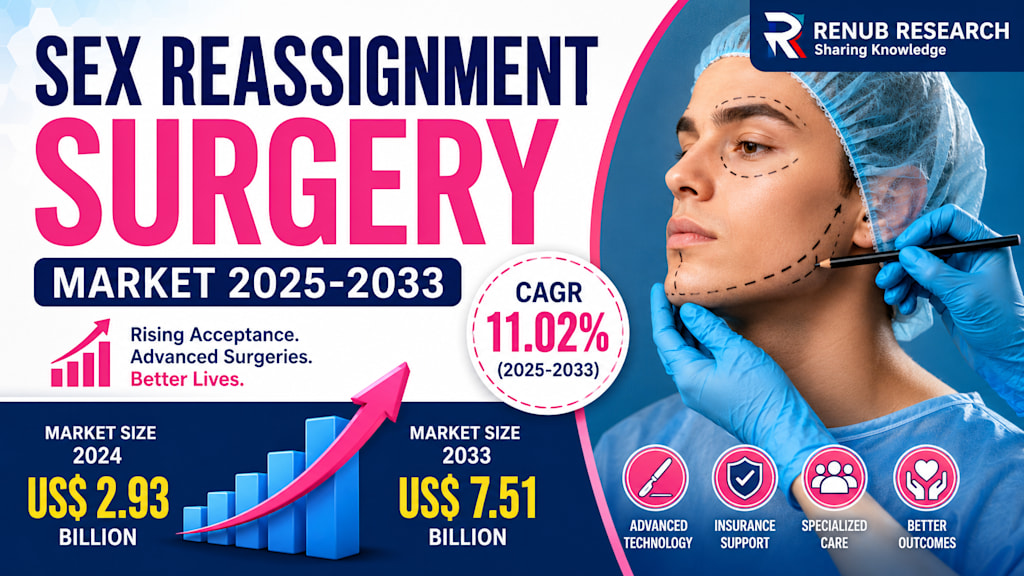
Global Sex Reassignment Surgery Market Outlook
The global healthcare industry is witnessing a profound transformation as gender-affirming care gains wider acceptance and accessibility. Among the most significant developments within this evolving healthcare landscape is the growing demand for Sex Reassignment Surgery (SRS), also known as Gender Confirmation Surgery.
According to Renub Research, the Worldwide Sex Reassignment Surgery Market is projected to grow from US$ 2.93 Billion in 2024 to US$ 7.51 Billion by 2033, expanding at a robust CAGR of 11.02% during 2025–2033.
This remarkable growth reflects changing societal attitudes toward gender identity, improved healthcare access, advancements in surgical technologies, and expanding insurance coverage for transgender individuals seeking gender-affirming procedures.
As healthcare systems become more inclusive and supportive, sex reassignment surgery is increasingly recognized as a medically necessary treatment that significantly improves quality of life, mental health outcomes, and overall well-being.
Understanding Sex Reassignment Surgery
Sex reassignment surgery encompasses a range of surgical procedures designed to align an individual's physical characteristics with their gender identity.
These procedures are typically pursued by transgender individuals experiencing gender dysphoria—a condition characterized by distress resulting from a mismatch between assigned sex at birth and experienced gender identity.
Depending on the patient's goals and transition pathway, procedures may include:
Breast augmentation
Chest masculinization
Vaginoplasty
Phalloplasty
Metoidioplasty
Facial feminization surgery
Facial masculinization surgery
Voice and airway surgeries
Body contouring procedures
For many patients, these interventions represent a life-changing step toward living authentically and comfortably within their identified gender.
Beyond physical transformation, numerous studies have linked gender-affirming surgeries to improved mental health outcomes, reduced anxiety and depression, increased self-esteem, and enhanced social integration.
Growing Awareness and Social Acceptance Fuel Market Expansion
One of the strongest growth catalysts for the sex reassignment surgery market is the increasing social acceptance of transgender individuals worldwide.
Over the past decade, advocacy organizations, healthcare institutions, and policymakers have worked to improve understanding of gender diversity and transgender healthcare needs. Public awareness campaigns, educational programs, and greater media representation have contributed significantly to reducing stigma.
As societal attitudes continue to evolve, more individuals feel empowered to seek professional healthcare support and gender-affirming treatments.
Governments in various countries are also implementing policies that strengthen legal protections for transgender populations and improve healthcare access.
These developments have created an environment where gender-affirming surgery is increasingly viewed as a legitimate and necessary component of comprehensive healthcare.
Medical Advancements Are Improving Outcomes
Technological innovation is revolutionizing the field of gender-affirming surgery.
Modern surgical techniques offer enhanced precision, reduced complication rates, shorter recovery periods, and improved aesthetic and functional outcomes.
Advancements include:
Microsurgical reconstruction
Robotic-assisted procedures
Advanced tissue engineering
Enhanced wound closure technologies
Improved anesthesia protocols
Digital surgical planning systems
Surgeons today can achieve outcomes that were previously difficult or impossible to attain, significantly increasing patient satisfaction.
Telemedicine has also emerged as an important tool, allowing patients to access consultations, follow-up appointments, and psychological support regardless of geographical location.
Artificial intelligence and digital imaging technologies are increasingly being used to personalize surgical planning and optimize patient outcomes.
As innovation continues, patients benefit from safer procedures and more predictable results, further driving market demand.
Insurance Coverage Is Expanding Access to Care
Historically, one of the biggest barriers to gender-affirming surgery was affordability.
Many procedures can cost tens of thousands of dollars, making treatment inaccessible for a large portion of the transgender population.
However, healthcare providers, insurers, and policymakers increasingly recognize sex reassignment surgery as medically necessary care rather than elective cosmetic treatment.
This shift has led to expanded insurance coverage across several regions, particularly in North America and Europe.
Public healthcare systems in numerous countries now cover certain gender-affirming procedures, while private insurance companies are gradually broadening their reimbursement policies.
As financial barriers decrease, a larger patient population can access surgery, contributing significantly to market growth.
High Procedure Costs Remain a Major Challenge
Despite increasing insurance support, the high cost of sex reassignment surgery continues to hinder broader adoption.
Comprehensive transition-related surgical pathways often involve multiple procedures spread over several years.
Expenses may include:
Surgical fees
Hospital stays
Anesthesia costs
Hormone therapy
Psychological evaluations
Follow-up care
Travel and accommodation expenses
In countries where insurance coverage remains limited, many individuals face significant financial hardship when pursuing treatment.
As a result, some patients postpone procedures, seek lower-cost alternatives abroad, or abandon treatment altogether.
Addressing affordability remains a critical challenge for healthcare providers and policymakers worldwide.
Shortage of Specialized Surgeons Limits Accessibility
Another obstacle affecting market growth is the limited availability of highly skilled surgeons.
Sex reassignment surgeries require expertise across multiple disciplines, including:
Plastic surgery
Reconstructive surgery
Urology
Gynecology
Endocrinology
The complexity of these procedures demands extensive training and experience.
Consequently, many healthcare systems face shortages of qualified professionals capable of delivering comprehensive gender-affirming surgical care.
Long waiting lists are common in public healthcare systems, particularly in Europe and parts of North America.
Patients often travel internationally to access specialized treatment centers, contributing to the rise of medical tourism in this sector.
Male-to-Female Procedures Continue to Dominate Market Revenue
Among surgery types, the Male-to-Female (MTF) segment remains the largest contributor to global market revenues.
Common procedures within this category include:
Breast augmentation
Facial feminization surgery
Vaginoplasty
Body contouring
The popularity of these procedures is supported by improved surgical outcomes and increased social acceptance.
Enhanced reconstructive techniques and hormone therapies have significantly elevated patient satisfaction levels, making MTF procedures a major growth engine for the overall market.
Genital Surgery Represents a Critical Market Segment
Genital reconstruction procedures remain among the most complex and transformative forms of gender-affirming surgery.
These procedures include:
Vaginoplasty
Phalloplasty
Metoidioplasty
Demand for genital surgery continues to rise as more patients pursue complete gender affirmation.
Although these surgeries involve longer recovery periods and higher costs, they often deliver substantial psychological and functional benefits.
Specialized centers in the United States, Europe, and Thailand currently lead this segment, while emerging healthcare markets continue to expand their capabilities.
Voice and Airway Surgery Is Emerging as a High-Growth Niche
Voice characteristics play a crucial role in gender expression and social identity.
As a result, voice and airway surgeries have become increasingly popular among transgender patients.
Procedures such as feminization laryngoplasty and cricothyroid approximation help transgender women achieve higher vocal ranges.
Similarly, selected interventions may assist transgender men seeking deeper vocal characteristics.
Growing awareness of the psychological impact of voice congruence is driving demand for these specialized procedures.
Advancements in minimally invasive techniques are further improving patient outcomes and reducing recovery times.
Hospitals Lead Service Delivery Across the Market
Hospitals continue to dominate the end-user segment due to their comprehensive capabilities and multidisciplinary care teams.
Major hospitals typically provide:
Psychological assessment
Hormone therapy management
Surgical intervention
Post-operative rehabilitation
Long-term follow-up care
Large healthcare institutions also possess advanced surgical infrastructure and emergency support systems necessary for complex procedures.
Many hospitals have established dedicated transgender health programs, enabling them to attract both domestic and international patients.
As awareness grows and patient volumes increase, hospitals are expected to remain central to market expansion.
Specialty Clinics Are Gaining Popularity
Specialty clinics focused exclusively on gender-affirming care are becoming increasingly influential.
These facilities offer:
Personalized treatment plans
Dedicated transgender healthcare expertise
Shorter waiting times
Enhanced patient privacy
Continuity of care
Many patients prefer specialty clinics because of their focused expertise and patient-centered environments.
The rise of boutique gender clinics across North America and Europe reflects growing demand for specialized, high-quality care tailored specifically to transgender populations.
Regional Market Insights
United States
The United States remains one of the world's largest and most advanced markets for sex reassignment surgery.
Strong healthcare infrastructure, expanding insurance coverage, and growing public awareness continue to support market growth.
The country is home to several internationally recognized surgeons and medical centers specializing in gender-affirming care.
Germany
Germany has emerged as a leading European destination for sex reassignment surgery.
Comprehensive insurance coverage, progressive healthcare policies, and high clinical standards support strong market expansion.
Major cities such as Berlin and Munich attract both domestic and international patients.
India
India is rapidly becoming a significant market due to affordable treatment costs and increasing medical tourism.
Major metropolitan areas including Mumbai, Delhi, Chennai, and Bengaluru offer specialized gender-affirming healthcare services.
Growing legal recognition of transgender rights is expected to further strengthen market opportunities.
Brazil
Brazil remains one of Latin America's most progressive markets for transgender healthcare.
Public healthcare support and strong expertise in reconstructive surgery have positioned the country as a regional leader.
Saudi Arabia
Although currently limited by cultural and regulatory constraints, gradual healthcare modernization initiatives may create future opportunities for market growth.
At present, many patients seek treatment abroad, particularly in Asia and Europe.
10 Recent Developments Shaping the Industry
1. Mount Sinai Health System Expanded Gender-Affirming Programs
Mount Sinai continues investing in comprehensive transgender healthcare services, integrating surgery, endocrinology, and mental health support.
2. Boston Medical Center Increased Access Initiatives
The organization expanded patient access programs focused on underserved transgender communities.
3. UCSF Transgender Care Enhanced Telehealth Services
Expanded virtual consultations have improved access for patients across remote regions.
4. The London Transgender Clinic Added New Surgical Specialists
The clinic strengthened its multidisciplinary surgical team to accommodate growing demand.
5. Phuket Plastic Surgery Institute Expanded International Patient Services
The institute introduced enhanced medical tourism packages targeting global patients.
6. Gender Surgery Amsterdam Strengthened European Referral Networks
The center expanded collaborations with healthcare providers across Europe.
7. Rumer Cosmetic Surgery Advanced Facial Feminization Techniques
The clinic introduced updated approaches designed to improve aesthetic outcomes and recovery experiences.
8. Transgender Surgery Institute of America Expanded Procedure Portfolio
New service offerings now cover a broader spectrum of gender-affirming surgeries.
9. Center for Gender Confirmation Serbia Increased International Outreach
The center enhanced global patient engagement and consultation programs.
10. Papillon Gender Clinic Strengthened Integrated Care Pathways
The clinic expanded psychological support and post-operative care services to improve patient outcomes.
Competitive Landscape
The global sex reassignment surgery market remains highly specialized, with leading institutions focusing on surgical excellence, multidisciplinary care, and patient-centered treatment approaches.
Key market participants include:
Mount Sinai Health System
Boston Medical Center
Rumer Cosmetic Surgery
The London Transgender Clinic
Phuket Plastic Surgery Institute
Gender Surgery Amsterdam
UCSF Transgender Care
Transgender Surgery Institute of America
Center for Gender Confirmation Serbia
Papillon Gender Clinic
Competition increasingly centers on clinical outcomes, innovation, patient experience, international outreach, and comprehensive care models.
Final Thoughts
The global sex reassignment surgery market is entering a period of sustained growth fueled by increasing acceptance of transgender identities, technological innovation, broader insurance coverage, and rising awareness of gender-affirming healthcare.
With the market expected to expand from US$ 2.93 Billion in 2024 to US$ 7.51 Billion by 2033, healthcare providers, policymakers, and industry stakeholders have a significant opportunity to improve accessibility and quality of care for transgender individuals worldwide.
While challenges related to affordability, workforce shortages, and regional disparities remain, ongoing advancements in surgical techniques and supportive healthcare policies are expected to strengthen market development throughout the forecast period.
As society continues to embrace diversity and inclusion, gender-affirming care is poised to become an increasingly important component of modern healthcare systems across the globe.
About the Creator
Enjoyed the story? Support the Creator.
Subscribe for free to receive all their stories in your feed.
Comments
There are no comments for this story
Be the first to respond and start the conversation.