
Semiconductor Market Expands as AI, Electric Vehicles, and 5G Drive Global Chip Demand
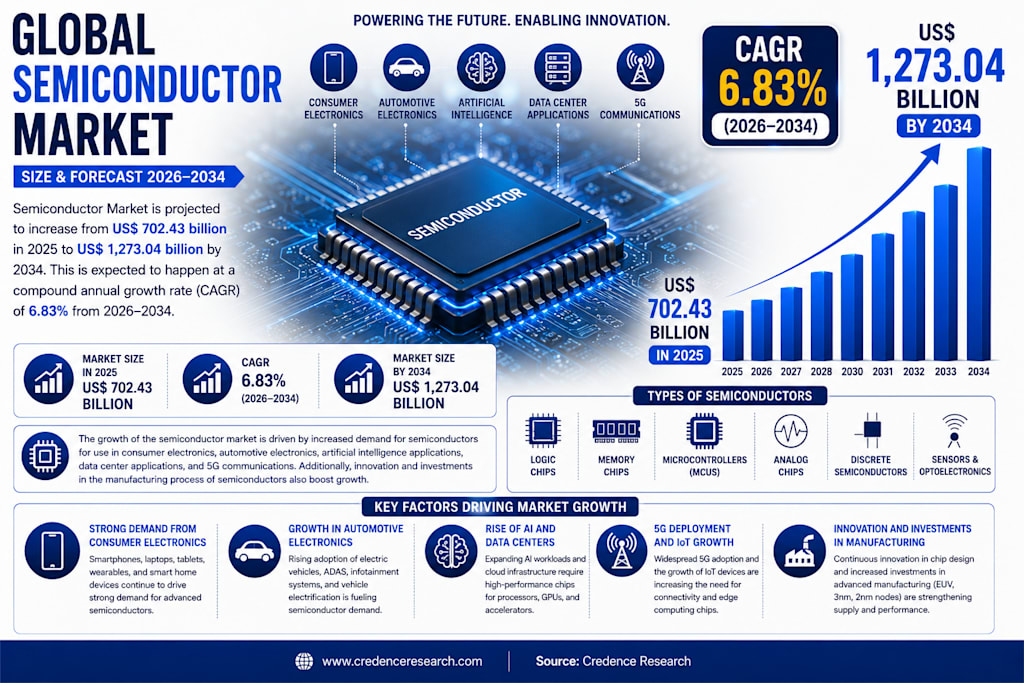
Surging demand across consumer electronics, automotive, and data infrastructure is set to propel the semiconductor market from US$ 702.43 billion in 2025 to US$ 1,273.04 billion by 2034 at a CAGR of 6.83%.

Semiconductor Market Overview
The global semiconductor market is a foundational pillar of the modern digital economy, powering everything from smartphones and laptops to electric vehicles and artificial intelligence systems. Semiconductors are materials with electrical conductivity between conductors and insulators, enabling precise control of electric current—making them essential for integrated circuits, microprocessors, sensors, and memory chips.
According to Renub Research, the semiconductor market is projected to grow from US$ 702.43 billion in 2025 to US$ 1,273.04 billion by 2034, expanding at a CAGR of 6.83% during 2026–2034.
Silicon remains the most widely used semiconductor material, alongside others like germanium and gallium arsenide. These materials form the backbone of modern electronics, supporting digitalization, automation, and connectivity across industries.
The growing reliance on advanced technologies such as artificial intelligence (AI), cloud computing, 5G networks, and electric mobility is significantly boosting the demand for semiconductors worldwide.
Key Growth Drivers in the Semiconductor Market
Rising Demand from Consumer Electronics and Smart Devices
The rapid expansion of consumer electronics is a major driver of semiconductor demand. Devices such as smartphones, laptops, tablets, smart TVs, and wearables rely heavily on advanced chips for processing power, connectivity, and energy efficiency.
As digital lifestyles become more integrated into everyday life, consumers are increasingly demanding high-performance devices with enhanced features such as AI capabilities, advanced cameras, and longer battery life. This trend is driving the need for more sophisticated semiconductor solutions.
In March 2023, Samsung Electronics announced a massive USD 230 billion investment to develop the world’s largest semiconductor production base in South Korea, highlighting the scale of demand and industry commitment to innovation.
Expansion of Automotive Electronics and Electric Vehicles
The automotive industry is emerging as a key growth engine for the semiconductor market. Modern vehicles are increasingly equipped with advanced electronics for safety, connectivity, infotainment, and energy management.
Electric vehicles (EVs) require significantly more semiconductors than traditional vehicles, particularly for battery management systems, power electronics, and motor control. Autonomous driving technologies further increase demand for high-performance processors and AI chips.
In November 2025, iDEAL Semiconductor introduced its SuperQ MOSFET, designed to enhance safety and efficiency in high-voltage EV battery systems, reflecting ongoing innovation in automotive semiconductors.
Growth of Data Centers, AI, and 5G Infrastructure
The expansion of data centers, AI applications, and 5G networks is another major driver of semiconductor market growth. Cloud computing, big data analytics, and AI-driven services require high-performance chips capable of processing large volumes of data efficiently.
The rollout of 5G technology is increasing demand for advanced communication chips and network processors. Organizations are investing heavily in data center infrastructure to support digital transformation and cloud-based services.
In November 2025, Sutherland launched an AI-enabled private 5G network solution in partnership with Celona, highlighting the integration of semiconductors in next-generation connectivity solutions.
Challenges in the Semiconductor Market
Supply Chain Complexity and Geopolitical Risks
The semiconductor supply chain is highly complex and globalized, involving multiple stages such as raw material sourcing, wafer fabrication, assembly, and testing. Geopolitical tensions, trade restrictions, and regional dependencies can disrupt supply chains and impact production.
These challenges have highlighted the need for supply chain diversification and increased domestic manufacturing capabilities in many countries.
High Capital Investment and Technological Complexity
The semiconductor industry requires significant capital investment, particularly for advanced fabrication facilities, which can cost billions of dollars. Rapid technological advancements also demand continuous research and development, increasing operational complexity.
Balancing innovation, cost efficiency, and sustainability is a major challenge for industry players. As technology nodes shrink and performance requirements increase, maintaining competitiveness becomes more difficult.
Segment Insights in the Semiconductor Market
Integrated Circuits (ICs)
Integrated circuits form the backbone of modern electronics, integrating multiple components onto a single chip. They are widely used in consumer electronics, telecommunications, and industrial applications.
Memory Semiconductors
Memory chips such as DRAM and NAND flash are essential for data storage and processing in devices and data centers. The growth of cloud computing and AI is driving demand for high-capacity and high-speed memory solutions.
Micro Semiconductors
Microprocessors and microcontrollers act as the “brains” of electronic devices, enabling computation, control, and real-time processing. These components are critical in applications such as IoT, industrial automation, and smart appliances.
Automotive Semiconductors
Automotive semiconductors are used in powertrain systems, safety features, infotainment, and autonomous driving technologies. The shift toward electric and connected vehicles is significantly increasing demand in this segment.
Aerospace and Defense Semiconductors
This segment includes high-performance chips used in radar systems, avionics, satellite communications, and defense electronics. These semiconductors must meet strict standards for reliability and durability.
Regional Insights in the Semiconductor Market
United States
The United States is a global leader in semiconductor innovation, with strong capabilities in chip design, research, and advanced manufacturing. Demand is driven by AI, cloud computing, automotive, and defense applications.
United Kingdom
The UK focuses on semiconductor design and specialized applications, particularly in compound semiconductors. Government support and research initiatives are driving innovation in this market.
India
India’s semiconductor market is growing rapidly due to increasing demand from consumer electronics, automotive, and digital infrastructure sectors. Government initiatives are supporting the development of domestic manufacturing capabilities.
Saudi Arabia
Saudi Arabia’s market is expanding with investments in smart cities, digital infrastructure, and industrial transformation. Demand is driven by applications in telecommunications, energy, and automation.
Market Segmentation
The semiconductor market is segmented by device type, application, and geography. Device types include integrated circuits, memory, logic, micro, analog, optoelectronics, and sensors.
Applications span automotive, industrial, data centers, telecommunications, consumer electronics, aerospace, healthcare, and more. Geographically, the market covers North America, Europe, Asia-Pacific, Latin America, and the Middle East & Africa.
Key Companies in the Semiconductor Market
Leading companies in the market include Broadcom Inc., Infineon Technologies AG, Intel Corporation, Micron Technology Inc., NXP Semiconductors N.V., Samsung Electronics Co. Ltd., and Toshiba Corporation. These companies are driving innovation through advanced chip design, manufacturing processes, and strategic investments.
Final Thoughts
The semiconductor market is at the heart of global technological advancement, enabling innovation across industries and driving the digital economy forward. From AI and 5G to electric vehicles and smart devices, semiconductors are essential for the future of connectivity and automation.
While challenges such as supply chain complexity and high capital requirements remain, strong demand, continuous innovation, and strategic investments position the market for sustained long-term growth. As digital transformation accelerates worldwide, semiconductors will continue to play a critical role in shaping the future of technology.
About the Creator
Enjoyed the story? Support the Creator.
Subscribe for free to receive all their stories in your feed.
Comments
There are no comments for this story
Be the first to respond and start the conversation.