
Saudi Arabia Smart Hospital Market Expands Rapidly as Vision 2030 Accelerates Healthcare Digitalization
Renub Research highlights strong growth in Saudi Arabia’s smart hospital industry as AI, IoT, telemedicine, and connected healthcare infrastructure reshape patient care across the Kingdom.

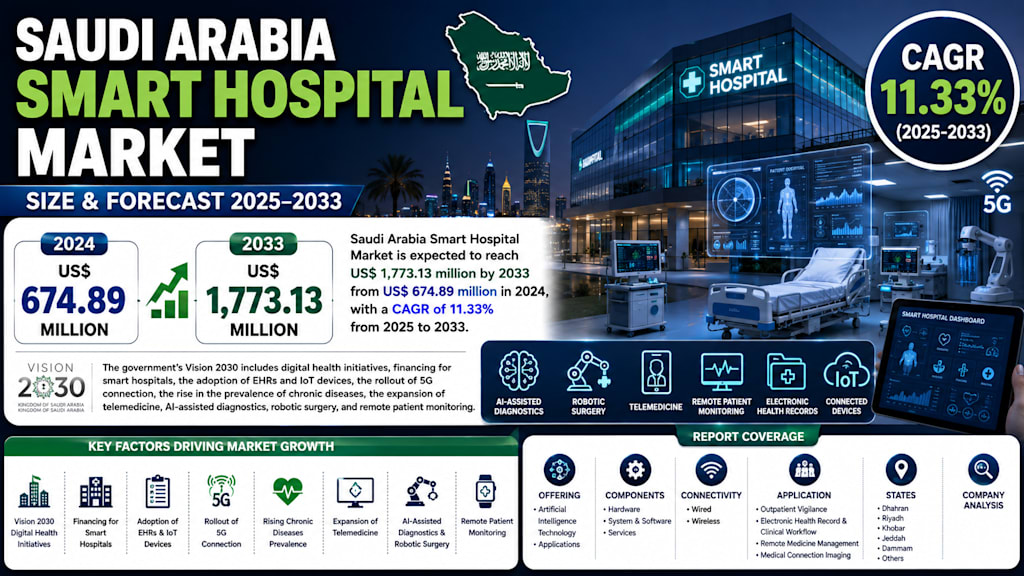
Saudi Arabia Smart Hospital Market Overview
Saudi Arabia’s healthcare sector is undergoing a major technological transformation as hospitals increasingly adopt digital systems, automation, artificial intelligence, and connected healthcare platforms. According to Renub Research, the Saudi Arabia Smart Hospital Market is projected to reach US$ 1,773.13 million by 2033 from US$ 674.89 million in 2024, growing at a CAGR of 11.33% from 2025 to 2033. Key growth drivers include Vision 2030 healthcare initiatives, increasing use of electronic health records (EHRs), telemedicine expansion, AI-assisted diagnostics, robotic surgery, remote patient monitoring, and the deployment of 5G infrastructure across the Kingdom.
Saudi Arabia’s smart hospital ecosystem is evolving rapidly due to the government’s focus on healthcare modernization and digital innovation. Hospitals across the country are integrating technologies such as artificial intelligence, Internet of Things (IoT), robotics, cloud computing, and remote monitoring systems to improve operational efficiency and patient outcomes. Smart hospitals are increasingly designed around connected infrastructure, automated clinical workflows, and data-driven healthcare delivery models.
The transformation is not limited to technology alone. Saudi Arabia is also prioritizing patient-centered healthcare by improving access to digital services, reducing administrative burdens on healthcare workers, and enhancing clinical decision-making through real-time data systems. Sustainability is another important factor, as hospitals adopt energy-efficient infrastructure and smart resource management solutions in line with global healthcare trends.
Growth Drivers of the Saudi Arabia Smart Hospital Market
One of the strongest growth drivers is the Saudi government’s Vision 2030 strategy. Healthcare modernization forms a central part of the Kingdom’s broader economic and social transformation agenda. Through the Health Sector Transformation Program, the government is investing heavily in digital health infrastructure, smart hospitals, workforce training, and advanced healthcare technologies. These initiatives are designed to create a more integrated, efficient, and sustainable healthcare system throughout the country.
Government support includes funding programs, regulatory reforms, strategic partnerships with international technology companies, and digital capability-building initiatives. These measures are accelerating the adoption of smart technologies in both public and private healthcare institutions. The government’s long-term objective is to position Saudi Arabia as a regional leader in digital healthcare and medical innovation.
Another major growth factor is the modernization of healthcare infrastructure. Saudi Arabia is investing significantly in upgrading hospitals and clinics with advanced medical equipment, cloud-based systems, robotic technologies, and IoT-enabled monitoring solutions. Existing facilities are being redesigned to support digital operations, while new smart hospitals are being constructed with integrated AI, 5G connectivity, telemedicine capabilities, and remote patient monitoring systems.
The increasing use of digital health solutions is also transforming healthcare delivery across the Kingdom. Hospitals are rapidly adopting electronic health records (EHRs) to centralize patient information and improve continuity of care. Telemedicine services are helping expand healthcare access, particularly in rural and underserved areas. Mobile health applications now allow patients to schedule appointments, access medical records, receive health education, and monitor chronic conditions remotely.
Artificial intelligence is becoming one of the most influential technologies within Saudi Arabia’s smart hospital market. AI-powered tools are increasingly used for diagnostics, clinical decision support, risk prediction, and workflow optimization. AI applications are helping healthcare providers move toward more personalized, predictive, and proactive care models.
Challenges Facing the Smart Hospital Industry
Despite rapid growth, the smart hospital market still faces several operational and financial challenges. One of the biggest barriers is the high cost of implementation. Building a smart hospital requires significant investment in advanced infrastructure, connected devices, software systems, automation platforms, cybersecurity tools, and staff training. The integration of AI systems, telemedicine networks, IoT devices, and EHR platforms can place substantial financial pressure on healthcare institutions, particularly smaller private providers.
Another major concern is cybersecurity and data privacy. Smart hospitals rely heavily on cloud-based systems, digital records, connected medical devices, and online communication platforms. This increases the risk of cyberattacks, unauthorized access, and data breaches involving sensitive patient information. Hospitals must continuously invest in encryption technologies, firewalls, multi-factor authentication, and cybersecurity monitoring systems to maintain secure digital healthcare environments.
The lack of standardized cybersecurity practices across healthcare facilities further complicates the situation. As digital healthcare adoption accelerates, ensuring patient trust and regulatory compliance will remain critical for the long-term sustainability of the smart hospital ecosystem in Saudi Arabia.
Artificial Intelligence in Smart Hospitals
Artificial intelligence is emerging as one of the most transformative components of Saudi Arabia’s smart hospital market. AI technologies are being used across diagnostics, imaging, clinical workflows, patient monitoring, and operational management. Hospitals are leveraging machine learning algorithms to identify disease patterns, improve diagnostic accuracy, and support treatment planning.
AI-assisted imaging technologies are particularly valuable for early disease detection and precision medicine. Intelligent systems can analyze medical scans faster and more accurately, helping physicians improve decision-making and reduce treatment delays. AI-powered predictive analytics are also supporting risk management, patient flow optimization, and resource allocation within hospitals.
Telemedicine and Remote Patient Monitoring
Telemedicine has become a major pillar of Saudi Arabia’s digital healthcare strategy. Hospitals and healthcare providers are increasingly offering virtual consultations, remote patient monitoring, and digital follow-up services. This approach improves healthcare access for patients living in remote regions while reducing pressure on physical healthcare facilities.
Remote medicine management systems are also helping hospitals monitor chronic diseases and post-treatment recovery more effectively. Connected devices, wearable sensors, and mobile health applications allow physicians to track patient conditions in real time and intervene quickly when necessary. These technologies are supporting the transition toward preventive and personalized healthcare delivery models.
Riyadh Smart Hospital Market
Riyadh remains the leading hub for smart healthcare innovation in Saudi Arabia. One of the region’s most advanced healthcare institutions is King Faisal Specialist Hospital & Research Centre (KFSHRC), which was recognized among Newsweek’s “World’s Best Smart Hospitals 2025.” The hospital uses artificial intelligence, robotics, telemedicine, digital imaging, and immersive simulation technologies to improve clinical outcomes and patient experiences.
KFSHRC has also established an AI-powered Patient Flow & Capacity Command Centre designed to optimize bed management and reduce waiting times. More than 20 AI applications developed through its Centre for Healthcare Intelligence are currently supporting diagnostics, operations, and healthcare delivery.
Riyadh is also home to Seha Virtual Hospital, described in the report as the world’s largest virtual hospital. The facility is connected to 224 hospitals and offers 44 specialty services through remote healthcare platforms, reinforcing Riyadh’s position as the center of digital healthcare transformation in the Kingdom.
Jeddah Smart Hospital Market
Jeddah is rapidly emerging as another major smart healthcare center in Saudi Arabia. The International Medical Center (IMC) has implemented a “Digital Door” strategy that integrates AI-powered applications to streamline patient interactions and improve healthcare efficiency. Mobile applications such as IMC Doc, Women’s Health App, and My IMC App are supporting digital engagement and healthcare accessibility.
King Faisal Specialist Hospital & Research Centre in Jeddah has also achieved important milestones in robotic surgery, including the region’s first fully robotic liver transplant procedure. Additionally, Andalusia New Hospital is integrating smart rooms and robotic technologies into its infrastructure, reflecting the city’s growing commitment to advanced healthcare innovation.
Dhahran Smart Hospital Market
Dhahran’s smart healthcare environment is strongly influenced by Johns Hopkins Aramco Healthcare (JHAH), one of the leading multispecialty healthcare institutions in the Eastern Province. JHAH has introduced technologies such as Epic Dorothy to streamline home healthcare operations and reduce administrative workloads for clinicians.
The institution has also pioneered AI-supported medical imaging for early cardiac risk diagnosis and introduced robotic-assisted surgical procedures, including minimally invasive colorectal and advanced urological surgeries. JHAH continues to serve as a benchmark for digital healthcare innovation and operational excellence in Saudi Arabia’s Eastern region.
Recent Developments from Key Companies
Koninklijke Philips N.V. continued strengthening its digital healthcare and connected care solutions across the Middle East, focusing on AI-powered imaging, patient monitoring, and hospital automation technologies.
Medtronic Plc expanded its smart healthcare technologies portfolio, particularly in remote patient monitoring, robotic-assisted surgery, and connected medical devices.
SAP SE continued supporting healthcare digitalization through cloud-based healthcare management systems and advanced data analytics solutions for hospitals.
Cerner Corporation enhanced its electronic health record (EHR) capabilities and interoperability solutions to support integrated healthcare delivery systems.
Schneider Electric Healthcare strengthened its role in smart hospital infrastructure through energy management systems, digital building technologies, and sustainable hospital solutions.
King Faisal Specialist Hospital & Research Centre was recognized among Newsweek’s “World’s Best Smart Hospitals 2025,” reinforcing Saudi Arabia’s growing international presence in digital healthcare innovation.
Seha Virtual Hospital expanded its integrated virtual healthcare services across 224 hospitals and 44 specialty areas, making it one of the world’s largest virtual healthcare platforms.
Johns Hopkins Aramco Healthcare implemented Epic Dorothy to improve home healthcare management and operational efficiency within its healthcare network.
International Medical Center in Jeddah expanded its AI-powered healthcare applications through digital engagement platforms and patient-focused mobile solutions.
Andalusia New Hospital integrated smart rooms and robotic technologies into its healthcare infrastructure as part of Saudi Arabia’s broader healthcare modernization strategy.
Final Thoughts
Saudi Arabia’s smart hospital market is rapidly evolving into one of the most technologically advanced healthcare ecosystems in the Middle East. Government-backed healthcare modernization, Vision 2030 initiatives, AI integration, telemedicine growth, and expanding digital infrastructure are transforming the way healthcare services are delivered across the Kingdom. While implementation costs and cybersecurity concerns remain important challenges, the long-term outlook for the sector remains highly positive. As hospitals continue embracing intelligent technologies and connected healthcare systems, Saudi Arabia is positioning itself as a regional leader in smart healthcare innovation and patient-centered digital medicine.
About the Creator
Enjoyed the story? Support the Creator.
Subscribe for free to receive all their stories in your feed.
Comments
There are no comments for this story
Be the first to respond and start the conversation.