
Saudi Arabia Quick Service Restaurant Market to Reach US$ 17.24 Billion by 2034 as Digital Ordering and Youth-Driven Dining Trends Accelerate Growth
Rising food delivery adoption, rapid urban development, and evolving consumer lifestyles are transforming the Saudi Arabia quick service restaurant industry

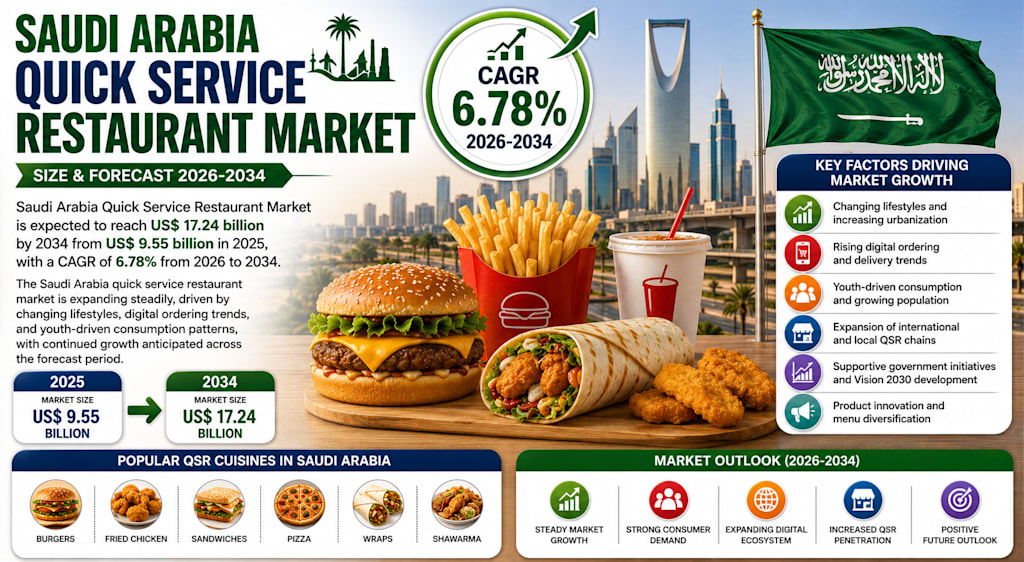
The Saudi Arabia quick service restaurant market is expected to witness steady and sustained expansion over the coming decade as changing lifestyles, increasing urbanization, and rapid digital adoption continue reshaping the country’s foodservice ecosystem. According to Renub Research, the Saudi Arabia quick service restaurant market is projected to grow from US$ 9.55 billion in 2025 to US$ 17.24 billion by 2034, registering a CAGR of 6.78% from 2026 to 2034. Rising demand for convenience dining, expansion of food delivery services, and strong youth-driven consumption patterns are among the key factors supporting long-term market growth across the Kingdom.
The Saudi Arabia quick service restaurant (QSR) industry has evolved into one of the most vibrant segments within the country’s broader foodservice landscape. International fast-food franchises and domestic brands continue expanding aggressively across major cities including Riyadh, Jeddah, Dammam, and Dhahran.
The market offers a diverse range of cuisines including:
- Burgers
- Pizza
- Bakeries
- Ice cream
- Meat-based cuisines
- Traditional Middle Eastern foods
- Asian fast food
- Fusion meals
This diversity reflects Saudi Arabia’s rapidly evolving dining culture and increasing exposure to international food trends.
Young and Expanding Population Is Driving Market Growth
One of the strongest growth drivers for the Saudi Arabia quick service restaurant market is the country’s predominantly young population.
Younger consumers are significantly more inclined toward dining out, experimenting with global cuisines, and embracing fast-food culture. They strongly value convenience, affordability, speed, and digital engagement, making QSRs highly attractive for both daily meals and social experiences.
The report highlights that urban migration among younger populations for employment and education has concentrated demand in major cities, encouraging aggressive QSR expansion.
Social media and digital marketing also strongly influence younger consumer behavior. Exposure to global food trends through online platforms continues increasing demand for branded restaurant experiences and innovative menu offerings.
As Saudi Arabia’s young population continues growing and gaining purchasing power, it is expected to remain one of the most important long-term drivers of QSR industry expansion.
Expansion of the Food Delivery Ecosystem Is Transforming the Industry
The rapid development of Saudi Arabia’s food delivery ecosystem has fundamentally reshaped the operational structure of the QSR market.
Consumers increasingly rely on mobile applications and online platforms to order meals because of convenience, time savings, and broader menu accessibility. QSR operators are actively investing in digital ordering systems and partnering with third-party delivery platforms to strengthen customer reach.
The rise of digital ordering has introduced several major consumer benefits including:
- Real-time order tracking
- Multiple payment methods
- Promotional discounts
- Faster delivery services
- Personalized ordering experiences
Cloud kitchens and delivery-only restaurant models are also becoming increasingly popular because they reduce operational costs while improving delivery efficiency.
The report highlights that rising smartphone penetration and expanding internet connectivity are strongly supporting this digital transformation across Saudi Arabia.
As digital food ordering continues becoming more integrated into everyday consumer behavior, online delivery channels are expected to remain one of the strongest contributors to QSR market growth.
Urban Development and Changing Lifestyles Continue Supporting Expansion
Rapid urban development across Saudi Arabia is significantly influencing dining habits and consumer food preferences.
As cities modernize and expand, consumers increasingly adopt fast-paced lifestyles that reduce the amount of time available for home cooking. This shift has increased reliance on convenient and accessible meal options offered by quick service restaurants.
The development of:
- Shopping malls
- Commercial districts
- Entertainment hubs
- Residential communities
- Transportation infrastructure
has created ideal environments for QSR expansion throughout the Kingdom.
The report also highlights that rising numbers of dual-income households and working women are contributing to stronger demand for dining out and takeaway food options.
Improved road networks and delivery logistics further strengthen accessibility for consumers seeking quick meal solutions.
Technology Integration Is Enhancing Customer Experience
Technology adoption continues playing a transformative role within the Saudi Arabia quick service restaurant market.
Restaurants increasingly implement advanced technologies including:
- Self-service kiosks
- Digital menus
- Contactless payment systems
- AI-driven ordering solutions
- Mobile loyalty applications
These innovations improve customer convenience while helping operators reduce waiting times and improve operational efficiency.
Consumers increasingly expect seamless digital experiences when interacting with restaurant brands.
The report highlights that technological integration not only enhances operational performance but also helps QSR companies remain competitive within a rapidly evolving market environment.
Digital transformation is therefore becoming essential for long-term market competitiveness across Saudi Arabia’s QSR sector.
Government Initiatives and Tourism Development Are Creating New Opportunities
Saudi Arabia’s economic diversification and tourism development strategies are creating major growth opportunities for the QSR industry.
Government initiatives focused on entertainment, tourism, and urban infrastructure are increasing consumer activity across shopping centers, leisure destinations, and commercial districts where QSR outlets thrive.
Major tourism projects and entertainment investments continue attracting both domestic and international visitors, strengthening demand for fast and convenient dining solutions.
The Kingdom’s Vision 2030 initiatives are also encouraging broader private-sector investment and modernization across retail and hospitality industries.
These developments continue supporting long-term expansion opportunities for both international franchises and regional restaurant operators.
Health-Conscious Consumer Preferences Are Influencing Menu Innovation
Changing consumer attitudes regarding health and wellness are reshaping menu strategies across the Saudi Arabia QSR market.
Consumers are becoming increasingly aware of nutrition, ingredient quality, and healthier eating habits. Traditional fast-food products are increasingly viewed as high in calories, fats, and sugars.
As a result, QSR operators are introducing healthier menu alternatives such as:
- Salads
- Grilled meals
- Low-calorie items
- Protein-focused options
- Plant-based alternatives
The report highlights that balancing convenience, affordability, and healthier food choices remains a key challenge for restaurant brands.
Consumers also increasingly expect transparency regarding ingredient sourcing and food quality, encouraging operators to improve menu diversity and nutritional positioning.
Cloud Kitchens Are Emerging as a Fast-Growing Business Model
Cloud kitchens are becoming increasingly important within Saudi Arabia’s evolving quick service restaurant landscape.
Delivery-only kitchens allow operators to expand market reach without requiring significant investment in dine-in infrastructure.
This model is especially attractive in densely populated urban areas where commercial real estate costs remain high.
Cloud kitchens offer several operational advantages including:
- Lower overhead costs
- Faster scalability
- Delivery optimization
- Flexible menu experimentation
- Improved operational efficiency
The continued growth of food delivery applications is expected to further accelerate adoption of cloud kitchen models throughout Saudi Arabia.
High Operational and Setup Costs Remain Major Challenges
Despite strong growth prospects, the Saudi Arabia quick service restaurant market faces several operational challenges.
One of the most significant issues is the high cost of operating QSR businesses across major cities.
Expenses related to:
- Commercial rent
- Labor
- Utilities
- Technology investments
- Supply-chain management
continue affecting profitability across the industry.
Prime retail locations in urban centers often involve extremely high leasing costs, creating barriers for smaller operators and new entrants.
Maintaining service quality, consistent customer experiences, and technological upgrades also requires continuous investment.
The report highlights that fluctuating raw material prices and logistical costs can further pressure operating margins.
Evolving Consumer Preferences Continue Creating Pressure
Consumer preferences within Saudi Arabia are evolving rapidly, requiring QSR operators to remain highly adaptable.
Customers increasingly expect:
- Better ingredient quality
- Diverse menu options
- Healthier choices
- Localized offerings
- Digital convenience
- Strong brand values
Balancing innovation with operational efficiency and cost control remains challenging for restaurant operators.
Cultural preferences and dietary expectations also require brands to localize menus while maintaining operational consistency across outlets.
The ability to adapt quickly to changing consumer behavior will remain essential for long-term market success.
Riyadh Remains the Largest and Most Competitive Market
Riyadh represents the largest and most competitive quick service restaurant market in Saudi Arabia.
As the country’s capital and largest city, Riyadh benefits from a large population base, high commercial activity, and strong consumer spending power.
QSR outlets are widely distributed across:
- Shopping malls
- Residential communities
- Business districts
- Entertainment destinations
Digital ordering and delivery services are particularly well developed within Riyadh because of the city’s young and technology-oriented population.
The report highlights that Riyadh continues serving as a key center for restaurant innovation and expansion across Saudi Arabia.
Jeddah Market Benefits from Tourism and Cultural Diversity
Jeddah’s QSR market continues expanding due to its position as a major commercial, tourism, and cultural center.
The city attracts residents, expatriates, and international visitors, creating strong demand for diverse and convenient dining options.
QSR outlets are strategically located across shopping centers, transportation hubs, and waterfront destinations to maximize accessibility and foot traffic.
The growth of online food delivery platforms has further strengthened market accessibility and consumer convenience across Jeddah.
Dammam and Dhahran Continue Supporting Regional Expansion
The Dammam quick service restaurant market is growing steadily because of increasing urbanization, industrial activity, and rising disposable incomes.
Commercial districts, residential communities, and transportation corridors continue supporting strong demand for convenient meal options.
Meanwhile, Dhahran’s QSR market benefits from its role as a residential and business hub serving professionals, students, and families.
Digital ordering adoption and delivery services continue supporting restaurant accessibility throughout both cities.
Recent Developments Highlight Strong Industry Momentum
Several major developments demonstrate the rapid evolution of the Saudi Arabia quick service restaurant market.
In April 2025, Pret A Manger opened its first Saudi Arabian location in Riyadh’s Olaya Towers as part of its broader Gulf Cooperation Council expansion strategy.
Also in April 2025, OOMCO partnered with Fresh Food Company Ltd., operator of “I’m Hungry,” to establish fast-food restaurants at four service stations in Saudi Arabia’s Eastern Province.
In February 2025, Foodics COO Djamel Mohand resigned after helping expand the platform to over 30,000 restaurants across 25 countries while supporting digital transformation within the QSR sector.
Additionally, Dunkin opened its 800th store in Saudi Arabia in partnership with Shahia Food Limited Company during October 2024.
These developments reflect the strong momentum and innovation shaping the Saudi Arabia QSR industry.
Key Companies Operating in the Saudi Arabia Quick Service Restaurant Market
Major companies operating in the Saudi Arabia quick service restaurant market include AlAmar Foods, ALBAIK, Americana Restaurants, Apparel Group, Fawaz Abdulaziz AlHokair Company, Galadari Ice Cream, Herfy Food Services, Kudu Company, and M.H. Alshaya.
These companies compete through menu innovation, digital ordering technologies, delivery optimization, franchise expansion, and customer-focused dining experiences.
Final Thoughts
The Saudi Arabia quick service restaurant market is entering a period of sustained expansion driven by urbanization, youth-driven consumption, digital transformation, and evolving dining habits.
Online food delivery ecosystems, cloud kitchens, technology integration, and rising demand for convenience dining are fundamentally reshaping the country’s foodservice landscape. According to Renub Research, the market is projected to reach US$ 17.24 billion by 2034, reflecting strong long-term growth opportunities across the Kingdom.
However, operators must continue navigating operational costs, changing health preferences, and intense competition. Companies that successfully combine convenience, innovation, digital efficiency, healthier menu offerings, and localized customer experiences are likely to lead the next phase of growth within Saudi Arabia’s evolving quick service restaurant industry.
About the Creator
Enjoyed the story? Support the Creator.
Subscribe for free to receive all their stories in your feed.
Comments
There are no comments for this story
Be the first to respond and start the conversation.