
Saudi Arabia IVF Market Set to Reach US$ 522 Million by 2033 as Fertility Technology and Delayed Parenthood Drive Growth
Rising infertility rates, technological breakthroughs, supportive healthcare policies, and changing social attitudes are transforming Saudi Arabia into a leading destination for advanced fertility treatments.

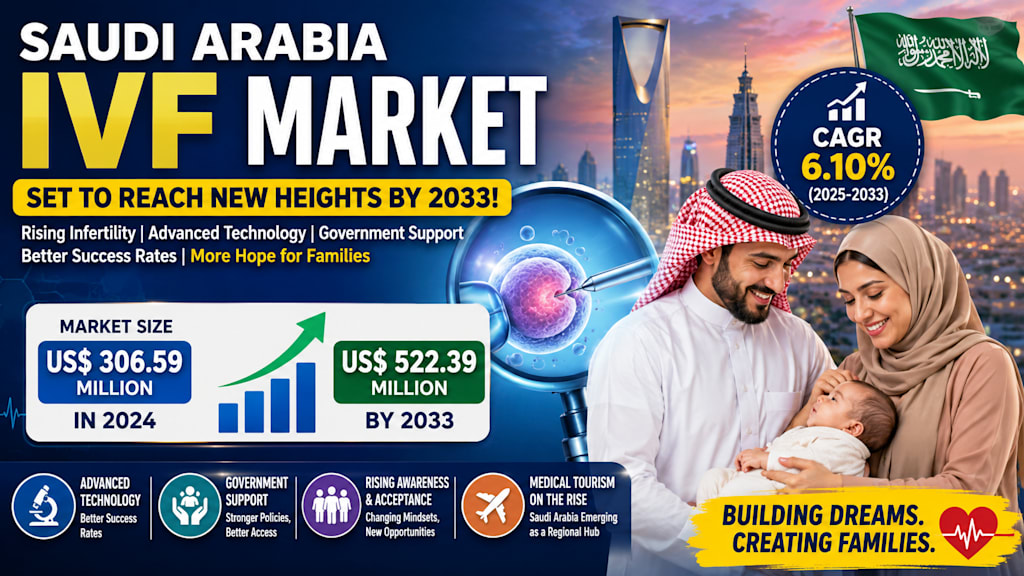
Saudi Arabia IVF Market Set for Significant Expansion Through 2033
The healthcare landscape in Saudi Arabia is undergoing a remarkable transformation, and one of the most rapidly evolving segments is the in vitro fertilization (IVF) market. As infertility challenges continue to rise worldwide, Saudi Arabia is witnessing increasing demand for advanced reproductive technologies that help couples achieve parenthood.
According to Renub Research, the Saudi Arabia IVF Market is projected to grow from US$ 306.59 million in 2024 to US$ 522.39 million by 2033, expanding at a CAGR of 6.10% between 2025 and 2033. This growth reflects changing social dynamics, rising healthcare investments, technological advancements, and stronger government support for reproductive health services.
As more Saudi families seek fertility solutions, IVF is becoming a critical component of the nation's healthcare ecosystem.
Understanding IVF and Its Growing Importance
In Vitro Fertilization, commonly known as IVF, is a medical procedure designed to help individuals and couples facing infertility challenges. The process involves fertilizing an egg with sperm in a laboratory environment before transferring the resulting embryo into the uterus.
IVF has become a widely accepted solution for numerous fertility-related conditions, including:
Blocked fallopian tubes
Male infertility
Ovulation disorders
Age-related fertility decline
Unexplained infertility
Modern IVF procedures often incorporate advanced technologies such as genetic screening, embryo freezing, hormone therapies, and specialized laboratory techniques that significantly improve pregnancy success rates.
As awareness grows and treatment outcomes improve, more Saudi families are considering IVF as a viable pathway to parenthood.
Delayed Parenthood Is Reshaping Fertility Trends
One of the most influential factors driving Saudi Arabia's IVF market growth is delayed parenthood.
Today's younger generation increasingly prioritizes higher education, professional advancement, financial stability, and personal development before starting families. While these societal shifts create opportunities for individuals, they also contribute to declining fertility rates as biological fertility naturally decreases with age.
Women are increasingly choosing to delay childbirth until their 30s or later, resulting in higher demand for assisted reproductive technologies. As fertility challenges become more common among older prospective parents, IVF offers an effective and scientifically proven solution.
The trend is particularly visible in urban centers where career aspirations and evolving lifestyles are reshaping traditional family planning timelines.
Technological Innovation Is Improving IVF Success Rates
Technology continues to revolutionize fertility treatment worldwide, and Saudi Arabia is benefiting from these advancements.
Innovations such as:
Intracytoplasmic Sperm Injection (ICSI)
Preimplantation Genetic Testing (PGT)
Embryo Vitrification
Advanced Cryopreservation
AI-assisted Embryo Selection
have significantly increased IVF success rates while reducing treatment risks.
These technologies provide fertility specialists with greater precision and allow patients to receive highly personalized treatment plans.
A notable development occurred in September 2024 when Burjeel Holdings announced plans to expand IVF services into Saudi Arabia through its Trust Fertility Clinic model. The initiative aims to integrate fertility care with gynecology, fetal medicine, pediatrics, and neonatal services, creating a comprehensive reproductive healthcare ecosystem.
Such investments demonstrate growing confidence in the Saudi fertility sector and reinforce the country's ambition to become a regional healthcare leader.
Government Support Is Strengthening Market Growth
Saudi Arabia's Vision 2030 initiative has accelerated healthcare modernization across the Kingdom, and fertility care is benefiting from this momentum.
Government support includes:
Regulatory oversight through the Ministry of Health
Licensing of fertility clinics
Investments in healthcare infrastructure
Support programs for eligible IVF patients
Expansion of specialized reproductive health centers
These measures have helped improve treatment accessibility while ensuring high standards of quality and patient safety.
The government's focus on healthcare diversification and medical excellence is creating a favorable environment for both local and international fertility providers.
As a result, Saudi Arabia is increasingly attracting patients from neighboring countries seeking advanced reproductive treatments.
Rising Healthcare Investments Create New Opportunities
Saudi Arabia has significantly increased healthcare spending over the past decade.
New hospitals, fertility clinics, research centers, and specialized medical facilities are helping improve patient access to sophisticated reproductive services.
Private-sector investments are also accelerating innovation and service expansion. International healthcare providers increasingly view Saudi Arabia as a strategic market due to its growing population, rising healthcare expenditure, and commitment to healthcare transformation.
This investment wave is contributing to:
Better fertility treatment outcomes
Expanded service availability
Enhanced patient experiences
Greater access to advanced technologies
Together, these factors are creating a strong foundation for long-term market growth.
Medical Tourism Is Emerging as a Growth Catalyst
Saudi Arabia is positioning itself as a destination for specialized healthcare services, including fertility treatments.
Modern fertility clinics equipped with state-of-the-art technologies and internationally trained specialists are attracting patients from across the Middle East and beyond.
The country's improving healthcare infrastructure, combined with government initiatives to strengthen medical tourism, is expected to further increase demand for IVF services.
As healthcare standards continue to rise, Saudi Arabia may become one of the region's most important fertility treatment hubs.
Challenges Facing the Saudi Arabia IVF Market
Despite strong growth prospects, several challenges continue to affect market expansion.
Cultural and Religious Considerations
Saudi Arabia's healthcare system operates within a framework guided by Islamic principles.
Certain fertility practices, including surrogacy and third-party gamete donation, face restrictions due to religious considerations. While these guidelines preserve cultural values, they also limit some treatment options available elsewhere.
Additionally, infertility can still carry social stigma in certain communities, discouraging open discussions and delaying treatment seeking behavior.
Greater public awareness and educational initiatives may help address these barriers over time.
High Treatment Costs
Cost remains one of the most significant obstacles to wider IVF adoption.
IVF procedures often require multiple treatment cycles, specialized laboratory procedures, and advanced medical expertise, all of which contribute to high expenses.
Although government support exists for some patients, many individuals still face substantial out-of-pocket costs. Limited insurance coverage for fertility treatments can further restrict access, particularly among middle-income families.
Expanding insurance support and improving affordability will be crucial for unlocking future market potential.
10 Recent Developments Shaping the Saudi Arabia IVF Industry
1. Burjeel Holdings Expands IVF Services into Saudi Arabia
The healthcare provider announced plans to introduce integrated fertility services in the Kingdom through its Trust Fertility Clinic network.
2. KFSHRC Researchers Identify PLCζ Infertility Breakthrough
Scientists at King Faisal Specialist Hospital & Research Centre highlighted the critical role of PLCζ protein in embryo implantation and fertility success.
3. Increased Adoption of Preimplantation Genetic Testing
Clinics are increasingly using genetic screening technologies to improve embryo selection and treatment outcomes.
4. Expansion of Advanced Embryo Freezing Technologies
Vitrification techniques continue to improve embryo preservation success rates.
5. Growing Demand for ICSI Procedures
Intracytoplasmic sperm injection remains one of the fastest-growing fertility treatment methods.
6. Rising Private Investment in Fertility Centers
Domestic and international investors are expanding fertility care infrastructure.
7. Al Hokail Hospital Recognized for IVF Excellence
The hospital earned recognition for advanced fertilization, embryo preservation, and fertility treatment capabilities.
8. Integration of Fertility Services with Women's Healthcare
More providers are combining IVF, obstetrics, gynecology, and neonatal care under one healthcare model.
9. Enhanced Regulatory Oversight
Government authorities continue strengthening fertility clinic standards and patient safety requirements.
10. Growth of Medical Tourism Initiatives
Saudi Arabia is increasingly promoting specialized healthcare services, including fertility treatment, to regional patients.
Competitive Landscape
Several leading global and regional companies are actively participating in Saudi Arabia's IVF ecosystem, helping drive innovation and technological advancement.
Key industry participants include:
FUJIFILM Holdings Corporation
Hamilton Thorne Ltd.
Vitrolife AB
Thermo Fisher Scientific, Inc.
Bayer AG
Merck & Co., Inc.
Boston IVF
Fortis Healthcare
These organizations continue investing in research, product development, and strategic partnerships to strengthen their market positions.
Final Thoughts
Saudi Arabia's IVF market is entering a period of sustained expansion driven by demographic changes, technological progress, government support, and rising awareness of fertility treatments.
With the market expected to surpass US$ 522 million by 2033, fertility services are becoming an increasingly important pillar of the Kingdom's healthcare transformation agenda. As advanced reproductive technologies become more accessible and socially accepted, thousands of aspiring parents may benefit from new opportunities to build families.
The combination of innovation, investment, and healthcare modernization places Saudi Arabia in a strong position to become one of the Middle East's leading fertility treatment destinations in the coming decade.
About the Creator
Enjoyed the story? Support the Creator.
Subscribe for free to receive all their stories in your feed.
Comments
There are no comments for this story
Be the first to respond and start the conversation.