
Saudi Arabia Hotel Market Booms as Vision 2034 Transforms the Kingdom into a Global Tourism Hub
Religious tourism, mega-projects, international events, and ambitious government investments are reshaping Saudi Arabia’s hospitality industry and creating unprecedented opportunities for hotel operators.

Saudi Arabia is undergoing one of the most ambitious tourism transformations in modern history. Once known primarily for religious pilgrimage and energy exports, the Kingdom is rapidly emerging as a global destination for leisure tourism, business travel, entertainment, and international events.
At the heart of this transformation lies the hotel industry, which plays a critical role in supporting the country's expanding tourism ecosystem. From luxury resorts along the Red Sea coastline to high-rise hotels in Riyadh and pilgrimage-focused accommodations in Makkah and Madinah, hospitality infrastructure is expanding at an unprecedented pace.
Driven by Vision 2030, Saudi Arabia's long-term strategy to diversify its economy beyond oil, the tourism and hospitality sectors have become major pillars of national development. Massive investments in infrastructure, entertainment, transportation, and tourism projects are generating strong demand for hotel accommodations across multiple segments.
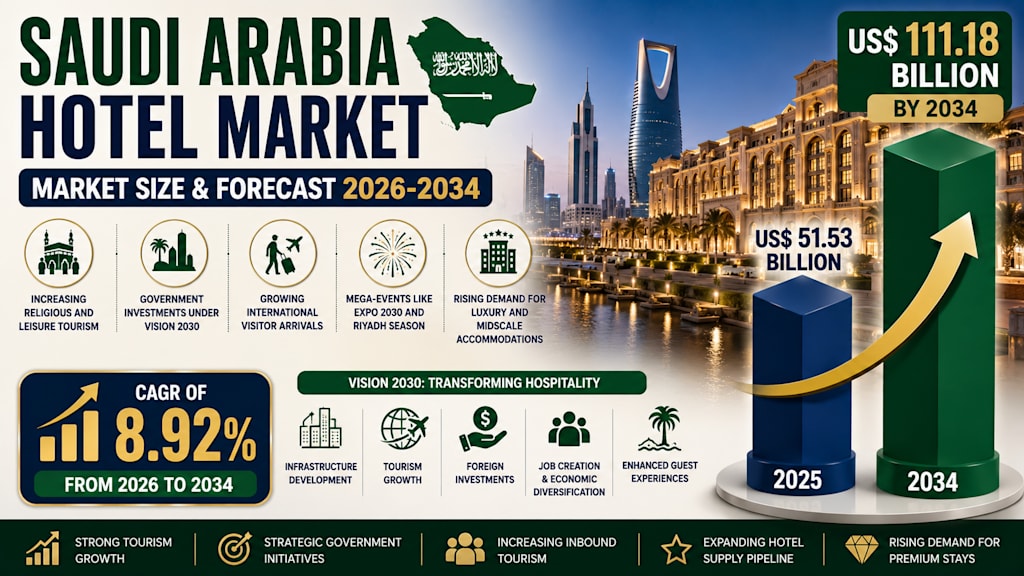
Reflecting this momentum, the Saudi Arabia hotel market is expected to grow from US$ 51.53 billion in 2025 to US$ 111.18 billion by 2034, registering a compound annual growth rate (CAGR) of 8.92% during the forecast period. Rising international arrivals, increasing domestic travel, religious tourism, mega-events, and luxury tourism developments are expected to fuel long-term expansion throughout the hospitality sector.
As Saudi Arabia positions itself among the world's leading tourism destinations, hotels are becoming essential drivers of economic growth, employment creation, and visitor experiences.
Religious Tourism Remains the Foundation of Hotel Demand
Religious tourism continues to serve as the backbone of Saudi Arabia's hospitality industry.
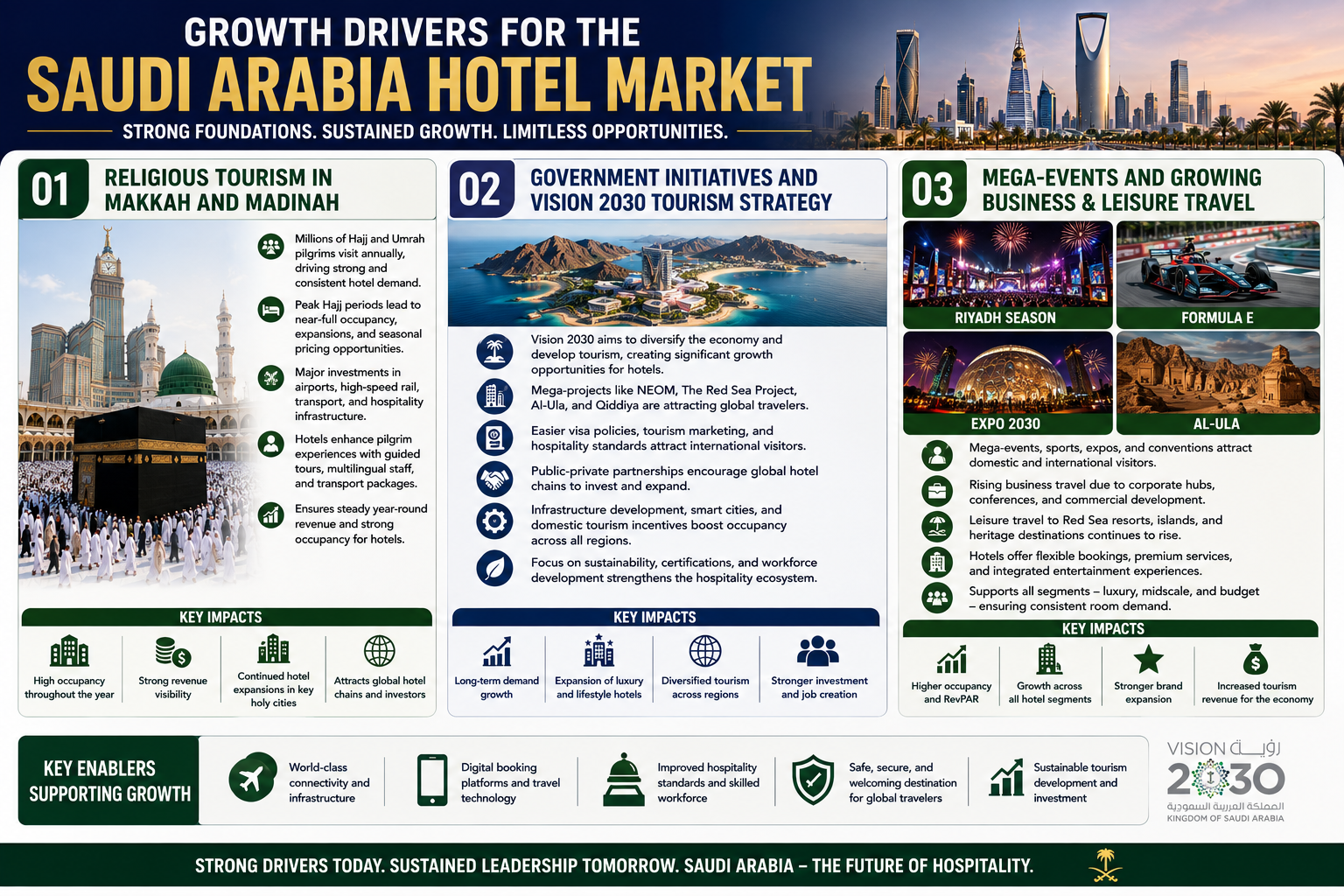
Every year, millions of Muslims travel to the Kingdom to perform Hajj and Umrah, creating one of the largest and most consistent tourism flows in the world. These pilgrimages generate enormous demand for accommodations, transportation, dining services, and hospitality experiences, particularly in Makkah and Madinah.
Hotels located near religious landmarks often experience exceptionally high occupancy rates during pilgrimage seasons. Demand spans every category, from luxury hotels serving international guests to midscale and budget accommodations catering to large groups of pilgrims.
To accommodate growing visitor numbers, Saudi Arabia has invested heavily in transportation infrastructure, including airport expansions, high-speed rail systems, and enhanced urban mobility networks.
Many hotels are also introducing specialized services such as multilingual staff, guided religious tours, transportation assistance, and customized pilgrimage packages designed to improve the overall visitor experience.
Because religious tourism occurs throughout much of the year, it provides a reliable source of revenue that helps support long-term market stability and investment.
Vision 2030 Is Reshaping the Hospitality Landscape
Perhaps no factor has had a greater impact on Saudi Arabia's hotel market than Vision 2030.
Launched as a national economic diversification strategy, Vision 2030 seeks to reduce the country's reliance on oil revenues while expanding sectors such as tourism, entertainment, culture, and technology.
Hospitality development has become a central component of this vision.
The government has introduced numerous initiatives aimed at increasing visitor arrivals, improving tourism infrastructure, and attracting international investment into the hotel sector.
Large-scale projects such as NEOM, the Red Sea Project, Qiddiya, Diriyah Gate, and AlUla are creating entirely new tourism destinations capable of attracting millions of visitors annually.
These developments require extensive hospitality infrastructure, including luxury resorts, boutique hotels, serviced apartments, conference facilities, and integrated entertainment complexes.
As these projects progress, hotel operators are gaining access to significant new growth opportunities across the Kingdom.
Leisure Tourism Is Emerging as a Major Growth Engine
While religious tourism remains dominant, leisure tourism is becoming increasingly important to Saudi Arabia's hospitality industry.
Historically, leisure travel represented a relatively small portion of the Kingdom's tourism sector. However, significant investments in entertainment, culture, sports, and natural attractions are changing this dynamic.
The Red Sea coastline, desert landscapes, historical sites, and cultural destinations are attracting growing numbers of domestic and international tourists seeking unique travel experiences.
Luxury beach resorts, eco-tourism developments, adventure tourism attractions, and heritage preservation projects are expanding the country's tourism appeal beyond pilgrimage travel.
Government efforts to simplify visa processes have further accelerated growth by making the Kingdom more accessible to international visitors.
As leisure tourism continues to gain momentum, demand for hotels across multiple segments is expected to increase substantially.
Mega-Events Are Driving Occupancy Growth
Saudi Arabia has become increasingly active in hosting major international events that attract visitors from around the world.
Large-scale entertainment festivals, sporting events, exhibitions, and business conferences are generating significant demand for hotel accommodations throughout the country.
Riyadh Season has emerged as one of the most prominent entertainment festivals in the region, attracting millions of visitors annually through concerts, sporting events, cultural activities, and family attractions.
The Kingdom has also hosted international sporting events, including Formula E races, boxing championships, football tournaments, and golf competitions.
Looking ahead, Expo 2030 is expected to become one of the most important tourism catalysts in Saudi Arabia's history, bringing millions of international visitors to the country.
These events create immediate occupancy demand while simultaneously enhancing Saudi Arabia's global visibility as a tourism destination.
Hotels across luxury, midscale, and budget segments all benefit from increased visitor traffic generated by major events and conferences.
Business Travel Continues to Expand
Business travel represents another significant source of hotel demand across Saudi Arabia.
Economic diversification efforts are attracting multinational corporations, investors, entrepreneurs, and professionals seeking opportunities within the Kingdom's rapidly evolving economy.
Cities such as Riyadh, Jeddah, Dammam, and Al Khobar have become important business hubs, hosting corporate headquarters, government institutions, financial organizations, and industrial operations.
Hotels serving business travelers increasingly offer conference facilities, meeting rooms, executive lounges, high-speed connectivity, and premium business services.
The growth of international investment, infrastructure projects, and commercial partnerships continues to strengthen demand for business-oriented accommodations.
Unlike seasonal tourism segments, business travel provides year-round occupancy support that contributes to market stability and revenue diversification.
Technology Is Transforming Guest Experiences
The hotel industry is increasingly embracing technology to improve operational efficiency and enhance guest satisfaction.
Modern travelers expect seamless digital experiences throughout their journeys, from booking accommodations to checking out after their stay.
Hotels across Saudi Arabia are investing in smart technologies that support online reservations, mobile check-in services, digital room keys, automated customer service, and personalized guest experiences.
Artificial intelligence and data analytics are helping operators better understand customer preferences while improving pricing strategies and occupancy management.
Cloud-based property management systems allow hotel operators to streamline operations, optimize staffing, and improve service delivery.
As competition intensifies, technology is becoming a critical differentiator for hospitality providers seeking to attract and retain guests.
Challenges Facing the Saudi Arabia Hotel Market
Despite its strong growth prospects, the Saudi Arabia hotel industry faces several challenges.
One of the most notable issues involves seasonal demand fluctuations.
Although religious tourism provides consistent visitor flows, peak pilgrimage periods can create capacity pressures while off-peak seasons may result in lower occupancy rates in certain locations.
Hotels must carefully manage pricing strategies, staffing levels, and operational costs to maintain profitability throughout the year.
Another challenge involves increasing competition.
The entry of international hotel brands and continued expansion by domestic operators have intensified competition across all market segments.
Hotels must differentiate themselves through service quality, unique experiences, technology integration, and pricing strategies.
Regulatory compliance also requires ongoing attention. Hospitality providers must meet evolving standards related to labor practices, environmental sustainability, guest safety, and operational performance.
Maintaining high service quality while managing costs and compliance requirements remains a key challenge for operators throughout the industry.
Key Regional Markets Driving Growth
Makkah remains the largest and most important hotel market in Saudi Arabia due to its role as the center of Islamic pilgrimage. Millions of pilgrims generate continuous demand for accommodations ranging from luxury hotels to budget lodging facilities.
Riyadh serves as the Kingdom's political, financial, and business capital. The city benefits from strong demand driven by corporate travel, government activity, exhibitions, conferences, and large-scale entertainment events.
Madinah continues to experience robust hotel demand due to religious tourism associated with the Prophet's Mosque. Ongoing infrastructure improvements and transportation investments are enhancing visitor accessibility and supporting long-term market growth.
Jeddah functions as a major gateway city for both international travelers and pilgrims. Its strategic location along the Red Sea coast supports a diverse mix of business travel, leisure tourism, and transit-related hospitality demand.
Al Khobar and Dammam also contribute significantly to market expansion through their roles as important commercial and industrial centers within Saudi Arabia's Eastern Province.
Together, these cities form the foundation of the Kingdom's rapidly expanding hospitality sector.
International Hotel Brands Are Expanding Rapidly
Global hotel companies increasingly view Saudi Arabia as one of the most attractive hospitality markets in the world.
Major international operators are expanding their presence through new hotel developments, management agreements, and strategic partnerships.
Luxury, upscale, and midscale brands are actively pursuing opportunities across key tourism and business destinations.
Recent announcements involving international hospitality groups highlight growing confidence in the Kingdom's long-term tourism prospects. New properties, integrated resorts, and branded developments are expected to significantly increase accommodation capacity over the coming decade.
The presence of globally recognized hotel brands also helps attract international visitors by providing familiar service standards and trusted hospitality experiences.
Looking Toward the Future
The future of Saudi Arabia's hotel industry appears exceptionally bright.
Vision 2030 initiatives, tourism diversification efforts, international events, and large-scale infrastructure investments are creating one of the world's most dynamic hospitality markets.
As the Kingdom continues opening itself to global tourism, demand for accommodations across luxury, midscale, and budget segments is expected to remain strong.
Technological innovation, sustainability initiatives, and evolving traveler expectations will likely shape the next phase of industry development.
Hotel operators that successfully combine quality service, digital innovation, and unique guest experiences will be best positioned to capitalize on future opportunities.
Final Thoughts
Saudi Arabia's hospitality industry is experiencing a historic transformation driven by religious tourism, economic diversification, international investment, and ambitious national development initiatives.
With the hotel market projected to grow from US$ 51.53 billion in 2025 to US$ 111.18 billion by 2034, the Kingdom is rapidly establishing itself as one of the most important hospitality destinations in the world. The continued expansion of tourism infrastructure, mega-projects, international events, and business travel will create substantial opportunities for hotel operators and investors alike.
As Vision 2030 continues to reshape the country's economic landscape, the hotel sector will remain at the center of Saudi Arabia's journey toward becoming a globally recognized tourism powerhouse.
About the Creator
Enjoyed the story? Support the Creator.
Subscribe for free to receive all their stories in your feed.
Comments
There are no comments for this story
Be the first to respond and start the conversation.