
Saudi Arabia Ecommerce Market Set to Reach US$69 Billion by 2034 as Digital Shopping Revolution Accelerates
Driven by Vision 2030, rising smartphone adoption, secure digital payments, and a young technology-oriented population, Saudi Arabia's ecommerce industry is entering a new era of rapid expansion.

Saudi Arabia's Digital Economy Is Redefining Retail
Saudi Arabia is undergoing one of the fastest digital transformations in the Middle East, and ecommerce has become one of its biggest success stories. Over the last decade, changing consumer habits, widespread internet access, government-backed digital initiatives, and significant improvements in payment infrastructure have reshaped how people shop for products and services.
Consumers are increasingly choosing online platforms for everything from electronics and fashion to groceries, health products, and home essentials. The convenience of mobile shopping, secure digital payments, same-day delivery, and competitive pricing has made ecommerce an essential part of everyday life.
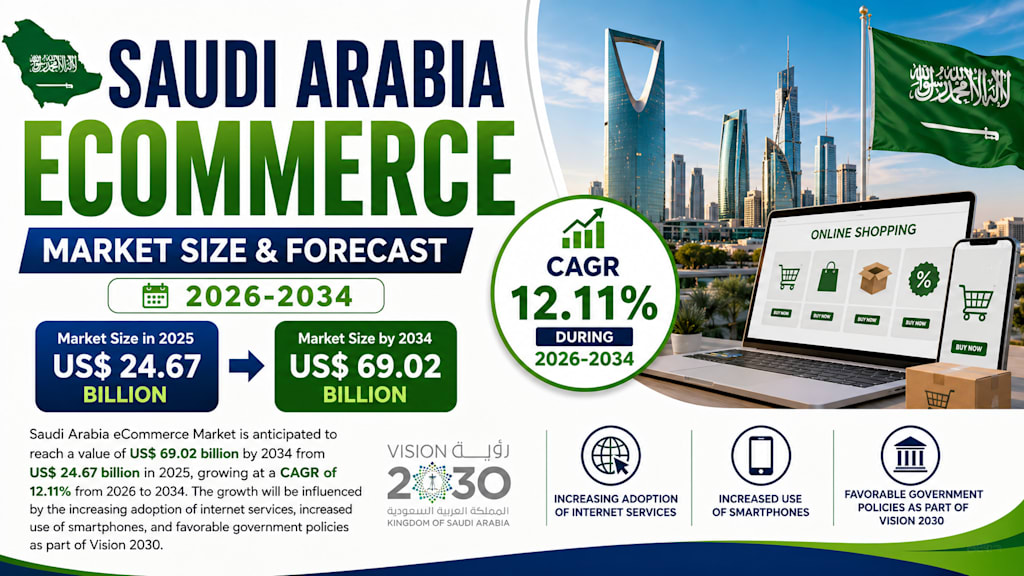
According to the latest market outlook, the Saudi Arabia Ecommerce Market is projected to grow from US$24.67 billion in 2025 to US$69.02 billion by 2034, expanding at an impressive compound annual growth rate (CAGR) of 12.11% during 2026–2034. This remarkable growth highlights the Kingdom's commitment to becoming one of the region's leading digital economies.
Understanding Ecommerce in the Modern Economy
Electronic commerce, commonly known as ecommerce, refers to buying and selling goods and services through digital platforms such as websites, mobile applications, and online marketplaces.
Unlike traditional retail, ecommerce enables customers to compare products, place orders, make secure digital payments, and receive deliveries without visiting physical stores. Modern ecommerce includes multiple business models, including Business-to-Consumer (B2C), Business-to-Business (B2B), and Consumer-to-Consumer (C2C), all supported by advanced logistics and secure payment systems.
Today, ecommerce is no longer simply an alternative shopping channel—it has become a primary retail destination for millions of Saudi consumers.
Vision 2030 Is Accelerating Digital Commerce
One of the strongest factors supporting ecommerce growth is Saudi Arabia's Vision 2030 initiative.
The national transformation strategy focuses heavily on digital innovation, economic diversification, financial inclusion, and smart infrastructure. Government programs encourage businesses to adopt digital technologies while promoting cashless transactions and online services across industries.
These initiatives have significantly improved consumer confidence in online shopping while creating a favorable business environment for both domestic and international ecommerce companies.
As digital transformation continues, ecommerce is expected to become one of the Kingdom's fastest-growing economic sectors.
Internet Penetration and Smartphone Usage Continue to Rise
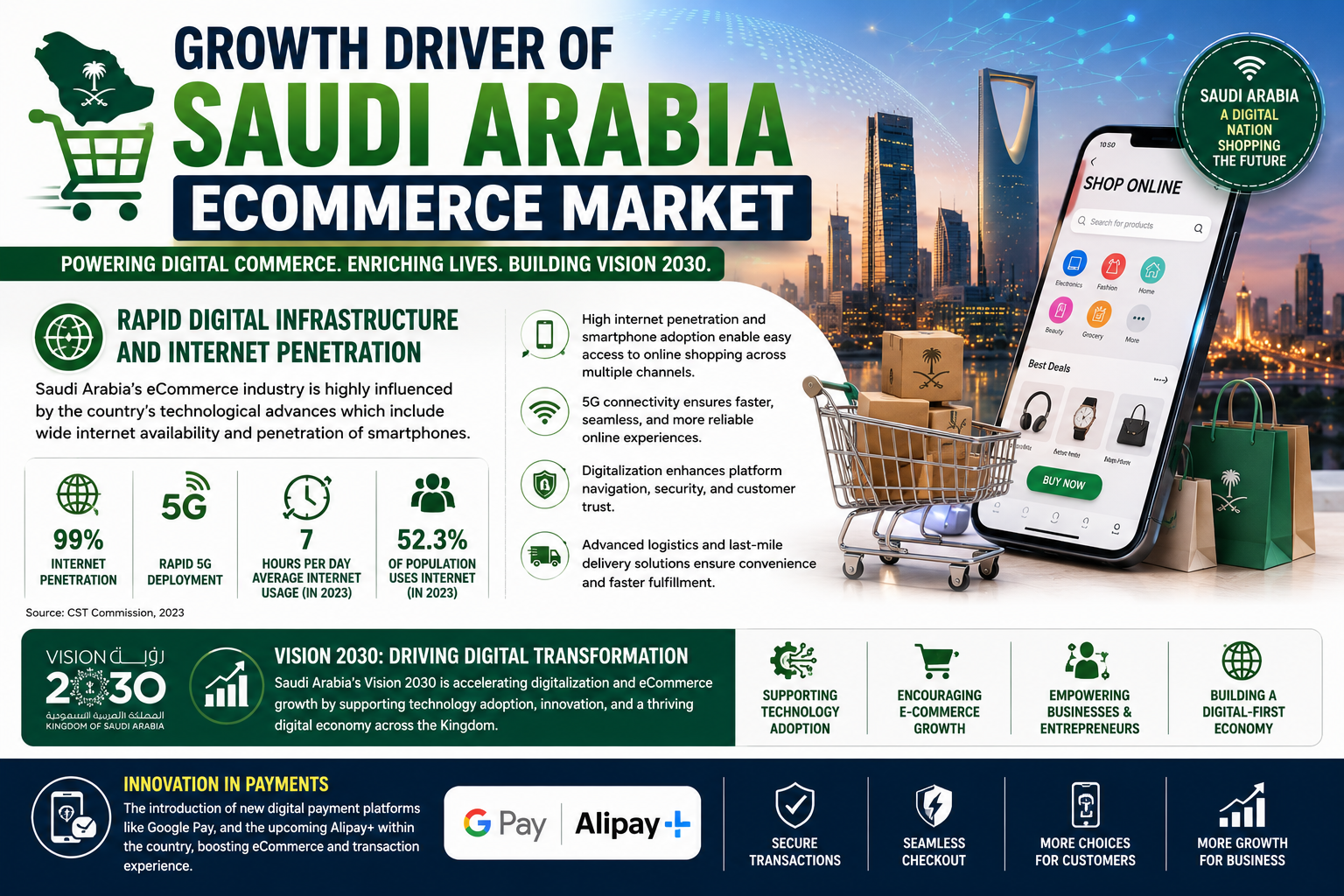
Saudi Arabia enjoys one of the highest internet penetration rates in the world.
With nearly universal internet availability and expanding 5G connectivity, consumers can browse online stores, compare prices, complete purchases, and track deliveries with remarkable ease.
The Communications, Space and Technology Commission (CST) estimated that approximately 52.3% of the Saudi population spent around seven hours online daily during 2023, demonstrating the country's deep digital engagement.
Smartphones have become the preferred shopping device for most consumers. Mobile applications now offer personalized recommendations, secure payment options, loyalty rewards, and real-time order tracking, creating an increasingly seamless customer experience.
The growing adoption of services such as Google Pay and the planned expansion of Alipay+ within Saudi Arabia are further strengthening the country's digital payment ecosystem.
Young Consumers Are Powering Ecommerce Growth
Saudi Arabia's youthful population represents one of the country's greatest competitive advantages.
A significant portion of citizens are under the age of 35, making them highly comfortable with smartphones, mobile banking, social media, and digital commerce.
This generation values convenience, speed, competitive pricing, and personalized shopping experiences. Rather than visiting physical stores, many consumers prefer ordering products directly through mobile applications with home delivery available within hours.
Artificial intelligence is also transforming online retail by providing customized recommendations, predictive search functions, and targeted promotions that improve customer satisfaction and increase purchasing activity.
Digital Payments Have Become More Secure
One of the biggest contributors to ecommerce growth has been the rapid development of secure digital payment infrastructure.
Consumers increasingly trust electronic payment methods due to stronger cybersecurity, government regulations, and continuous fintech innovation.
Credit cards, debit cards, digital wallets, and mobile payment applications have significantly reduced reliance on cash transactions.
In 2024, Mastercard introduced a domestic ecommerce payment processing platform in Saudi Arabia designed to improve payment efficiency for merchants and customers.
Financial technology company Barq also partnered with Mastercard Gateway to develop personalized digital payment solutions that support businesses while enhancing customer experiences.
These innovations continue making online shopping safer, faster, and more convenient.
Logistics Networks Continue to Improve
Fast delivery has become a major competitive advantage within ecommerce.
Saudi Arabia has invested heavily in logistics infrastructure, warehouse development, transportation networks, and last-mile delivery services.
Improved fulfillment centers allow retailers to process orders faster while sophisticated delivery systems shorten shipping times across major cities.
Quick-commerce has emerged as one of the fastest-growing retail trends, enabling customers to receive groceries, medicines, and daily essentials within only a few hours—or even less.
As logistics technology continues advancing, delivery efficiency is expected to become an even stronger driver of ecommerce adoption.
Business-to-Consumer Ecommerce Leads Market Growth
Business-to-Consumer (B2C) ecommerce remains the largest segment of Saudi Arabia's online retail market.
Consumers regularly purchase fashion, electronics, cosmetics, groceries, books, and household products through digital marketplaces.
Major ecommerce platforms compete aggressively by offering personalized promotions, loyalty rewards, competitive pricing, flexible payment options, and fast shipping.
The growing availability of international brands alongside domestic retailers has further expanded consumer choice.
The combination of convenience, product variety, and reliable delivery continues encouraging higher online spending across the Kingdom.
Business-to-Business Ecommerce Is Expanding
Business-to-Business (B2B) ecommerce is also experiencing strong growth as companies digitize procurement and supply chain operations.
Manufacturers, wholesalers, distributors, and retailers increasingly use digital platforms to purchase inventory, compare suppliers, negotiate pricing, and manage orders efficiently.
Digital procurement reduces administrative costs while improving operational transparency and inventory management.
As more businesses embrace digital transformation, B2B ecommerce is expected to become an increasingly important contributor to overall market growth.
Challenges Remain Despite Strong Growth
Although Saudi Arabia's ecommerce market has achieved remarkable progress, several challenges remain.
Last-Mile Delivery
The Kingdom's large geographical area creates logistical challenges, particularly when serving remote regions.
Meeting consumer expectations for same-day or next-day delivery requires continuous investment in transportation infrastructure, distribution centers, warehouse automation, and intelligent routing systems.
Retailers must balance delivery speed with operational costs while maintaining service quality across all regions.
Regulatory Compliance
As ecommerce expands, governments have strengthened regulations surrounding consumer protection, cybersecurity, digital privacy, and online business licensing.
These regulations improve customer trust but also require businesses to invest in secure technologies, transparent return policies, data protection systems, and ongoing regulatory compliance.
Companies that successfully adapt to evolving legal requirements will likely enjoy stronger consumer confidence over the long term.
Competition Continues to Intensify
Saudi Arabia's ecommerce landscape has become increasingly competitive.
International companies compete alongside regional marketplaces to attract customers through innovation, pricing strategies, exclusive product selections, and improved customer experiences.
Leading companies continue investing heavily in artificial intelligence, personalized shopping, subscription services, digital marketing, and faster delivery capabilities.
Competition ultimately benefits consumers by improving service quality while encouraging continuous innovation throughout the market.
The Future Looks Exceptionally Bright
Saudi Arabia's ecommerce industry is entering a period of sustained expansion supported by digital infrastructure, government initiatives, technological innovation, and changing consumer behavior.
Emerging technologies such as artificial intelligence, machine learning, augmented reality shopping, voice commerce, and predictive analytics will further transform the online shopping experience over the coming decade.
At the same time, improvements in logistics, fintech, cybersecurity, and cloud computing will continue making ecommerce more efficient, secure, and accessible for businesses and consumers alike.
Final Thoughts
Saudi Arabia's ecommerce market is no longer an emerging industry—it has become one of the Kingdom's most important engines of digital economic growth.
The projected increase from US$24.67 billion in 2025 to US$69.02 billion by 2034, supported by a strong 12.11% CAGR, reflects growing consumer confidence, continuous technological innovation, and the government's ambitious Vision 2030 strategy.
With widespread smartphone adoption, world-class digital infrastructure, secure payment ecosystems, expanding logistics networks, and a young, technology-driven population, Saudi Arabia is well positioned to become one of the Middle East's leading ecommerce markets over the next decade. Businesses that continue investing in customer experience, innovation, and digital transformation are expected to benefit most from this rapidly expanding opportunity.
About the Creator
Enjoyed the story? Support the Creator.
Subscribe for free to receive all their stories in your feed.
Comments
There are no comments for this story
Be the first to respond and start the conversation.