
Saudi Arabia Contact Lenses Market Expands as Vision Care and Beauty Trends Converge
Rising digital eye strain, cosmetic lens demand, and advanced lens technologies are reshaping Saudi Arabia’s contact lenses industry.

Contact lenses are becoming both a medical and lifestyle product
The contact lenses market in Saudi Arabia is evolving rapidly as consumers increasingly prioritize vision correction, comfort, appearance, and convenience. What was once viewed mainly as a medical necessity has now become closely connected to fashion, beauty, and modern lifestyle preferences.
Consumers across the Kingdom are increasingly adopting contact lenses not only to improve eyesight but also to enhance personal appearance and support active daily routines. At the same time, rising digital screen exposure and growing awareness of eye health are contributing to stronger demand for advanced vision correction products.
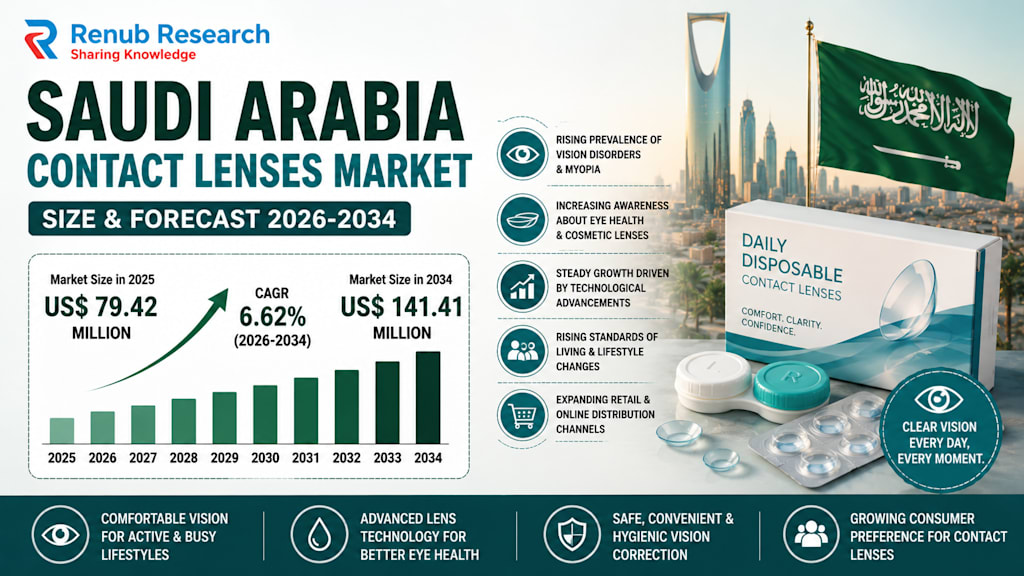
These changes are helping fuel long-term market expansion. The Saudi Arabia Contact Lenses Market is expected to grow from US$ 79.42 Million in 2025 to US$ 141.41 Million in 2034, registering a compound annual growth rate (CAGR) of 6.62% during 2026–2034.
Vision disorders are increasing across the Kingdom
One of the strongest drivers behind the Saudi Arabia contact lenses market is the rising prevalence of vision-related disorders.
Myopia, hyperopia, astigmatism, and presbyopia are becoming more common across different age groups. The growing use of smartphones, computers, tablets, and digital screens is significantly contributing to digital eye strain and worsening vision conditions.
Professionals, students, and younger consumers now spend long hours in front of screens for work, education, and entertainment. This increased screen exposure is placing additional pressure on eye health and increasing the need for vision correction products.
According to the source, studies conducted in February 2025 found that the prevalence of uncorrected refractive error (URE) in Saudi Arabia ranged from 4.5% to 45.8%, while vision impairment rates reached as high as 24%.
As awareness about eye health continues to improve, more consumers are seeking regular eye examinations and adopting contact lenses as a convenient corrective solution.
Contact lenses fit modern lifestyles better than glasses
Many consumers in Saudi Arabia prefer contact lenses because they offer greater convenience and flexibility compared to eyeglasses.
Contact lenses are especially popular during sports, social events, and professional activities because they provide a wider field of vision and do not interfere with physical movement or appearance.
The Kingdom’s large young population, rising incomes, and increasing focus on personal appearance are also supporting adoption.
Consumers increasingly view contact lenses as products that combine practicality with confidence and style. This trend is particularly strong among younger adults and working professionals who prefer a more natural look without eyeglass frames.
Cosmetic contact lenses are driving a major part of demand
One of the most distinctive features of the Saudi Arabia contact lenses market is the strong demand for cosmetic lenses.
Cosmetic contact lenses are widely used to enhance or change eye color, and they have become especially popular among women and younger consumers. Beauty trends, fashion culture, celebrities, and social media influence have all contributed to rising adoption.
Consumers now have access to a wide variety of colors, patterns, and styles designed for both everyday wear and special occasions.
The market for cosmetic lenses has expanded far beyond consumers requiring vision correction. Many buyers now purchase lenses purely for aesthetic purposes, creating new opportunities for optical brands and retailers.
Rising disposable income and growing spending on beauty and personal care products are further supporting this segment’s expansion.
Technology is improving comfort and safety
Technological advancement is playing a major role in strengthening consumer confidence in contact lens products.
Modern lenses made from silicone hydrogel materials provide significantly better oxygen permeability to the eye, reducing dryness, irritation, and discomfort. These improvements make lenses safer and more comfortable for long-term wear.
Daily disposable lenses are also gaining popularity because they offer improved hygiene and convenience. Consumers increasingly prefer products that minimize cleaning requirements and reduce infection risks.
Manufacturers continue investing in research and development to improve hydration technology, comfort levels, and visual clarity.
Technological innovation is also influencing the industry at the corporate level. In October 2025, EssilorLuxottica acquired RetinAI as part of its strategy to strengthen its position in eye care technology and artificial intelligence-driven healthcare solutions.
Retail expansion is improving product accessibility
The expansion of Saudi Arabia’s retail and healthcare infrastructure has significantly improved the availability of contact lenses.
Consumers can now purchase lenses through optical stores, pharmacies, hospitals, healthcare facilities, shopping malls, and online platforms.
Retail pharmacies play a particularly important role because they offer accessibility, product verification, professional advice, and promotional discounts. Their growing presence in urban areas has strengthened market coverage across the Kingdom.
Online retail has also become increasingly important. Consumers appreciate the convenience of ordering contact lenses online, comparing prices, and accessing a wider variety of products.
This improved accessibility is helping broaden the consumer base beyond major urban centers.
Daily disposable lenses are becoming increasingly popular
Daily disposable lenses are emerging as one of the fastest-growing product categories in Saudi Arabia.
Consumers increasingly value hygiene, comfort, and convenience, particularly in hot and dry climates where eye irritation can become more common.
Daily disposable lenses reduce the need for cleaning solutions and long-term maintenance, making them attractive for busy professionals and younger consumers.
These lenses are also viewed as safer because they lower the risk of contamination associated with reusable products.
As consumers become more health-conscious and convenience-oriented, demand for disposable products is expected to continue increasing.
Hybrid lenses are addressing advanced vision needs
Hybrid contact lenses are gaining traction among consumers with more complex eye conditions.
These lenses combine a rigid gas-permeable center with a soft outer ring, offering sharper vision while maintaining comfort. They are particularly useful for conditions such as astigmatism, keratoconus, and irregular corneas.
Eye care professionals in Saudi Arabia are increasingly recommending hybrid lenses to patients who experience discomfort with traditional rigid lenses.
The expansion of specialized eye care facilities and advanced diagnostic technologies is further supporting growth in this segment.
Spherical lenses remain the dominant segment
Spherical contact lenses continue to hold a major market share because they effectively address common vision problems such as nearsightedness and farsightedness.
These lenses remain popular because they are affordable, comfortable, and widely available. Young consumers and working professionals frequently choose spherical lenses due to their simplicity and convenience.
The rising prevalence of common refractive errors across Saudi Arabia is expected to keep this segment strong in the coming years.
Safety concerns remain a major challenge
Despite strong demand growth, the market faces important safety challenges.
Improper use of contact lenses, poor hygiene practices, and purchasing lenses from unauthorized sources can lead to infections, dryness, irritation, redness, and serious complications such as keratitis.
First-time cosmetic lens users may be particularly vulnerable if they do not receive proper guidance or eye examinations.
Manufacturers, healthcare providers, and retailers must continue educating consumers about safe usage, cleaning practices, and the importance of professional fitting.
Consumer safety awareness will remain critical for maintaining long-term market trust.
Premium lens costs can limit adoption
The high cost of premium and daily disposable contact lenses is another challenge for the industry.
Advanced products such as silicone hydrogel lenses provide superior comfort and hygiene benefits but are often more expensive than conventional lenses or eyeglasses.
Replacement schedules, cleaning products, and imported brand pricing can increase the overall financial burden for consumers.
Price-sensitive consumers may prefer eyeglasses or lower-cost alternatives despite the convenience offered by contact lenses.
Manufacturers and retailers are increasingly introducing promotions, discounts, and competitive pricing strategies to improve affordability.
Riyadh remains the largest market in the Kingdom
Riyadh continues to represent one of the strongest contact lenses markets in Saudi Arabia.
As the Kingdom’s capital and economic center, Riyadh has a large population of professionals, students, and technology users who are increasingly experiencing vision problems related to digital device usage.
The city also benefits from advanced healthcare infrastructure, including hospitals, eye care centers, optical stores, and retail pharmacies that provide easy access to contact lens products.
High disposable income and strong interest in aesthetics are further supporting demand for cosmetic lenses.
Jeddah and Dammam are also experiencing strong growth
Jeddah’s market is expanding due to modern lifestyle trends, rising consumer awareness, and strong demand for beauty and fashion products.
Residents increasingly prefer contact lenses for daily activities and professional use, while cosmetic lenses remain especially popular among younger consumers.
Dammam is also witnessing rising demand because of economic development, improving healthcare facilities, and increasing digital device usage among professionals. Consumers in the city are showing growing interest in advanced and aesthetic vision correction products.
Mecca’s market benefits from population growth and retail expansion
The contact lenses market in Mecca is growing steadily due to expanding healthcare infrastructure, population growth, and increased retail availability.
Consumers in the city increasingly choose contact lenses for comfort, convenience, and cosmetic appeal during social and religious activities.
The expansion of shopping centers, healthcare facilities, and optical stores has further improved product accessibility across the city.
Competition is increasingly focused on innovation and aesthetics
Major companies operating in the Saudi Arabia contact lenses market include Alcon, Menicon, Al-Jamil Optical, Yateem Opticians, and Ray-Ban.
Competition is increasingly centered around comfort, oxygen permeability, cosmetic variety, and technological innovation.
Manufacturers are introducing products that combine medical performance with aesthetic appeal, particularly in the cosmetic lens category.
Retailers are also investing in digital platforms, promotional campaigns, and broader product portfolios to attract younger consumers.
Final thoughts
The Saudi Arabia contact lenses market is steadily evolving into a modern healthcare and lifestyle industry shaped by digital habits, beauty trends, and technological innovation.
Rising vision disorders, increasing screen exposure, growing cosmetic lens demand, and improved retail accessibility are all contributing to strong market expansion.
At the same time, safety concerns, hygiene awareness, and affordability challenges remain important areas that the industry must address.
As Saudi consumers continue prioritizing convenience, appearance, and eye health, contact lenses are expected to become an increasingly important part of the Kingdom’s broader healthcare and beauty landscape.
About the Creator
Enjoyed the story? Support the Creator.
Subscribe for free to receive all their stories in your feed.
Comments
There are no comments for this story
Be the first to respond and start the conversation.