
Robots on the Assembly Line: How Automotive Robotics Is Powering the Future of American Manufacturing
Driven by electric vehicle production, AI-powered automation, smart factories, and Industry 4.0 technologies, automotive robotics is transforming vehicle manufacturing across the United States.

The American automotive industry is entering a new era of transformation. For more than a century, automobile manufacturing has been a symbol of industrial innovation, evolving from manual assembly lines to highly automated production facilities.
Today, the next major leap forward is being driven by robotics.
Modern automotive factories increasingly rely on intelligent robotic systems capable of performing tasks with exceptional speed, accuracy, and consistency. From welding vehicle frames and painting body panels to assembling battery packs and conducting quality inspections, robots have become an essential part of the manufacturing ecosystem.
The rise of electric vehicles (EVs), growing labor challenges, increasing consumer demand for high-quality vehicles, and advances in artificial intelligence are accelerating adoption across the industry.
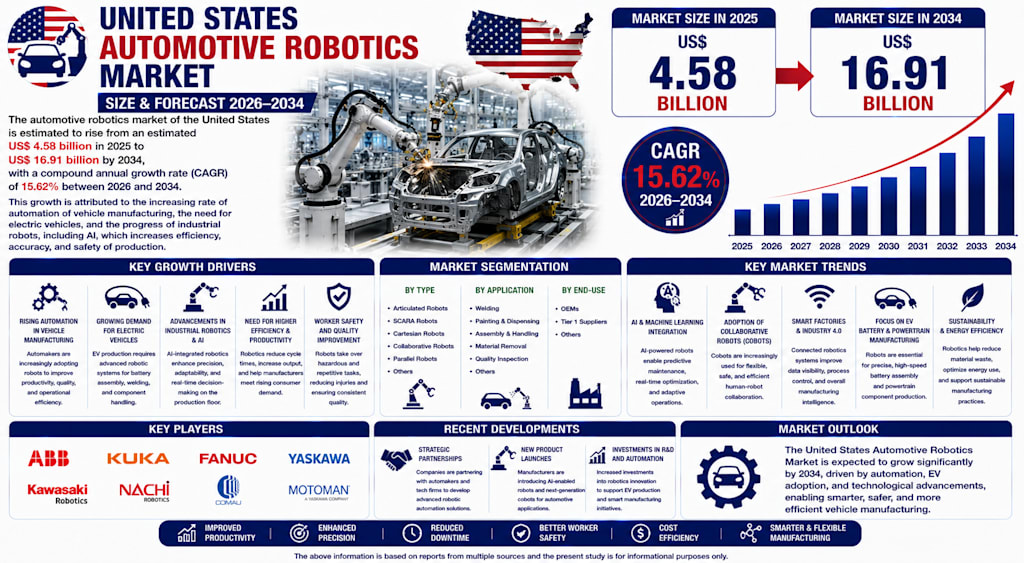
According to Renub Research, the United States Automotive Robotics Market is expected to grow from US$ 4.58 billion in 2025 to US$ 16.91 billion by 2034, expanding at a remarkable compound annual growth rate (CAGR) of 15.62% between 2026 and 2034. The market's rapid growth is fueled by increasing factory automation, expanding EV production, advancements in robotics and artificial intelligence, and the growing adoption of Industry 4.0 technologies.
As manufacturers seek greater efficiency, flexibility, and competitiveness, automotive robotics is becoming one of the most important technologies shaping the future of American manufacturing.
Understanding Automotive Robotics
Automotive robotics refers to the use of programmable robotic systems to perform manufacturing and assembly operations within vehicle production facilities.
These robots are designed to execute a wide variety of tasks, including:
Welding, painting, material handling, assembly, inspection, cutting, packaging, and quality control.
Modern automotive robots incorporate advanced technologies such as:
Artificial intelligence, machine vision systems, sensors, machine learning algorithms, data analytics, and Internet of Things (IoT) connectivity.
Unlike traditional industrial machines, many modern robotic systems can adapt to changing production requirements while maintaining high levels of precision.
Collaborative robots, commonly known as cobots, are increasingly being deployed alongside human workers to improve productivity while maintaining workplace safety.
The integration of robotics into manufacturing processes is helping automakers produce vehicles faster, more efficiently, and with fewer defects.
Automation Is Reshaping Vehicle Production
One of the most powerful drivers behind market growth is the increasing adoption of automation throughout the automotive industry.
Manufacturers face growing pressure to reduce production costs while maintaining strict quality standards.
Robotics offers a highly effective solution.
Industrial robots can operate continuously, perform repetitive tasks with exceptional consistency, and reduce the likelihood of human error.
Applications include:
Body welding, component assembly, paint application, quality inspection, logistics management, and final vehicle finishing.
Automation also helps manufacturers improve workplace safety by reducing employee exposure to hazardous tasks.
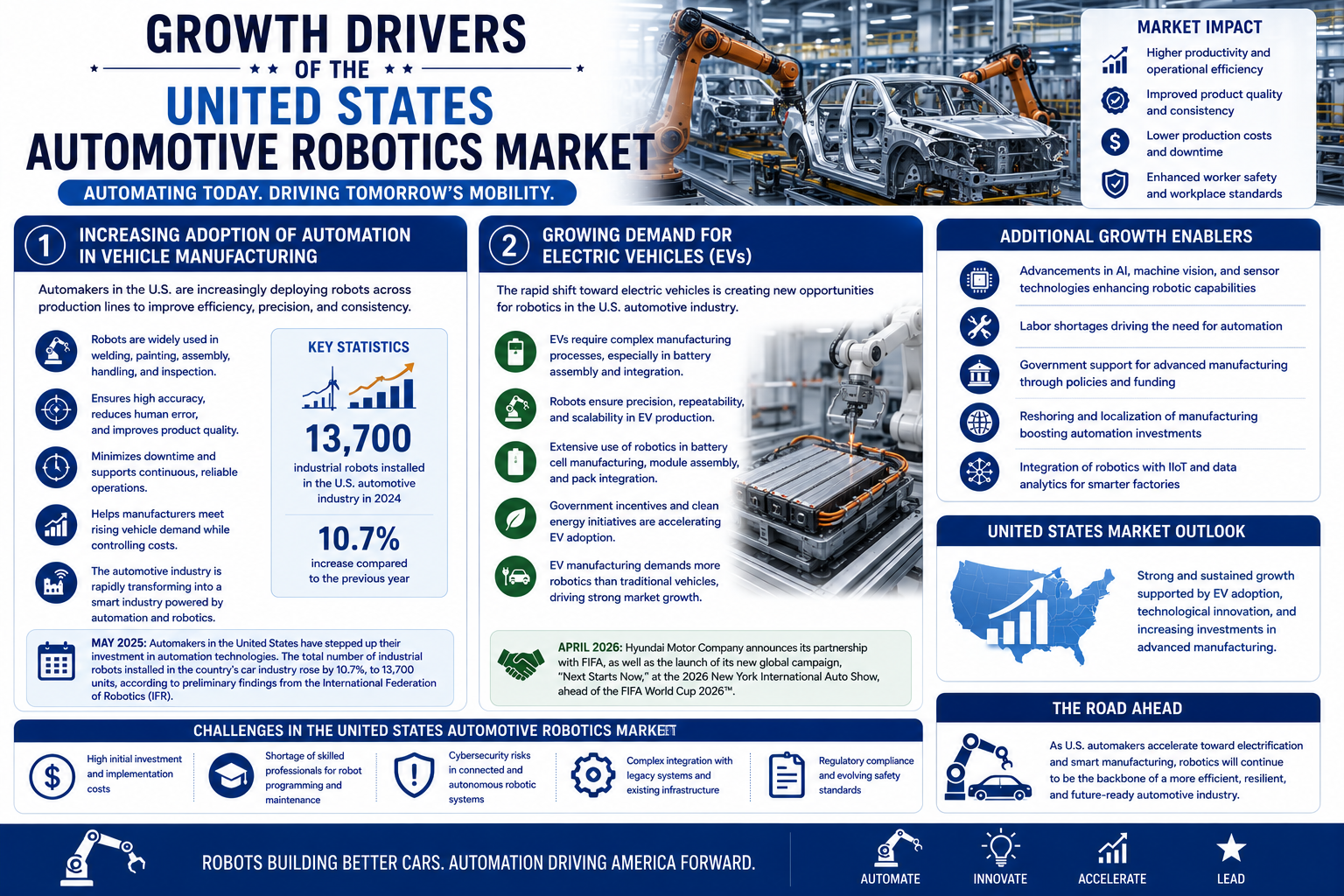
According to preliminary findings from the International Federation of Robotics, industrial robot installations within the U.S. automotive sector increased by approximately 10.7% to 13,700 units in 2025.
This trend highlights the growing importance of automation in maintaining competitiveness within a rapidly evolving global automotive market.
Electric Vehicles Are Creating Massive Opportunities
The transition toward electric vehicles represents one of the most significant growth drivers for automotive robotics.
Unlike traditional internal combustion vehicles, EV manufacturing involves highly specialized processes, particularly in battery production and integration.
Battery assembly requires extraordinary precision and consistency.
Robotic systems are increasingly used for:
Cell handling, battery module assembly, battery pack installation, adhesive application, welding, and quality inspection.
Automakers across the United States are investing billions of dollars in new EV manufacturing facilities and upgrading existing production plants.
These investments create substantial demand for advanced robotics systems capable of supporting complex production requirements.
The growing popularity of EVs, combined with government incentives promoting clean transportation, is expected to significantly accelerate robotics adoption throughout the automotive industry.
Artificial Intelligence Is Making Robots Smarter
Artificial intelligence is fundamentally changing the capabilities of industrial robots.
Traditional robots followed predetermined instructions and required extensive programming.
Today's AI-enabled robots are becoming increasingly adaptive, intelligent, and autonomous.
Machine learning algorithms allow robotic systems to:
Recognize patterns, optimize workflows, identify defects, predict maintenance needs, and adapt to changing production environments.
Computer vision technologies further enhance robotic capabilities by enabling machines to analyze images and identify quality issues in real time.
These advancements improve manufacturing efficiency while reducing operational costs.
In March 2026, Brain Corp announced BrainOS Clean 2.0, a significant software upgrade designed to enhance robotic intelligence, adaptation, and integration capabilities.
Although developed for autonomous systems beyond automotive manufacturing, such advancements illustrate the broader trend toward increasingly intelligent robotics.
Collaborative Robots Are Transforming Factory Floors
Collaborative robots have emerged as one of the fastest-growing segments within industrial automation.
Unlike traditional robots that typically operate behind safety barriers, cobots are designed to work alongside human employees.
These systems assist workers with repetitive, physically demanding, or precision-intensive tasks while maintaining safe interactions.
Benefits include:
Improved productivity, enhanced workplace safety, reduced employee fatigue, and greater operational flexibility.
Cobots are particularly valuable in applications requiring human judgment combined with robotic precision.
As manufacturers seek more adaptable production systems, collaborative robotics is expected to become increasingly important across automotive facilities nationwide.
Sensors Are Becoming the Foundation of Smart Manufacturing
Sensors play a crucial role in modern automotive robotics systems.
These devices provide real-time information regarding:
Position, force, pressure, temperature, proximity, vibration, and movement.
By continuously monitoring manufacturing processes, sensors help robotic systems make precise adjustments and maintain consistent performance.
Advanced vision sensors powered by artificial intelligence are becoming especially important for quality control applications.
These technologies enable automated inspection systems capable of detecting defects that might be difficult for human inspectors to identify consistently.
As smart manufacturing continues expanding, demand for sophisticated sensor technologies is expected to grow rapidly.
Robotic Arms Remain the Industry Workhorse
Robotic arms represent one of the most widely used components within automotive manufacturing.
These versatile systems perform numerous functions, including:
Welding, assembly, painting, material handling, packaging, and inspection.
Modern robotic arms offer exceptional flexibility and can be reprogrammed to accommodate changing production requirements.
The increasing demand for vehicle customization and shorter product life cycles has made flexibility more important than ever.
Technological advancements such as AI integration, advanced motion control systems, and machine vision capabilities continue enhancing robotic arm performance.
As manufacturers seek greater adaptability, robotic arms remain central to factory automation strategies.
Articulated Robots Dominate Automotive Applications
Among the various robotic configurations available, articulated robots remain the most widely used in automotive manufacturing.
These robots feature multiple rotary joints that provide exceptional flexibility and range of motion.
Their versatility makes them ideal for:
Complex welding operations, assembly tasks, material handling, painting applications, and work within confined spaces.
Because articulated robots can perform repetitive tasks with high precision, they are particularly valuable in automotive production environments where consistency is essential.
The growth of smart factories and advanced manufacturing initiatives continues supporting strong demand for articulated robotic systems.
Robotic Welding Continues to Expand
Welding remains one of the most important applications for automotive robotics.
Vehicle manufacturing requires thousands of precise welds to ensure structural integrity and safety.
Robotic welding systems offer significant advantages, including:
Higher precision, faster production speeds, reduced material waste, improved consistency, and enhanced worker safety.
The rise of electric vehicles has further increased demand for specialized welding technologies used in battery assembly and lightweight vehicle construction.
Advanced laser welding systems continue improving productivity while supporting more sophisticated manufacturing processes.
As vehicle designs become increasingly complex, robotic welding will remain a critical component of automotive production.
Robotic Cutting Supports Advanced Vehicle Design
The growing use of lightweight materials and advanced composites in vehicle manufacturing has increased demand for robotic cutting systems.
These systems perform:
Laser cutting, trimming, contouring, and material shaping operations with exceptional precision.
Robotic cutting technologies help manufacturers minimize waste while improving production speed and consistency.
They also reduce safety risks by limiting direct human involvement in potentially hazardous cutting operations.
As automakers continue adopting lightweight materials to improve fuel efficiency and EV performance, robotic cutting systems are expected to experience sustained growth.
Texas Emerges as a Major Growth Hub
Texas has become one of the most important regions for automotive robotics growth within the United States.
Several factors contribute to the state's strong position.
Texas offers a large industrial base, favorable business conditions, skilled labor resources, and significant investments in manufacturing infrastructure.
The state's growing role in electric vehicle production further supports demand for advanced automation technologies.
Automotive manufacturers throughout Texas increasingly rely on robotics to improve efficiency, enhance product quality, and maintain competitiveness.
As industrial investment continues expanding, Texas is expected to remain a major contributor to national market growth.
Georgia Benefits from Manufacturing Expansion
Georgia is also emerging as a significant automotive robotics market.
Growing automotive manufacturing activity and expanding supply-chain operations are encouraging investment in automation technologies.
The state's workforce development initiatives and strong logistics infrastructure further support robotics adoption.
The expansion of electric vehicle manufacturing facilities is creating additional opportunities for robotics vendors and technology providers.
As industrial activity continues increasing, Georgia's role within the automotive robotics ecosystem is expected to strengthen.
Challenges Continue to Affect Adoption
Despite strong growth prospects, several challenges remain.
One of the most significant barriers is the high initial cost associated with implementing advanced robotic systems.
Purchasing equipment, integrating robotics into existing facilities, upgrading infrastructure, and training employees require substantial investment.
While large manufacturers often possess the resources necessary to make these investments, smaller firms may struggle to justify the costs.
Workforce concerns also remain important.
Automation raises questions regarding job displacement while simultaneously creating demand for highly skilled workers capable of operating, maintaining, and programming robotic systems.
Many manufacturers face shortages of qualified personnel with expertise in robotics, artificial intelligence, and advanced manufacturing technologies. Bridging this skills gap will be essential for sustaining long-term growth.
Final Thoughts
The United States automotive robotics market is entering a period of extraordinary expansion.
Driven by rising automation, growing electric vehicle production, artificial intelligence advancements, and the evolution of smart factories, robotics is fundamentally transforming how vehicles are manufactured.
Modern robotic systems are helping automakers improve productivity, enhance quality, reduce costs, and respond more effectively to changing consumer demands.
With the market projected to grow from US$ 4.58 billion in 2025 to US$ 16.91 billion by 2034, opportunities for innovation remain substantial.
As Industry 4.0 technologies continue reshaping manufacturing, automotive robotics will remain at the forefront of industrial transformation—powering the next generation of American vehicle production and helping ensure the nation's competitiveness in an increasingly automated world.
About the Creator
Enjoyed the story? Support the Creator.
Subscribe for free to receive all their stories in your feed.
Comments
There are no comments for this story
Be the first to respond and start the conversation.