
RFID Market Set for Explosive Growth as Automation and Smart Tracking Transform Global Industries
Global RFID Market Expected to Reach US$ 43.31 Billion by 2034 Amid Rising Demand for Real-Time Visibility and Intelligent Operations

The world is becoming increasingly connected, automated, and data-driven. Businesses across industries are searching for technologies that can improve operational efficiency, reduce costs, and provide real-time visibility into their assets and workflows. Among the technologies leading this transformation is Radio Frequency Identification (RFID), a solution that has evolved from a simple tracking tool into a cornerstone of modern digital infrastructure.
RFID technology is now helping organizations streamline inventory management, automate logistics operations, strengthen security systems, and improve customer experiences. As industries embrace digital transformation initiatives, RFID adoption is accelerating worldwide.
According to Renub Research, the global RFID market is expected to grow from US$ 17.32 billion in 2025 to US$ 43.31 billion by 2034, expanding at a compound annual growth rate (CAGR) of 10.72% between 2026 and 2034. This remarkable growth reflects the increasing importance of RFID technology across retail, healthcare, manufacturing, transportation, and government sectors.
Understanding RFID Technology
Radio Frequency Identification, commonly known as RFID, is a wireless technology that uses radio waves to identify and track objects automatically. Unlike traditional barcode systems that require direct visual scanning, RFID systems can read multiple items simultaneously without requiring line-of-sight access.
A standard RFID system consists of RFID tags attached to products or assets, RFID readers that capture information from those tags, and software platforms that process and analyze the collected data. This combination allows organizations to track products, equipment, vehicles, and other assets quickly and accurately.
The technology offers several advantages over conventional tracking methods. Businesses can automate inventory processes, reduce human errors, improve operational efficiency, and gain real-time visibility into supply chains. These benefits have made RFID one of the most valuable technologies supporting modern enterprise operations.
Why RFID Adoption Is Accelerating Worldwide
Organizations today operate in highly competitive environments where efficiency and accuracy are critical. Traditional methods of tracking inventory and assets often involve manual processes that consume time and increase the risk of mistakes.
RFID addresses these challenges by providing instant access to accurate data. Companies can monitor inventory levels in real time, locate assets immediately, and automate routine tasks that previously required significant labor resources.
Technological advancements have further improved RFID performance. Modern RFID systems offer longer read ranges, higher accuracy rates, enhanced durability, and seamless integration with cloud platforms and Internet of Things (IoT) ecosystems. At the same time, declining hardware costs have made RFID solutions more affordable for organizations of all sizes.
As digital transformation initiatives continue to expand globally, RFID technology is becoming a strategic investment rather than an optional enhancement.
Retail Industry Continues to Drive RFID Growth
The retail sector remains one of the strongest contributors to RFID market expansion. Modern retailers face increasing pressure to deliver seamless shopping experiences while maintaining accurate inventory across both physical stores and digital channels.
Consumers expect products to be available whenever and wherever they choose to shop. This expectation has made inventory visibility more important than ever before.
RFID technology enables retailers to track merchandise in real time, conduct faster inventory counts, reduce stock discrepancies, and improve product availability. The result is a more efficient operation that benefits both businesses and consumers.
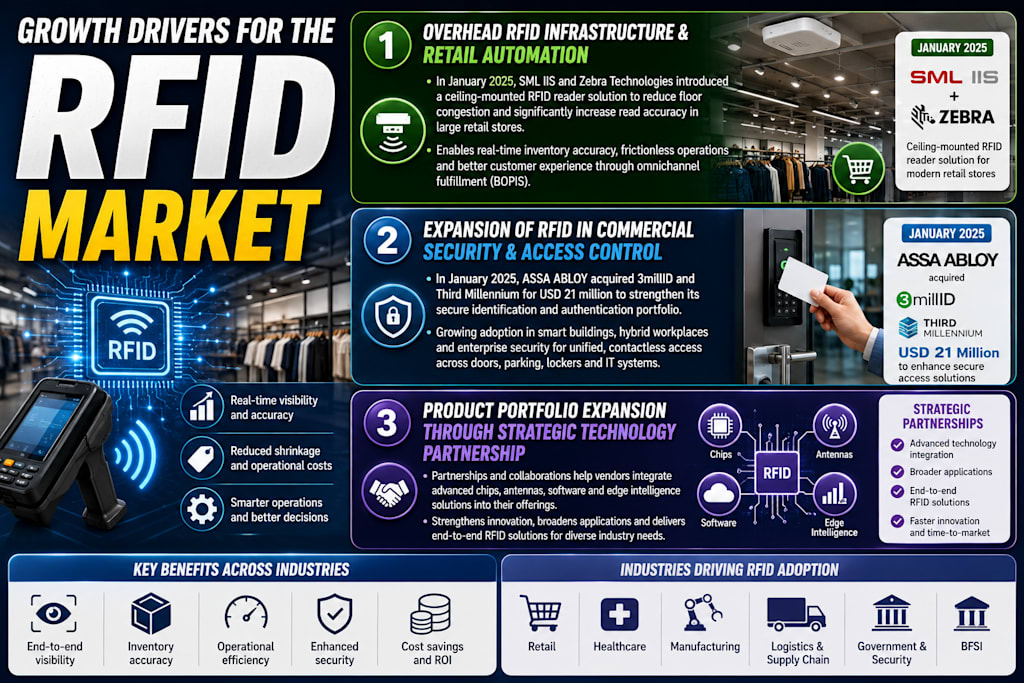
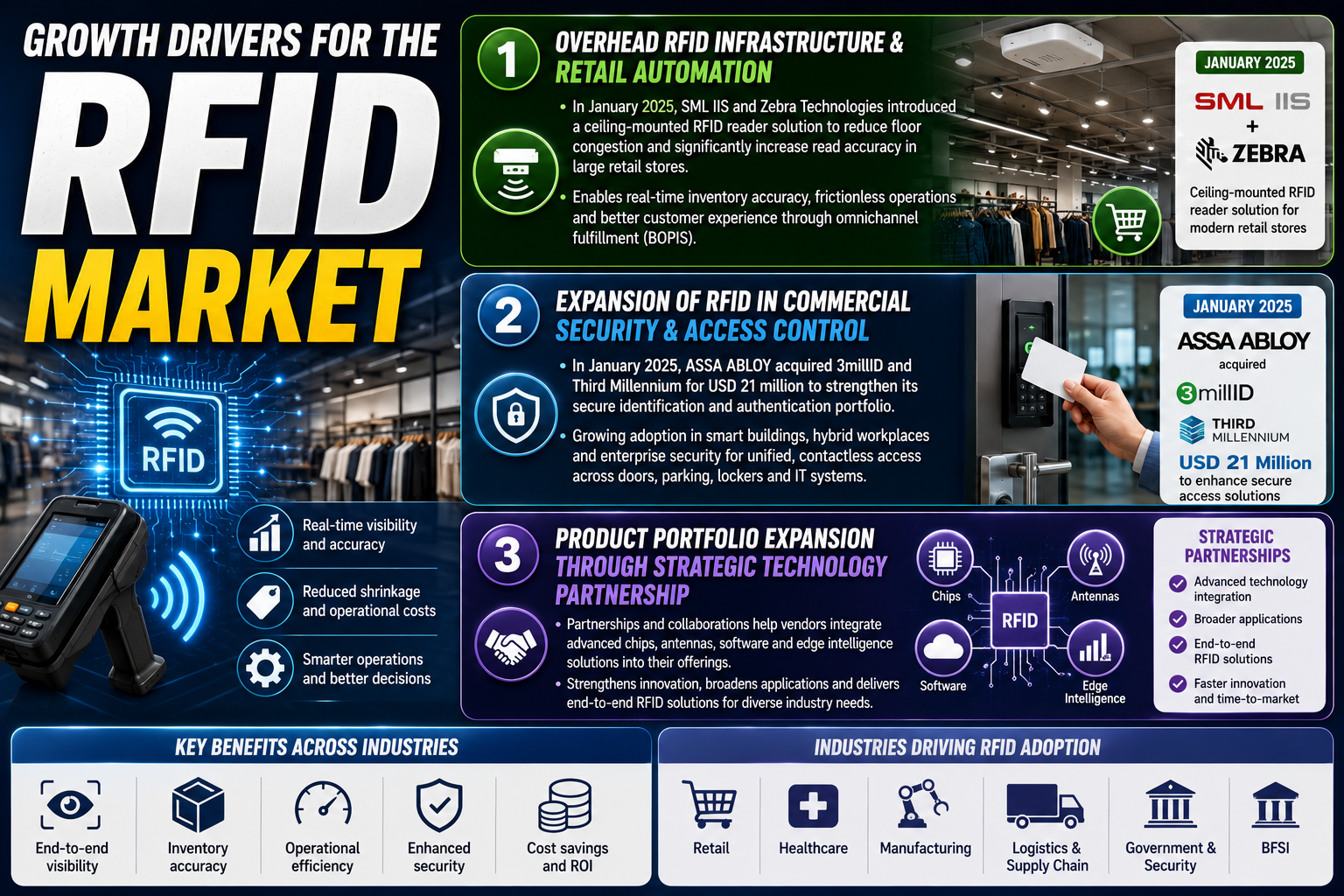
A significant development occurred in January 2025 when SML IIS and Zebra Technologies introduced a ceiling-mounted RFID reader solution designed specifically for large retail environments. Unlike traditional handheld systems, these overhead readers continuously monitor merchandise movement throughout stores, helping retailers improve inventory accuracy while reducing operational disruptions.
The rise of omnichannel retailing, including services such as Buy Online Pick Up In Store (BOPIS), has further increased the need for accurate inventory management. RFID provides the visibility required to synchronize inventory across multiple sales channels, making it an essential technology for modern retailers.
Logistics and Supply Chains Embrace Intelligent Tracking
The logistics industry is undergoing a profound transformation fueled by e-commerce growth, globalization, and increasing consumer expectations. Companies are managing more complex supply chains than ever before, creating a growing need for real-time tracking solutions.
RFID technology has emerged as a powerful tool for addressing these challenges. Logistics providers use RFID to monitor shipments, optimize warehouse operations, improve inventory accuracy, and enhance supply chain visibility.
By implementing RFID systems, organizations can achieve faster inventory processing, improved shipment accuracy, reduced labor costs, enhanced warehouse automation, and better asset utilization. These benefits are particularly important in today's fast-paced logistics environment where delays and inaccuracies can have significant financial consequences.
As global trade volumes continue to increase, RFID technology is expected to play an even larger role in ensuring efficient and transparent supply chain operations.
Healthcare Sector Discovers New Opportunities
Healthcare organizations are increasingly adopting RFID technology to improve patient care, asset management, and operational efficiency. Hospitals and medical facilities manage thousands of critical assets daily, ranging from medical equipment and pharmaceuticals to patient records and diagnostic tools.
Manual tracking methods can be inefficient and prone to errors, creating challenges for healthcare providers.
RFID offers a solution by providing real-time visibility into the location and status of important assets. Healthcare organizations use RFID to track medical equipment locations, monitor pharmaceutical inventories, improve patient identification, reduce equipment loss, and enhance workflow efficiency.
The technology helps healthcare providers optimize resource utilization while improving patient safety. As healthcare systems continue their digital transformation journeys, RFID adoption is expected to increase significantly across hospitals, clinics, and research facilities worldwide.
Security and Access Control Create New Growth Opportunities
Another important driver of RFID market growth is the increasing use of RFID technology in security and access control applications.
Modern organizations require flexible, secure, and contactless authentication systems capable of integrating with broader digital infrastructure. RFID technology provides an effective solution for managing access permissions while maintaining convenience for users.
In January 2025, ASSA ABLOY acquired 3millID and Third Millennium in a move designed to strengthen its secure identification and authentication portfolio. The acquisition highlights growing industry demand for advanced RFID-based security solutions.
Today, RFID systems are widely used for building access, employee identification, parking management, locker security, visitor tracking, and enterprise security management. The integration of RFID with mobile credentials, biometric technologies, and cloud-based security platforms is creating new opportunities for innovation and market expansion.
Strategic Partnerships Are Driving Innovation
The RFID industry is witnessing an increasing number of strategic partnerships aimed at accelerating product development and expanding technological capabilities.
One notable example occurred in January 2024 when Newland AIDC partnered with Impinj to integrate advanced RAIN RFID technology into its product offerings. The partnership demonstrates how companies are combining expertise to create more advanced, scalable, and efficient RFID solutions.
Strategic collaborations support faster product development, expanded market reach, improved technological performance, greater interoperability, and enhanced customer solutions. These partnerships enable organizations to respond more effectively to changing market demands while accelerating innovation across the RFID ecosystem.
As competition intensifies, collaboration is becoming a key strategy for maintaining technological leadership.
The Growing Influence of IoT
The Internet of Things is playing a major role in expanding RFID adoption. Businesses increasingly seek connected environments where devices, assets, and systems communicate seamlessly to provide actionable insights.
RFID serves as a critical data collection layer within IoT ecosystems. By integrating RFID with IoT platforms, organizations gain real-time operational insights, predictive analytics capabilities, automated decision-making tools, enhanced asset visibility, and improved resource allocation.
This integration allows businesses to move beyond simple tracking and toward intelligent operational management. As IoT adoption continues to expand globally, demand for RFID-enabled solutions is expected to grow alongside it.
Challenges Facing the RFID Industry
Despite its numerous advantages, RFID technology still faces several challenges that could affect adoption rates.
One of the most significant obstacles is the high upfront investment required for deployment. Large-scale implementations often require expenditures on tags, readers, antennas, middleware, software integration, and infrastructure upgrades. While RFID costs have declined over time, implementation remains a considerable investment for many organizations.
Integration complexity also presents challenges. Connecting RFID systems with existing enterprise software such as warehouse management systems, enterprise resource planning platforms, and point-of-sale systems often requires specialized expertise and customization.
Privacy and security concerns represent another important issue. RFID systems generate substantial amounts of operational and identity-related data, creating potential risks related to unauthorized tracking, data interception, credential cloning, and system tampering. Organizations must implement strong security measures and compliance protocols to address these concerns effectively.
Regional Markets Continue to Expand
The United States remains one of the largest RFID markets due to widespread adoption across retail, logistics, healthcare, and defense sectors. Strong technological innovation and extensive investments in automation continue to support growth.
Germany is another important market, driven by advanced manufacturing practices and Industry 4.0 initiatives. RFID plays a vital role in automotive production, industrial automation, quality control, and warehouse management applications throughout the country.
China has emerged as one of the fastest-growing RFID markets globally. Government-led digitalization programs, smart city initiatives, and the country's vast e-commerce ecosystem continue to fuel demand for RFID technologies across numerous industries.
Saudi Arabia is also experiencing rapid growth in RFID adoption, supported by Vision 2030 initiatives focused on digital transformation, smart infrastructure development, logistics modernization, and advanced identification technologies.
Recent Developments Reflect Strong Industry Momentum
The RFID industry continues to evolve through innovation and strategic investment. Recent developments include RFID-enabled casino management systems, secure identity solutions, advanced self-checkout technologies, specialized metal-surface RFID tags, and RFID-enabled electric vehicle charging cards.
These innovations demonstrate the versatility of RFID technology and its expanding role across diverse industries. As companies continue investing in research and development, RFID solutions are becoming more accurate, affordable, and capable of supporting increasingly complex applications.
Final Thoughts
RFID technology is no longer just a tool for inventory management. It has become a foundational component of modern business operations, supporting automation, digital transformation, and real-time decision-making across industries.
From retail stores and logistics networks to hospitals and smart buildings, organizations are leveraging RFID to improve efficiency, reduce costs, and gain unprecedented visibility into their operations.
With Renub Research forecasting that the global RFID market will grow from US$ 17.32 billion in 2025 to US$ 43.31 billion by 2034, the future of RFID appears exceptionally bright. As automation, IoT integration, and intelligent operations become standard business requirements, RFID will continue to play a critical role in shaping the next generation of connected enterprises.
About the Creator
Enjoyed the story? Support the Creator.
Subscribe for free to receive all their stories in your feed.
Comments
There are no comments for this story
Be the first to respond and start the conversation.