
RFID Market Accelerates as Real-Time Tracking and Automation Redefine Global Industries
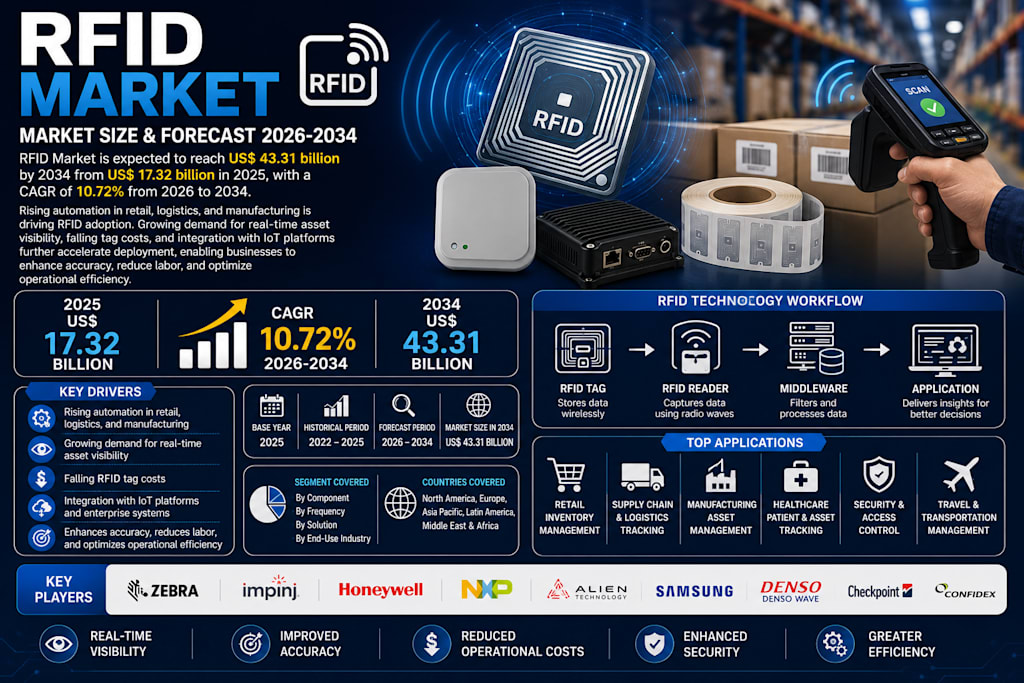
Driven by rising demand for real-time visibility, automation, and IoT integration, the global RFID market is projected to grow from US$ 17.32 billion in 2025 to US$ 43.31 billion by 2034 at a CAGR of 10.72%.

RFID Market Overview
The global RFID (Radio Frequency Identification) market is entering a phase of accelerated expansion, driven by the urgent need for real-time tracking, automation, and data-driven operations across industries. According to Renub Research, the market is expected to grow significantly from US$ 17.32 billion in 2025 to US$ 43.31 billion by 2034, registering a strong CAGR of 10.72% between 2026 and 2034.
RFID technology uses radio waves to identify and track objects without requiring direct line-of-sight, making it far more efficient than traditional barcode systems. A standard RFID system consists of tags, readers, and software that work together to capture and process data instantly. This capability allows businesses to improve accuracy, reduce manual errors, and gain real-time visibility into operations.
As industries continue to digitize and automate their processes, RFID is becoming a foundational technology in retail, logistics, healthcare, manufacturing, and security systems. Its ability to support bulk reading, automation, and seamless integration with cloud and IoT platforms is transforming how organizations manage assets, inventory, and workflows.
Key Growth Drivers in the RFID Market
One of the most powerful drivers of RFID adoption is the growing demand for real-time asset visibility. Businesses today operate in increasingly complex supply chains where accuracy and speed are critical. RFID enables organizations to track inventory instantly, reduce shrinkage, and improve operational efficiency without manual scanning.
Retail automation is a particularly important growth area. In January 2025, SML IIS and Zebra Technologies introduced a ceiling-mounted RFID reader system designed to improve read accuracy and reduce store congestion. These overhead systems allow continuous monitoring of inventory without interfering with customer movement, supporting frictionless shopping experiences and omnichannel fulfillment strategies like buy-online-pick-up-in-store (BOPIS).
Another major driver is the expansion of RFID in security and access control systems. In January 2025, ASSA ABLOY acquired 3millID and Third Millennium to strengthen its capabilities in secure identification technologies. This move highlights the increasing importance of contactless authentication in modern workplaces, smart buildings, and enterprise security systems. RFID is now widely used for access cards, parking systems, and identity management solutions.
Strategic partnerships are also accelerating innovation. In January 2024, Newland AIDC partnered with Impinj to integrate advanced RAIN RFID technology into its product portfolio. These collaborations allow companies to combine hardware, chips, and software into more scalable and efficient solutions. As a result, RFID systems are becoming more accurate, cost-effective, and easier to deploy across industries.
Role of IoT and Digital Transformation
The integration of RFID with the Internet of Things (IoT) is transforming how organizations manage data and operations. RFID devices can now connect with cloud platforms, analytics tools, and enterprise systems to provide real-time insights. This enables predictive decision-making, automated workflows, and improved supply-chain coordination.
Digital transformation initiatives across industries are further fueling RFID adoption. Companies are investing in technologies that improve efficiency, reduce labor costs, and enhance customer experiences. RFID fits perfectly into this strategy by enabling automation, accuracy, and scalability. As businesses move toward data-driven models, RFID is becoming a critical component of modern infrastructure.
Challenges in the RFID Market
Despite its advantages, RFID adoption comes with challenges. One of the main barriers is the high initial investment required for deployment. Implementing RFID systems involves costs for tags, readers, antennas, and integration with existing enterprise systems such as ERP and warehouse management software. For small and medium-sized businesses, these costs can be a significant obstacle.
Integration complexity is another concern. RFID systems must work seamlessly with existing infrastructure, which often requires customization and technical expertise. Environmental factors such as metal surfaces and signal interference can also affect performance, requiring specialized solutions.
Privacy and data security issues further complicate adoption. RFID systems generate large volumes of data, raising concerns about unauthorized access, tracking, and data misuse. Inconsistent global regulations and lack of standardization can also create challenges for companies operating across multiple regions. Addressing these concerns is essential for long-term market growth.
United States RFID Market
The United States is one of the largest and most advanced RFID markets. Strong adoption across retail, logistics, healthcare, and defense sectors drives demand for real-time tracking and automation solutions. Major retailers use RFID for inventory management and smart store operations, while logistics companies rely on it for warehouse automation and shipment tracking.
The country benefits from a mature technology ecosystem, continuous innovation, and strong investments in IoT and automation. Government and military applications also contribute to market growth, particularly in asset tracking and secure identification systems.
Germany RFID Market
Germany’s RFID market is strongly influenced by its advanced manufacturing sector and leadership in Industry 4.0. RFID plays a critical role in production processes, intralogistics, and quality control. The automotive and industrial sectors use RFID to track components, monitor workflows, and improve efficiency.
Retailers in Germany are also adopting RFID to improve inventory accuracy and support omnichannel operations. Government initiatives promoting digital transformation and smart logistics further support market expansion. However, strict data protection regulations and integration complexity can slow adoption in some cases.
China RFID Market
China is one of the fastest-growing RFID markets, supported by large-scale manufacturing, strong e-commerce growth, and government-led digitalization initiatives. RFID is widely used in logistics, smart retail, and industrial automation.
The country’s expanding infrastructure and smart-city projects are creating new opportunities for RFID deployment. Local manufacturers are producing cost-effective tags and readers, making the technology more accessible. Despite challenges related to standardization and security, China remains a key growth engine for the global RFID market.
Saudi Arabia RFID Market
Saudi Arabia’s RFID market is growing rapidly as part of the country’s broader digital transformation strategy under Vision 2030. RFID is being adopted across logistics, healthcare, retail, and government sectors to improve efficiency and transparency.
Applications include asset tracking, patient management, and access control systems. Large infrastructure projects and smart-city initiatives such as NEOM are further driving demand for RFID solutions. While challenges such as high costs and skill gaps remain, the overall outlook is highly positive.
Recent Developments in the RFID Market
Innovation continues to shape the RFID market. In October 2024, TOPPAN Holdings and TOPPAN Next acquired HID’s Citizen Identity Solutions division to strengthen their presence in secure identification technologies.
In March 2024, Galaxy Entertainment Group and Melco Resorts planned to introduce RFID-enabled tablets in casinos to improve monitoring and reduce fraud.
In January 2024, HID Global partnered with Olea Kiosk to enhance authentication systems through RFID integration. Meanwhile, Metalcraft launched a cost-effective RFID tag designed for metal surfaces, and Tata Power introduced RFID-enabled EV charging cards to support electric mobility infrastructure.
These developments highlight the expanding range of RFID applications across industries, from retail and entertainment to energy and infrastructure.
Market Segmentation
The RFID market is segmented by system type, product type, end use, and geography. Systems include active and passive RFID, while product categories cover tags, readers, and software services. End-use industries range from retail and healthcare to transportation, government, and industrial sectors.
Geographically, the market spans North America, Europe, Asia-Pacific, Latin America, and the Middle East & Africa. Each region presents unique growth opportunities based on industrial development, technology adoption, and regulatory frameworks.
Key Companies in the RFID Market
Leading players in the RFID market include Alien Technology Corporation, William Frick & Company, Invengo Technology Pte Ltd., Impinj Inc., CCL Industries Inc., Nedap NV, and Trace-Tech ID Solutions SL. These companies are driving innovation through product development, partnerships, and global expansion strategies.
Final Thoughts
The RFID market is rapidly evolving as industries embrace automation, digital transformation, and real-time data visibility. Its ability to improve efficiency, reduce errors, and enable smarter decision-making makes it a critical technology for the future.
With strong growth projections and expanding applications, RFID is set to play a central role in shaping the next generation of connected, intelligent, and automated business environments worldwide.
About the Creator
Enjoyed the story? Support the Creator.
Subscribe for free to receive all their stories in your feed.
Comments
There are no comments for this story
Be the first to respond and start the conversation.