
Retinal Surgery Device Market Expands Rapidly as Advanced Eye Care Technologies Transform Ophthalmology
Rising prevalence of retinal disorders, minimally invasive procedures, and next-generation imaging systems are driving strong global market growth

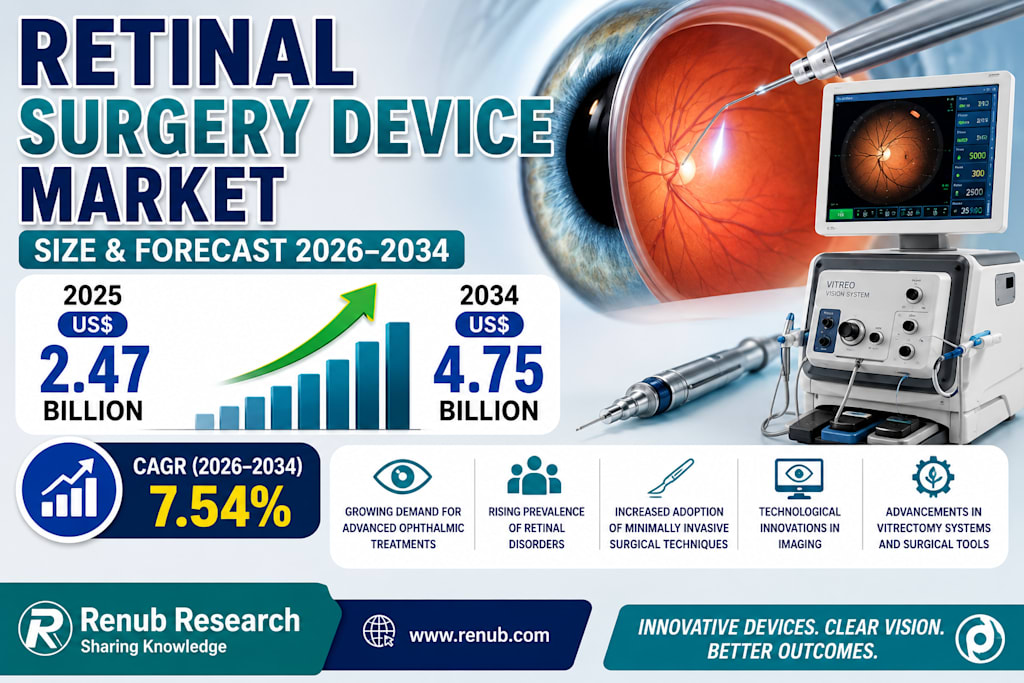
The global ophthalmology industry is experiencing a major technological transformation as healthcare systems invest more heavily in advanced eye care solutions. Among the fastest-growing segments within this industry is the retinal surgery device market, driven by increasing rates of retinal diseases, rising demand for minimally invasive procedures, and continuous innovation in surgical imaging and visualization technologies.
According to Renub Research, the Retinal Surgery Device Market is projected to grow from US$ 2.47 Billion in 2025 to US$ 4.75 Billion by 2034, registering a Compound Annual Growth Rate (CAGR) of 7.54% during 2026–2034. Growing prevalence of diabetic retinopathy, retinal detachment, age-related macular degeneration, and other vision-threatening conditions is accelerating the need for advanced retinal surgical interventions worldwide.
As healthcare providers continue prioritizing precision, faster recovery, and minimally invasive procedures, retinal surgery devices are becoming essential components of modern ophthalmic care.
Retinal Surgery Devices Are Reshaping Modern Eye Care
Retinal surgery devices are specialized medical instruments designed to diagnose, repair, and treat disorders affecting the retina and surrounding ocular structures. These technologies include vitrectomy systems, retinal lasers, illumination equipment, surgical instruments, and high-definition imaging platforms that support delicate microsurgical procedures.
Retinal disorders such as diabetic retinopathy, macular holes, vitreous hemorrhage, retinal tears, and retinal detachment often require highly precise surgical intervention. Modern retinal surgery systems allow ophthalmic surgeons to perform these procedures with improved control, greater safety, and enhanced visualization.
Advancements in micro-instrumentation, fluidics management, and digital imaging technologies have significantly improved surgical outcomes over the past decade. Patients increasingly benefit from shorter recovery times, smaller incisions, reduced complications, and more accurate treatment.
As retinal diseases become more common globally, these technologies are becoming increasingly important across hospitals, specialized eye clinics, and ophthalmology centers.
Rising Cases of Retinal Disorders Are Driving Demand
One of the strongest factors supporting the growth of the retinal surgery device market is the increasing prevalence of retinal diseases worldwide. Diabetes, aging populations, and lifestyle-related health conditions are contributing significantly to the rise in vision-threatening eye disorders.
Diabetic retinopathy remains one of the leading causes of blindness globally. As diabetes rates continue rising, the number of patients requiring retinal treatment is also increasing rapidly. Similarly, age-related macular degeneration is becoming more common due to aging demographics across developed and emerging economies.
These conditions often require repeated monitoring, laser treatment, or complex vitreoretinal surgeries, creating sustained long-term demand for advanced ophthalmic devices.
Healthcare providers are increasingly emphasizing early diagnosis and surgical intervention to preserve vision and improve patient quality of life. This trend is expected to continue fueling market expansion throughout the forecast period.
Technological Innovation Is Transforming Retinal Surgery
Technological advancement remains one of the most important growth drivers within the retinal surgery device industry. Modern vitrectomy platforms, AI-assisted imaging systems, advanced illumination tools, and real-time visualization technologies are dramatically improving surgical precision and workflow efficiency.
Companies are also pursuing strategic acquisitions and collaborations to strengthen their technology portfolios. The report highlights Carl Zeiss Meditec AG’s April 2024 acquisition of the Dutch Ophthalmic Research Center, which expanded its ophthalmic workflow solutions and innovation capabilities.
Artificial intelligence is becoming increasingly integrated into ophthalmic imaging systems, enabling faster interpretation of retinal scans and supporting earlier disease detection.
Enhanced visualization systems such as 3D microscopes and digital surgical platforms are also helping surgeons improve procedural accuracy while reducing fatigue during complex operations.
As hospitals and eye care centers continue modernizing their ophthalmic departments, adoption of advanced retinal technologies is expected to accelerate further.
Regulatory Approvals Are Accelerating Market Adoption
Another major growth driver is the increasing availability of advanced surgical platforms supported by regulatory approvals. Ophthalmology centers increasingly prefer systems that provide better precision, improved fluidics control, and streamlined surgical workflows.
The report notes that in June 2024, Alcon received U.S. FDA 510(k) clearance for its Unity VCS and Unity CS systems, part of its next-generation surgical platform portfolio for cataract and vitreoretinal surgery. These systems are designed to improve efficiency and support more advanced ophthalmic procedures.
Regulatory clearances not only strengthen physician confidence but also accelerate commercialization and hospital adoption.
Healthcare facilities increasingly seek technologies that can improve patient outcomes while reducing operating time and recovery periods. This demand is driving faster replacement cycles for older ophthalmic equipment.
Minimally Invasive Procedures Are Becoming Standard
The shift toward minimally invasive ophthalmic surgery is another critical trend shaping the retinal surgery device market. Patients and surgeons increasingly prefer procedures involving smaller incisions, faster healing, and lower postoperative complication risks.
Micro-incisional vitrectomy systems, refined fluidics management, laser-assisted procedures, and advanced illumination technologies are enabling surgeons to operate with greater precision and control.
The report also highlights Alcon’s July 2024 acquisition of Belkin Vision to strengthen its energy-based ophthalmic treatment portfolio, including direct selective laser trabeculoplasty technologies.
As minimally invasive procedures continue gaining popularity globally, demand for sophisticated surgical instruments and retinal platforms is expected to rise substantially.
High Equipment Costs Remain a Major Barrier
Despite strong growth potential, the retinal surgery device market faces several significant challenges. One of the largest barriers is the high cost associated with advanced ophthalmic surgical systems.
Modern vitrectomy machines, imaging systems, laser equipment, and surgical microscopes require substantial capital investment. Additional costs related to maintenance, disposable consumables, software upgrades, and staff training further increase financial pressure on healthcare providers.
Smaller hospitals and eye clinics, particularly in low-income or developing regions, may struggle to afford next-generation retinal technologies.
Limited reimbursement support in certain healthcare systems also slows adoption, especially for premium surgical platforms.
These financial constraints remain a key obstacle to broader global penetration of advanced retinal surgical systems.
Shortage of Skilled Retinal Surgeons Is Affecting Growth
The retinal surgery device market also faces a shortage of highly trained ophthalmic surgeons capable of performing advanced vitreoretinal procedures. Retinal surgeries require exceptional microsurgical precision, specialized training, and extensive clinical experience.
In many developing regions, limited access to fellowship programs and ophthalmic training infrastructure restricts the number of qualified specialists available.
Even in developed healthcare markets, aging populations and increasing disease prevalence are placing additional pressure on ophthalmology departments and surgical capacity.
The shortage of skilled professionals can delay patient treatment and reduce the pace at which advanced technologies are adopted.
As a result, training initiatives, simulation technologies, and AI-assisted surgical guidance systems are becoming increasingly important within the industry.
United States Continues Leading Global Market
The United States remains one of the most advanced retinal surgery device markets globally due to its strong healthcare infrastructure, large base of ophthalmic specialists, and rapid adoption of innovative technologies.
The country benefits from frequent product launches, strong regulatory support, high procedural volumes, and extensive clinical research activity.
Rising cases of diabetes and age-related macular degeneration continue driving demand for retinal interventions and advanced surgical systems across hospitals and specialized eye care centers.
Collaboration between medical institutions, universities, and manufacturers also supports continuous innovation within the U.S. ophthalmology industry.
Germany Prioritizes Precision and Advanced Ophthalmic Care
Germany represents another major retinal surgery device market due to its advanced healthcare infrastructure and strong focus on precision medicine. Hospitals and ophthalmology centers in Germany are early adopters of high-end imaging systems, vitrectomy technologies, and microsurgical platforms.
The country’s aging population is contributing to rising incidences of retinal disorders, creating sustained demand for surgical treatment.
Strong insurance coverage and close collaboration between hospitals, research institutions, and manufacturers further support innovation and rapid adoption of advanced ophthalmic technologies.
China Emerges as a Fast-Growing Market
China’s retinal surgery device market is growing rapidly due to increasing diabetic retinopathy cases, healthcare modernization, and expanding access to specialized eye care services.
Government investment in hospital modernization and ophthalmic care infrastructure is accelerating adoption of advanced surgical technologies across both public and private healthcare facilities.
International manufacturers are also strengthening their presence in China through partnerships, training programs, and local manufacturing initiatives.
The country’s large aging population and rising awareness about early eye disease treatment are expected to continue driving long-term market growth.
Saudi Arabia Is Expanding Ophthalmic Infrastructure
Saudi Arabia is becoming an increasingly important retinal surgery device market in the Middle East due to healthcare modernization efforts under Vision 2030. Rising diabetes prevalence and increasing investment in ophthalmic centers are supporting strong demand for advanced retinal technologies.
Hospitals are expanding ophthalmology departments while partnering with global medical device manufacturers to improve surgical capabilities and physician training.
Private-sector healthcare growth and rising medical tourism are also contributing to market development within the region.
Recent Innovations Highlight Industry Momentum
The retinal surgery device market continues evolving rapidly through product innovation and next-generation imaging systems.
The report highlights several major recent developments:
In February 2025, Optos introduced MonacoPro, an upgraded ultra-widefield and OCT retinal imaging platform featuring improved diagnostic accuracy and workflow efficiency.
In January 2025, Norlase received FDA 510(k) clearance and CE Mark approval for LYNX, a pattern-scanning laser indirect ophthalmoscope offering enhanced portability, voice activation, and advanced laser controls.
In September 2024, ZEISS unveiled several AI-enabled retinal care technologies at EURETINA 2024, including advanced visualization microscopes, AI-assisted OCT interpretation systems, and surgical optimization tools.
These innovations demonstrate how rapidly ophthalmic surgery is becoming more digital, intelligent, and precision-focused.
Market Segmentation Reflects Diverse Clinical Demand
The retinal surgery device market is segmented across products, applications, and end-users. Major product categories include vitrectomy machines, retinal laser equipment, microscopic illumination systems, and surgical instruments.
Applications include diabetic retinopathy, retinal detachment, epiretinal membrane treatment, and macular hole repair. Hospitals and specialized eye clinics remain the primary end users.
As disease prevalence rises globally, all major market segments are expected to experience continued expansion.
Leading Companies Continue Investing in Innovation
The competitive landscape includes several major ophthalmic technology companies investing heavily in research, product development, and global expansion. Key players include Topcon Corporation, Alcon AG, Carl Zeiss, Bausch Health Companies, Iridex Corporation, Escalon Medicals, Quantel Medical, and Rhein Medical.
These companies are focusing on AI integration, digital visualization systems, minimally invasive technologies, and surgeon workflow optimization to strengthen market position.
Innovation is expected to remain the central competitive strategy within the retinal surgery industry over the next decade.
Final Thoughts
The retinal surgery device market is entering a period of strong global expansion fueled by rising retinal disease prevalence, rapid technological advancement, and growing demand for minimally invasive eye care procedures.
Advanced imaging systems, AI-assisted diagnostics, next-generation vitrectomy platforms, and precision surgical tools are transforming how ophthalmic surgeries are performed worldwide.
According to Renub Research, the market is expected to grow from US$ 2.47 Billion in 2025 to US$ 4.75 Billion by 2034, highlighting the increasing importance of advanced retinal care technologies within modern healthcare systems.
About the Creator
Enjoyed the story? Support the Creator.
Subscribe for free to receive all their stories in your feed.
Comments
There are no comments for this story
Be the first to respond and start the conversation.