
Renewable Energy Market Set to Surpass USD 5 Trillion by 2033 as Nations Accelerate the Clean Energy Transition
From Solar Farms to Offshore Wind Projects, Renewable Energy Is Reshaping the Global Economy

The global energy sector is undergoing one of the most significant transformations in modern history. As governments, corporations, and consumers increasingly prioritize sustainability, renewable energy has emerged as the foundation of a cleaner and more resilient future. From massive solar parks in deserts to offshore wind farms stretching across coastlines, investments in renewable energy continue to reshape the way the world produces and consumes electricity.
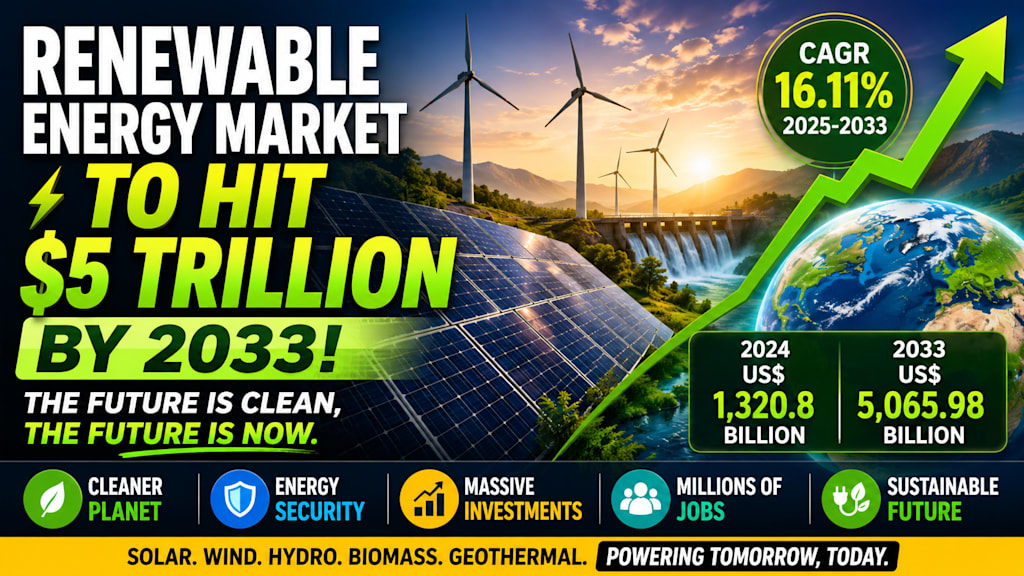
According to Renub Research, the Renewable Energy Market is projected to grow from US$ 1,320.8 billion in 2024 to an impressive US$ 5,065.98 billion by 2033, expanding at a CAGR of 16.11% during the forecast period from 2025 to 2033. This remarkable growth reflects the increasing demand for sustainable energy solutions, supportive government policies, and technological advancements that continue to make renewable energy more cost-effective and accessible.
The Rise of Renewable Energy in a Carbon-Conscious World
Renewable energy refers to power generated from naturally replenishing resources such as sunlight, wind, water, biomass, and geothermal heat. Unlike fossil fuels, these sources produce little to no greenhouse gas emissions and offer a sustainable pathway to meeting global energy needs.
Over the past decade, renewable energy has evolved from a niche industry into a mainstream economic force. The growing urgency to address climate change, coupled with concerns about energy security and rising electricity demand, has accelerated the transition away from fossil fuels.
Countries around the world are setting ambitious carbon reduction goals, implementing renewable energy mandates, and investing heavily in clean energy infrastructure. Businesses are also embracing renewable power as part of their Environmental, Social, and Governance (ESG) commitments, further driving market growth.
As renewable technologies become more efficient and affordable, the industry is attracting unprecedented levels of public and private investment.
Why Renewable Energy Demand Is Rising Rapidly
The world's appetite for electricity continues to grow as populations increase, urbanization expands, and industries become more digitized. Emerging technologies such as artificial intelligence, cloud computing, electric vehicles, and smart manufacturing are significantly increasing electricity consumption.
Meeting this demand through conventional fossil fuels would further intensify environmental challenges. Renewable energy offers an alternative that balances economic growth with environmental responsibility.
Consumers are also becoming more environmentally conscious. Residential users increasingly install rooftop solar systems, while businesses are purchasing renewable energy through long-term power purchase agreements (PPAs). This shift is creating strong demand across residential, commercial, and industrial sectors.
Wind Power Emerges as a Major Growth Engine
Among renewable energy technologies, wind power continues to demonstrate exceptional momentum.
Global wind installations reached approximately 117 GW in 2023, representing a substantial increase compared to the previous year. Advances in turbine technology, larger rotor designs, and improved grid integration capabilities have significantly enhanced efficiency while reducing costs.
Offshore wind projects are particularly attracting investor interest. Offshore locations often provide stronger and more consistent wind resources, enabling higher energy output compared to onshore facilities.
Governments across Europe, North America, and Asia-Pacific are supporting offshore wind expansion through favorable policies, long-term contracts, and investment incentives. As technology continues to improve, wind energy is expected to remain one of the fastest-growing segments within the renewable energy industry.
Government Policies Are Accelerating the Clean Energy Revolution
Government support remains one of the strongest drivers behind renewable energy adoption worldwide.
Many countries offer tax incentives, grants, subsidies, and feed-in tariffs that make renewable energy projects financially attractive. National clean energy targets and emission reduction commitments are encouraging utilities and industries to transition toward sustainable power generation.
India provides a compelling example of this trend. The Andhra Pradesh Integrated Clean Energy Policy announced major renewable energy investments aimed at expanding capacity, creating jobs, and attracting large-scale capital.
Governments are also investing in critical infrastructure such as energy storage systems, transmission networks, and smart grids. These investments help ensure that renewable power can be effectively integrated into existing electricity systems while maintaining reliability.
The result is a favorable ecosystem that supports continued renewable energy growth across multiple regions.
Climate Change Concerns Continue to Fuel Investments
The increasing frequency of extreme weather events, rising temperatures, and environmental degradation has intensified global concern about climate change.
Global carbon dioxide emissions from fossil fuels reached approximately 37.4 billion tons in 2024, highlighting the ongoing challenge of reducing greenhouse gas emissions. Renewable energy represents one of the most effective tools available for addressing this issue.
Solar, wind, hydroelectric, and geothermal power technologies generate electricity with significantly lower environmental impacts than coal, oil, or natural gas.
Beyond emissions reduction, renewable energy contributes to improved air quality, reduced water consumption, and better protection of natural ecosystems. These benefits are encouraging policymakers and investors to prioritize renewable infrastructure development on an unprecedented scale.
Technology Is Making Renewable Energy More Affordable
One of the most important developments supporting market growth is the rapid decline in renewable energy costs.
Solar photovoltaic panels have become dramatically cheaper over the past decade. Wind turbine efficiency has improved considerably, while battery storage technologies continue to become more affordable and effective.
Energy storage is particularly important because it helps address one of renewable energy's biggest challenges: intermittency. Modern battery systems allow excess solar and wind power to be stored and used when generation levels decline.
Artificial intelligence, predictive analytics, and digital monitoring systems are also improving energy production efficiency and reducing operational costs.
Together, these innovations are helping renewable energy compete directly with traditional fossil fuel-based power generation.
Challenges Facing the Renewable Energy Industry
Despite strong growth prospects, several obstacles continue to affect market expansion.
High Initial Investment Costs
Building renewable energy infrastructure often requires substantial upfront capital. Large-scale solar farms, offshore wind facilities, geothermal plants, and energy storage projects involve significant expenditures for equipment, installation, and land acquisition.
Although long-term operating costs are generally lower than fossil fuel alternatives, securing initial financing can remain challenging, particularly in developing economies.
Grid Integration Complexity
Renewable energy sources are inherently variable. Solar generation depends on sunlight, while wind energy relies on weather conditions.
Traditional electricity grids were originally designed around centralized fossil fuel plants providing steady output. Integrating large volumes of decentralized renewable generation requires advanced grid management systems, upgraded transmission infrastructure, and energy storage solutions.
Without adequate modernization, grid stability and reliability can become concerns as renewable penetration increases.
United States Leads Through Innovation and Investment
The United States continues to play a major role in global renewable energy development.
Federal support, state-level incentives, and private-sector investment have helped accelerate solar, wind, and bioenergy deployment nationwide. Offshore wind has become a strategic priority, with several major projects moving forward along the Atlantic coast.
Grid modernization initiatives and energy storage investments are helping address integration challenges while strengthening the country's renewable energy ecosystem.
As demand for clean electricity grows, the United States is expected to remain a leading contributor to global renewable energy expansion.
Germany Continues to Advance Its Energiewende Vision
Germany remains one of the world's most influential renewable energy markets.
Through its Energiewende strategy, the country aims to reduce dependence on fossil fuels and nuclear energy while expanding renewable electricity generation.
Germany has made substantial investments in offshore wind infrastructure and continues to strengthen its renewable energy portfolio through strategic partnerships and acquisitions.
The country's commitment to achieving a largely renewable electricity system demonstrates how policy consistency and long-term planning can drive successful energy transformation.
India Becomes a Renewable Energy Powerhouse
India is emerging as one of the fastest-growing renewable energy markets globally.
The country's ambitious target of achieving 500 GW of non-fossil fuel capacity by 2030 is attracting significant domestic and international investment. Solar energy remains a major focus, supported by favorable government policies and declining technology costs.
Large-scale projects across states such as Rajasthan, Gujarat, Karnataka, and Andhra Pradesh are expanding India's renewable capacity at an impressive pace.
Private companies are also playing an increasingly important role, contributing billions of dollars toward solar, wind, and hybrid renewable energy developments.
Saudi Arabia Diversifies Through Clean Energy Investments
Saudi Arabia's renewable energy ambitions are transforming the Middle East's energy landscape.
As part of Vision 2030, the Kingdom aims to generate 50% of its electricity from renewable sources by the end of the decade.
Massive solar projects, strategic partnerships, and substantial financial commitments are supporting this transition. Investments from organizations such as ACWA Power, Saudi Aramco, and the Public Investment Fund demonstrate the country's determination to diversify beyond traditional oil revenues.
These initiatives are positioning Saudi Arabia as a significant renewable energy player within the region.
Top 10 Recent Developments in the Renewable Energy Industry
1. REplace Secures Funding for AI-Powered Site Selection
In May 2025, REplace raised USD 2.1 million to enhance renewable project development through artificial intelligence-driven site selection technology.
2. Toyota Boshoku America Launches Solar Project
Toyota Boshoku America initiated a 5.7 MW solar power project at its Kentucky facility in May 2025.
3. Australia Unveils Hunter Hydrogen Infrastructure Masterplan
The Hunter region announced a comprehensive hydrogen infrastructure roadmap in February 2025.
4. Nevada Announces Valmy Solar-Plus-Storage Project
Nevada introduced a USD 1.2 billion solar-plus-storage project in January 2025.
5. ReNew Commissions Major Solar Plant in Rajasthan
ReNew launched a 400 MW solar facility under a long-term power purchase agreement with SECI.
6. Siemens Energy Expands Grid Modernization Initiatives
The company continues investing in digital grid technologies to support renewable integration.
7. ABB Accelerates Smart Energy Solutions
ABB has strengthened its renewable energy infrastructure and automation portfolio.
8. Enel Increases Renewable Capacity Investments
Enel continues expanding solar and wind projects across multiple international markets.
9. Acciona Advances Sustainable Energy Projects
Acciona remains focused on large-scale renewable developments and clean infrastructure investments.
10. Invenergy Expands North American Renewable Portfolio
Invenergy continues developing utility-scale wind, solar, and storage projects across the continent.
The Future Outlook
The renewable energy market stands at the center of the global sustainability movement. Declining technology costs, supportive policies, increasing climate awareness, and growing corporate commitments are creating a powerful foundation for long-term expansion.
Emerging innovations in battery storage, green hydrogen, smart grids, and artificial intelligence will further improve efficiency and reliability. As countries pursue net-zero goals and energy independence, renewable energy is expected to become the dominant source of new power generation worldwide.
With trillions of dollars expected to flow into clean energy infrastructure over the coming decade, the sector offers enormous opportunities for investors, businesses, governments, and consumers alike.
Final Thoughts
Renewable energy is no longer simply an environmental initiative—it has become an economic necessity and a strategic priority. As the world navigates climate challenges, energy security concerns, and rising electricity demand, renewable technologies provide a practical and scalable solution.
The forecasted growth from US$ 1.32 trillion in 2024 to more than US$ 5.06 trillion by 2033 illustrates the magnitude of this transformation. Nations, corporations, and communities that embrace renewable energy today will be better positioned to thrive in tomorrow's low-carbon economy.
The clean energy revolution is already underway, and its impact will define the future of global development for decades to come.
About the Creator
Enjoyed the story? Support the Creator.
Subscribe for free to receive all their stories in your feed.
Comments
There are no comments for this story
Be the first to respond and start the conversation.