
Radiology Information System Market Is Quietly Becoming the Digital Backbone of Modern Imaging
Rising diagnostic volumes, healthcare digitization, cloud adoption, and AI integration are pushing RIS from a support tool into a strategic necessity.

A market moving from back office to frontline infrastructure
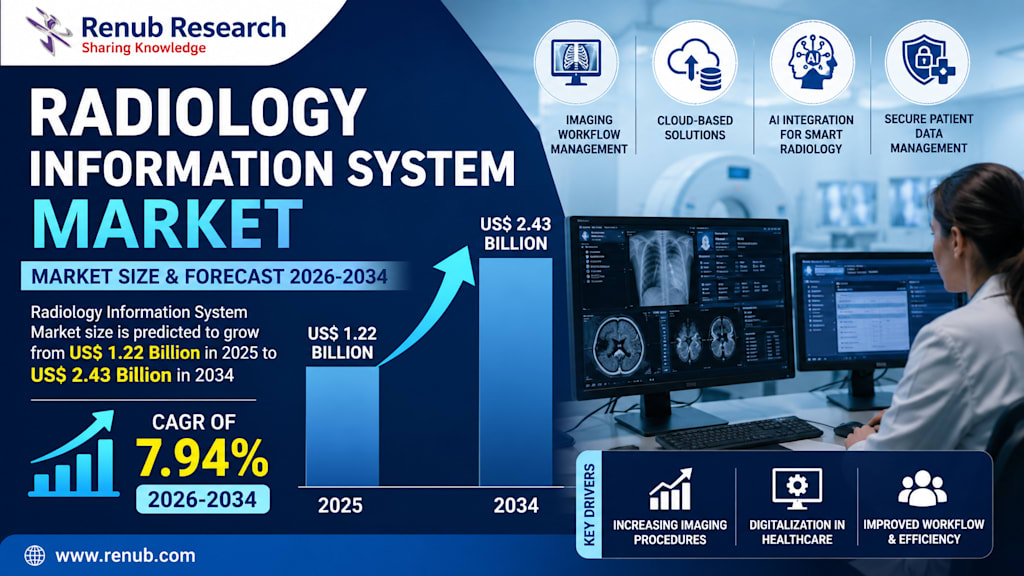
The Radiology Information System market is entering a stronger growth phase, and the numbers point to a clear shift in how hospitals and imaging centers think about workflow technology. According to Renub Research, the market is expected to rise from US$ 1.22 billion in 2025 to US$ 2.43 billion by 2034, expanding at a CAGR of 7.94% from 2026 to 2034. That growth is being fueled by rising imaging volumes, broader digitalization in healthcare, and the need for tighter workflow management across radiology departments. PACS integration, cloud deployment, and AI-enabled tools are adding further momentum to the market.
What makes this market especially interesting is that RIS is no longer being viewed as a simple administrative layer. It is increasingly becoming a core operational system that connects registration, scheduling, reporting, image handling, and billing inside one framework. In practical terms, that means RIS is helping healthcare organizations do more than keep records: it is helping them reduce friction, improve speed, and support better patient care.
Why RIS is becoming essential in radiology
Radiology departments today are under pressure from both sides. On one side, patient volumes are rising because of the growing burden of cancer, cardiovascular disease, and neurological disorders. On the other side, hospitals are being asked to deliver faster results, fewer errors, and better coordination across departments. Diagnostic imaging procedures such as MRI, CT scans, X-rays, and ultrasounds are central to early diagnosis and treatment, and that makes efficient information management a priority rather than a convenience. Renub Research notes that the rising incidence of chronic disease and the aging population are major reasons the market is seeing higher RIS adoption across hospitals, diagnostic centers, and clinics.
That pressure has made workflow efficiency a decisive factor in market growth. RIS platforms automate appointment scheduling, exam procedures, reporting, and billing, which reduces administrative bottlenecks and allows radiologists and staff to focus more on patients. Faster communication between departments can also reduce reporting delays and improve clinical decisions. In a healthcare environment where time matters, that kind of operational lift is valuable.
Digital transformation is the real growth engine
The broader healthcare industry is rapidly shifting toward digital systems, and RIS fits directly into that transition. Manual, paper-based processes are giving way to automated electronic workflows, and RIS is one of the systems helping that change happen in imaging departments. Integration with Electronic Health Records and PACS makes it easier to access both patient information and imaging data from a single environment, which improves coordination and cuts down on duplication and manual entry. Governments and private investors are also increasing healthcare IT spending, which is strengthening the case for more advanced RIS platforms.
Cloud-based RIS is especially important in this shift. Its scalability, cost-effectiveness, remote access, and lower hardware dependence make it attractive to healthcare providers that want flexibility without building heavy local infrastructure. The report highlights that cloud-based RIS is becoming a preferred choice as telemedicine and remote diagnostics expand, and that trend is helping the market broaden beyond large urban hospitals into smaller and mid-sized facilities as well.
AI is also beginning to reshape expectations. Renub Research cites the AI-driven workflow momentum in North America, including solutions focused on interoperability, automated study distribution, and AI-based reporting. This matters because AI is not only improving image interpretation; it is also improving how work moves through the radiology department. That combination of intelligence and automation is part of why RIS is becoming more strategic in the healthcare technology stack.
Integration is shaping the next phase of the market
One of the strongest themes in the RIS market is integration. Healthcare providers increasingly want systems that can connect RIS with PACS, EHR, and Hospital Information Systems so that data flows smoothly without manual duplication. Integrated RIS improves communication across departments, accelerates diagnosis, and supports real-time access to accurate information. For hospitals trying to improve care delivery while controlling complexity, that kind of connected environment is becoming the standard to aim for.
The hardware side of the market remains important too. Servers, workstations, storage devices, and networking infrastructure are still needed to support imaging data, reporting, and secure access. As imaging volumes rise and facilities continue digitizing records, they need hardware that can support both performance and data security. This is why the market is not only about software adoption; it is also about upgrading the physical infrastructure that makes modern radiology possible.
Service demand is expanding alongside technology demand. Implementation support, training, maintenance, and consulting services are increasingly needed as hospitals adopt RIS and try to make it work smoothly in real-world environments. For many providers, the software itself is only part of the purchase decision; the ability to deploy, train, secure, and maintain the system is just as important.
Web-based RIS is another important layer in the market’s evolution. Because it runs through internet browsers, it removes the need for local installation and gives healthcare professionals access to information from different locations. That makes it especially useful for smaller organizations and for health systems that operate across multiple sites. As remote care, distributed teams, and flexible access become more common, web-based RIS is gaining relevance.
The market still faces two major obstacles
Despite the strong outlook, the Radiology Information System market is not without challenges. Cost remains a major barrier, especially for smaller hospitals and healthcare facilities in developing regions. Implementation can be expensive because it includes software, hardware, staff training, upgrades, and integration with existing systems such as EHR and PACS. Even when cloud-based models reduce some of the burden, the overall cost of adoption can still slow penetration.
Data security and privacy also remain critical concerns. RIS handles confidential patient information, which makes it a target in an environment where cybercrime, unauthorized access, and data breaches are persistent threats. Healthcare providers need encryption, access controls, and stronger governance to keep systems safe, but those protections also add complexity and expense. For many organizations, security is not just a technical requirement; it is a trust issue.
Regional growth is uneven, but the direction is clear
North America and Europe currently lead RIS adoption because of their more advanced healthcare systems and stronger digital infrastructure. The report also points to increasing uptake across Asia-Pacific, Latin America, and the Middle East, where healthcare modernization is creating new demand for digital radiology tools. That suggests the market’s growth story is increasingly global, not just concentrated in mature economies.
The United States remains one of the most advanced RIS markets. Strong healthcare infrastructure, a growing emphasis on digital health, and broad adoption of EHR systems are helping drive implementation. Chronic disease burden and the presence of major health IT companies are also supporting adoption, while the US Health Information Technology Final Rule has reinforced the move toward interoperable digital systems.
The United Kingdom is also seeing steady growth, supported by NHS digitalization efforts and the broader push to improve imaging workflows and patient care. The report highlights continued adoption of cloud-based RIS because of its flexibility and lower cost, while also noting recent advances in radiology informatics and imaging interoperability.
India is emerging as a fast-growing market, supported by healthcare investment, rising diagnostic volumes, and stronger private diagnostic infrastructure. The growing need for CT, MRI, and ultrasound, along with government support for digital healthcare, is helping RIS gain traction. Cloud-based systems are especially attractive in India because they offer scale and affordability.
Saudi Arabia is another important growth market, driven by healthcare modernization and the country’s Vision 2030 digital transformation goals. The report points to rising chronic disease prevalence, stronger diagnostic demand, and growing interest in cloud-based RIS. That makes the region a promising long-term growth area as healthcare systems continue to modernize.
Competitive landscape and where the market is headed
The market’s competitive base includes major global health technology names such as Koninklijke Philips, Siemens Healthineers, Oracle, McKesson, GE HealthCare, Fujifilm, Shimadzu, Hologic, and Sectra. That roster tells an important story: RIS is not a niche software category anymore. It sits inside a broader ecosystem of enterprise healthcare IT, imaging, and connected diagnostics, where scale, interoperability, and innovation all matter.
Looking ahead, the strongest opportunities appear to be in integrated, cloud-based, and AI-supported RIS platforms. Hospitals want systems that are easier to deploy, simpler to maintain, and capable of connecting departments without delays. They also want solutions that can support imaging growth without creating administrative overload. In that sense, the market’s future is not just about digitizing radiology; it is about building a smarter, faster, and more connected diagnostic workflow.
Final thoughts
The Radiology Information System market is growing because healthcare itself is changing. Imaging volumes are rising, hospitals are digitizing faster, and providers are under pressure to improve efficiency without sacrificing accuracy. RIS sits right at the center of that shift. It helps radiology departments manage daily operations, connect with other hospital systems, and keep pace with modern demands. With the market projected to nearly double by 2034, RIS is moving from a support function to a strategic healthcare investment.
About the Creator
Enjoyed the story? Support the Creator.
Subscribe for free to receive all their stories in your feed.
Comments
There are no comments for this story
Be the first to respond and start the conversation.