
Proton Therapy Market Gains Momentum as Precision Cancer Care Becomes a Global Priority
Rising cancer cases, technological advancements, and increasing demand for targeted radiation treatments are driving significant growth in the proton therapy market.

Cancer remains one of the world's most pressing healthcare challenges, affecting millions of people every year and placing enormous pressure on healthcare systems globally. As cancer incidence continues to rise, medical professionals and researchers are increasingly focused on developing treatment methods that improve outcomes while minimizing side effects.
Among the most promising innovations in modern oncology is proton therapy, an advanced form of radiation treatment that offers exceptional precision compared to conventional radiation techniques. By delivering highly targeted proton beams directly to tumors while minimizing exposure to surrounding healthy tissues, proton therapy is transforming how certain cancers are treated.
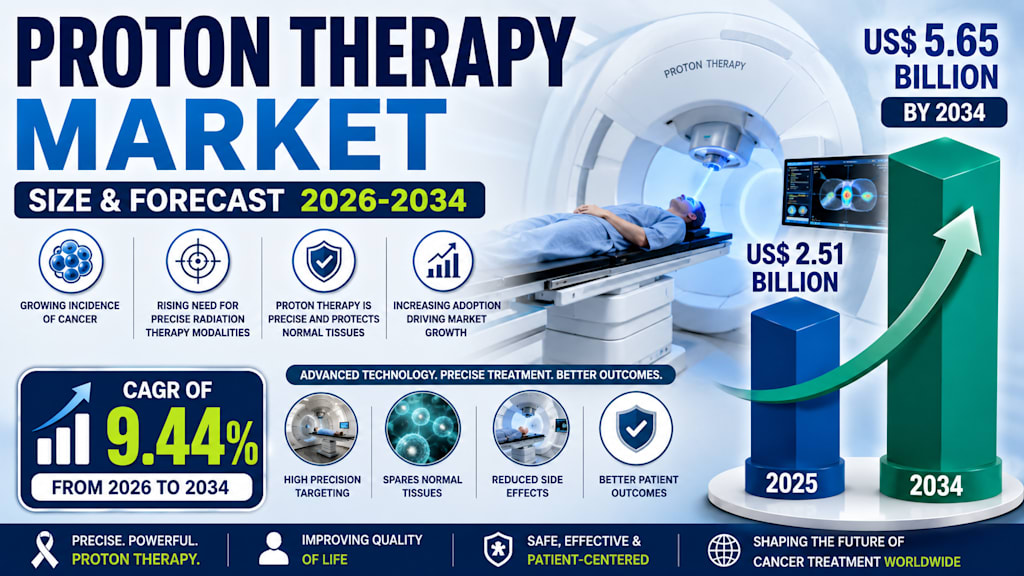
The growing demand for safer and more effective cancer therapies is contributing to significant market expansion. The global proton therapy market is projected to grow from US$ 2.51 billion in 2025 to US$ 5.65 billion by 2034, registering a compound annual growth rate (CAGR) of 9.44% during the forecast period. Rising cancer prevalence, technological innovation, increased investment in specialized treatment centers, and growing awareness of precision oncology are all supporting the market's long-term growth trajectory.
As healthcare providers seek treatment approaches that maximize effectiveness while reducing treatment-related complications, proton therapy is becoming an increasingly important component of modern cancer care.
Understanding Proton Therapy
Proton therapy is an advanced radiation treatment that uses high-energy proton particles rather than traditional X-rays to destroy cancer cells.
Unlike conventional radiation therapy, which continues to release energy as it passes through the body, proton beams deliver most of their energy directly at the tumor site through a phenomenon known as the Bragg Peak. This unique characteristic allows physicians to target tumors with remarkable precision while significantly reducing radiation exposure to nearby healthy tissues and critical organs.
This advantage is particularly important when treating cancers located near sensitive structures such as the brain, spinal cord, heart, eyes, and major blood vessels.
The technology has proven especially valuable in treating pediatric cancers, brain tumors, head and neck cancers, prostate cancer, lung cancer, and various complex malignancies where minimizing collateral tissue damage is essential.
As clinical evidence continues to grow, proton therapy is increasingly recognized as a key advancement in precision cancer treatment.
Rising Global Cancer Burden Is Driving Demand
One of the primary factors fueling growth in the proton therapy market is the increasing global incidence of cancer.
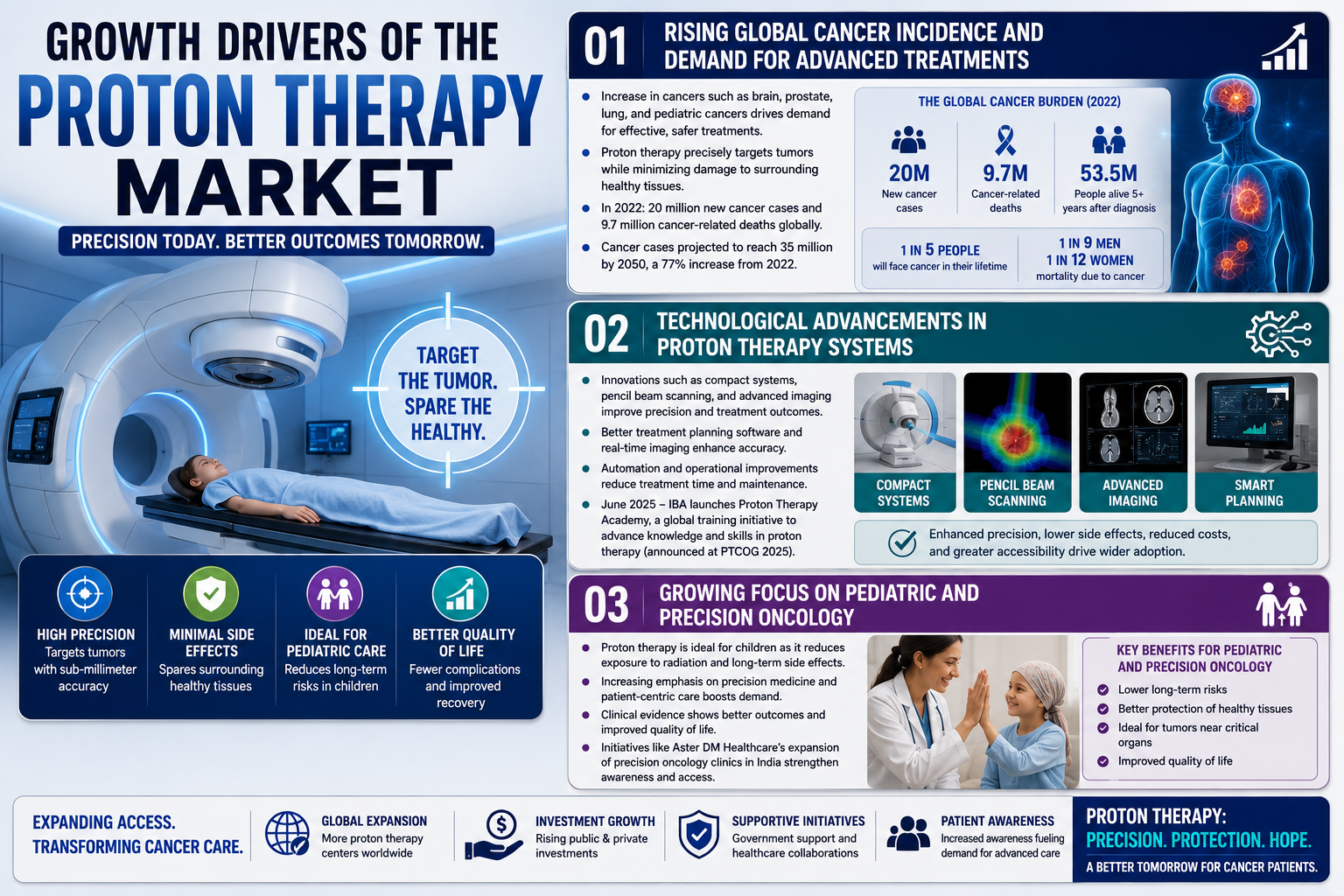
Cancer cases continue to rise due to aging populations, lifestyle changes, environmental factors, and improved diagnostic capabilities. According to international estimates referenced in the market report, approximately 20 million new cancer cases and 9.7 million cancer-related deaths occurred globally in 2022. The number of new cancer cases is expected to increase substantially in the coming decades, creating greater demand for advanced treatment solutions.
As healthcare systems confront this growing burden, there is increasing emphasis on treatments that offer both effectiveness and improved quality of life for patients.
Traditional radiation therapy remains an important treatment option, but concerns regarding long-term side effects and damage to healthy tissues have encouraged the adoption of more targeted alternatives. Proton therapy addresses these concerns by allowing clinicians to deliver higher radiation doses directly to tumors while minimizing exposure elsewhere.
This capability is making proton therapy increasingly attractive for both physicians and patients seeking safer treatment options.
Technological Innovation Is Transforming the Market
Continuous technological advancements are playing a crucial role in expanding the proton therapy market.
Historically, proton therapy facilities required enormous infrastructure investments, making them accessible only to a limited number of specialized medical centers. However, recent innovations have significantly improved efficiency, reduced facility requirements, and lowered operational complexity.
Compact proton therapy systems are among the most important developments. These systems require less physical space and lower capital investment compared to traditional multi-room facilities, making proton therapy more accessible to hospitals and cancer centers.
Advances in pencil beam scanning technology have also improved treatment precision. This technique allows clinicians to direct proton beams with exceptional accuracy, conforming radiation delivery to the shape of the tumor while sparing surrounding tissues.
Improved imaging integration, treatment planning software, and real-time monitoring systems further enhance treatment accuracy and patient outcomes.
Automation is also helping reduce treatment times and streamline workflows, increasing operational efficiency while improving patient experience.
As technology continues to evolve, proton therapy is becoming more scalable and economically viable for healthcare providers worldwide.
Precision Oncology Is Expanding Adoption
The growing focus on precision medicine has significantly increased interest in proton therapy.
Precision oncology emphasizes individualized treatment approaches tailored to the specific characteristics of each patient's cancer. Proton therapy aligns closely with this philosophy by enabling highly targeted radiation delivery based on tumor location, size, and surrounding anatomy.
The ability to minimize radiation exposure to healthy tissues is particularly valuable in complex cancer cases where conventional treatments may pose substantial risks.
Patients increasingly seek therapies that not only improve survival rates but also preserve quality of life during and after treatment. Proton therapy's precision helps reduce complications such as cognitive impairment, organ damage, swallowing difficulties, and other long-term side effects associated with traditional radiation therapy.
As healthcare providers continue adopting patient-centered treatment models, proton therapy is becoming an increasingly important tool within comprehensive cancer care programs.
Pediatric Cancer Treatment Remains a Key Application
One of the most significant advantages of proton therapy lies in pediatric oncology.
Children are especially vulnerable to the long-term effects of radiation because their bodies and organs are still developing. Exposure to unnecessary radiation can increase the risk of developmental issues, secondary cancers, and other health complications later in life.
Proton therapy helps address these concerns by minimizing radiation exposure beyond the targeted treatment area.
As awareness of these benefits grows, many pediatric oncology centers are incorporating proton therapy into treatment protocols for appropriate cases. Clinical evidence supporting improved safety profiles and reduced long-term complications continues to strengthen the case for broader adoption.
For many healthcare professionals, pediatric applications represent one of the strongest arguments for expanding proton therapy availability worldwide.
Expanding Applications Across Multiple Cancer Types
While proton therapy is often associated with pediatric cancer treatment, its applications extend far beyond this area.
The head and neck cancer segment has emerged as an important growth area due to the complexity of treating tumors located near critical structures. Proton therapy's precision helps reduce side effects such as dry mouth, swallowing difficulties, and damage to nearby organs.
The prostate cancer segment is also experiencing significant growth. Proton therapy allows radiation to be delivered directly to prostate tumors while reducing exposure to the bladder and rectum, lowering the risk of treatment-related complications.
Similarly, proton therapy is increasingly used in lung cancer treatment, particularly for tumors located near the heart or spinal cord. The ability to spare healthy lung tissue is especially valuable for patients with compromised respiratory function.
As clinical research expands, additional cancer indications are expected to support future market growth.
Single-Room Systems Are Improving Accessibility
Accessibility has long been one of the biggest challenges facing the proton therapy industry.
Traditional proton therapy centers often require substantial capital investment, extensive construction, and large treatment facilities. These requirements have historically limited availability to major academic medical centers and specialized cancer institutions.
The development of single-room proton therapy systems is helping address this challenge.
These systems require less space, lower upfront investment, and faster installation compared to traditional multi-room facilities. As a result, mid-sized hospitals and regional cancer centers can now consider offering proton therapy services.
The growing adoption of single-room systems is expected to expand patient access while accelerating global market penetration.
Challenges Continue to Impact Market Expansion
Despite strong growth prospects, several challenges continue to affect the proton therapy market.
The most significant barrier remains the high cost associated with establishing and operating proton therapy facilities. Construction costs, advanced equipment requirements, specialized workforce training, and ongoing maintenance expenses can create substantial financial burdens for healthcare providers.
In many regions, reimbursement policies remain inconsistent, making it difficult for facilities to recover investments through patient treatment revenues alone.
Limited availability also affects patient access. Although the number of proton therapy centers continues to increase, facilities remain concentrated in specific geographic regions, creating travel and scheduling challenges for many patients.
Another challenge involves clinical evidence. While proton therapy has demonstrated clear benefits for pediatric cancers and certain complex cases, additional research is ongoing to establish comparative advantages across a broader range of cancer indications.
Addressing these challenges will be essential for sustaining long-term market growth.
Regional Markets Driving Growth
The United States remains the largest proton therapy market globally, supported by advanced healthcare infrastructure, significant research activity, and the highest concentration of operational proton therapy centers. Ongoing technological innovation and strong clinical adoption continue to position the country as a global leader in precision radiation therapy.
The United Kingdom is steadily expanding its proton therapy capabilities through government-supported investments and specialized treatment centers. Growing awareness among clinicians and successful patient outcomes are supporting market development across the region.
India represents one of the fastest-growing emerging markets. Rising cancer incidence, expanding healthcare infrastructure, increasing medical tourism, and investments in advanced oncology technologies are creating new opportunities for proton therapy adoption.
Saudi Arabia is also emerging as a promising market under Vision 2030. Government initiatives aimed at strengthening cancer care infrastructure and expanding access to advanced treatments are supporting proton therapy development throughout the country.
Together, these markets demonstrate the increasingly global demand for sophisticated cancer treatment technologies.
Looking Toward the Future
The future of the proton therapy market appears highly promising.
Continued advances in technology, increasing clinical evidence, growing awareness among healthcare professionals, and expanding cancer treatment infrastructure are expected to drive further adoption.
Future innovations may focus on reducing treatment costs, improving automation, enhancing imaging integration, and expanding accessibility through compact treatment systems.
As healthcare systems continue prioritizing precision medicine and patient-centered care, proton therapy is likely to play an increasingly important role within comprehensive oncology programs.
The combination of technological progress and rising demand for targeted therapies positions proton therapy as one of the most influential developments in modern cancer treatment.
Final Thoughts
Proton therapy is redefining radiation oncology by offering a highly precise treatment option that minimizes damage to healthy tissues while effectively targeting cancerous cells. Its growing use in pediatric cancers, brain tumors, prostate cancer, lung cancer, and head and neck malignancies highlights its expanding importance within modern healthcare.
With the global proton therapy market projected to grow from US$ 2.51 billion in 2025 to US$ 5.65 billion by 2034, the industry is entering a period of sustained expansion. Rising cancer incidence, technological innovation, increasing investment in treatment centers, and the growing emphasis on precision oncology will continue driving adoption worldwide.
As healthcare providers seek more effective and patient-friendly cancer treatments, proton therapy is poised to become an increasingly critical component of the future oncology landscape.
About the Creator
Enjoyed the story? Support the Creator.
Subscribe for free to receive all their stories in your feed.
Comments
There are no comments for this story
Be the first to respond and start the conversation.