
Prostate Cancer Diagnostics Market to Reach US$ 14.83 Billion by 2034 Amid Rising Cancer Awareness
Advancements in AI-powered diagnostics, early screening initiatives, and growing aging populations are accelerating demand across the global prostate cancer diagnostics industry.

Market Overview
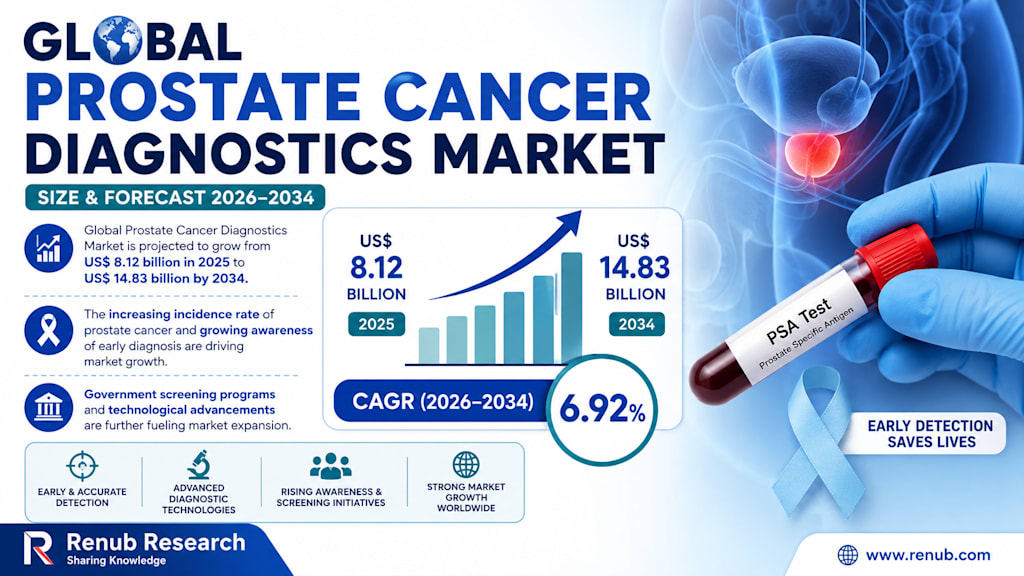
The global prostate cancer diagnostics market is witnessing strong expansion as healthcare systems increasingly focus on early cancer detection and preventive healthcare. According to the Renub Research data provided in the source file, the market is projected to grow from US$ 8.12 billion in 2025 to US$ 14.83 billion by 2034, registering a CAGR of 6.92% from 2026 to 2034.
The increasing prevalence of prostate cancer, growing awareness regarding early diagnosis, and government-supported screening initiatives are major factors supporting industry growth. In addition, rapid advancements in imaging technologies, molecular diagnostics, biomarker testing, and artificial intelligence are transforming the way prostate cancer is detected and monitored.
Prostate cancer diagnostics include a wide range of tests and procedures designed to identify, evaluate, and monitor prostate cancer in men. These include prostate-specific antigen (PSA) tests, digital rectal examinations, MRI scans, ultrasound imaging, genomic testing, and biomarker-based diagnostics.
Rising Prostate Cancer Cases Are Driving Diagnostic Demand
One of the most important drivers of the prostate cancer diagnostics market is the increasing incidence of prostate cancer worldwide. The disease is now considered one of the most common cancers among men, especially individuals over the age of 50.
The report highlights that approximately 1.5 million men are diagnosed with prostate cancer every year globally. Aging populations across both developed and developing economies are contributing significantly to the increase in patient numbers.
As life expectancy rises worldwide, healthcare systems are witnessing higher rates of age-related diseases, including prostate cancer. Governments and healthcare organizations are therefore promoting awareness campaigns and routine screening programs to encourage early detection.
Early diagnosis plays a crucial role in improving survival rates and lowering long-term treatment costs. This has increased the importance of reliable and accessible diagnostic tools across hospitals, diagnostic centers, and outpatient clinics.
Technological Advancements Are Transforming Diagnostics
Technology is rapidly reshaping the prostate cancer diagnostics landscape. Traditional diagnostic approaches such as PSA testing and biopsies are now being enhanced by advanced imaging systems and molecular diagnostics.
Multiparametric MRI, targeted ultrasound, biomarker testing, and genomic analysis are helping physicians identify cancer with greater precision and lower invasiveness. Artificial intelligence and machine learning technologies are also improving the accuracy and efficiency of imaging interpretation and cancer detection.
One of the most notable developments mentioned in the report occurred in December 2024, when the University of Texas Medical Branch became the first healthcare system in Texas to integrate an AI-powered prostate cancer detection tool into routine pathology practice. The AI system developed by Ibex creates digital overlays on prostate biopsy images to assist pathologists in identifying cancer more accurately.
The emergence of liquid biopsy technologies is also creating new opportunities for non-invasive cancer detection and monitoring. These innovations are expected to improve patient experience while supporting more personalized treatment approaches.
Government Screening Programs Are Supporting Market Growth
Government-backed awareness and screening programs are becoming major growth catalysts for the prostate cancer diagnostics market.
Public health campaigns are helping educate men about the importance of early screening and routine check-ups. Many countries are expanding access to diagnostic services and introducing reimbursement policies that reduce the financial burden on patients.
Healthcare systems are increasingly prioritizing preventive care as a strategy to reduce advanced-stage cancer cases and improve long-term patient outcomes. Developed countries with strong healthcare infrastructure are especially benefiting from organized screening initiatives.
The report also references a major FDA development from March 2022, when the agency approved 177Lu-PSMA-617, a treatment designed for metastatic prostate cancer. The therapy demonstrated the ability to reduce mortality risk by 38%, highlighting the importance of advanced diagnostics in identifying eligible patients.
High Costs Remain a Significant Challenge
Despite technological progress, the prostate cancer diagnostics market faces major financial challenges.
Advanced diagnostic technologies such as multiparametric MRI, genomic sequencing, and biomarker analysis require expensive equipment and highly skilled medical professionals. These factors significantly increase testing costs, particularly in developing countries and underserved regions.
Even in developed markets, some patients avoid advanced diagnostics because of affordability concerns. This creates barriers to widespread adoption and limits access to cutting-edge healthcare technologies.
Healthcare systems and diagnostic companies are therefore focusing on improving cost efficiency while maintaining high diagnostic accuracy.
Concerns About False Positives and Overdiagnosis
Another major concern in the prostate cancer diagnostics market is the risk of overdiagnosis and false-positive test results.
Elevated PSA levels are not always linked to prostate cancer. Conditions such as prostatitis or benign prostate enlargement can also cause abnormal PSA readings. This may lead to unnecessary anxiety, biopsies, and invasive procedures for patients.
Healthcare providers are increasingly emphasizing the need for more accurate diagnostic methods capable of distinguishing aggressive cancers from low-risk conditions. Advances in biomarkers, AI-assisted imaging, and precision diagnostics are expected to help reduce diagnostic uncertainty over time.
Benign Prostatic Hyperplasia Diagnostics Market Expands
The diagnostics market for benign prostatic hyperplasia (BPH) is growing steadily due to rising cases of prostate enlargement among aging men.
BPH is a non-cancerous condition that affects urinary function and often requires early medical evaluation. Common diagnostic procedures include PSA testing, digital rectal examinations, ultrasound imaging, and urine flow analysis.
Increasing awareness regarding men’s health and preventive screening is supporting demand for BPH diagnostic services globally.
Small Cell Carcinoma Diagnostics Gain Importance
Although small cell carcinoma is less common in prostate cancer cases, its highly aggressive nature makes rapid diagnosis essential.
Advanced imaging methods such as CT scans, MRI, PET scans, biopsy analysis, and molecular diagnostics are increasingly used to identify this rare but dangerous cancer type. Biomarker technologies are also improving diagnostic precision and supporting research efforts in oncology.
Growing awareness regarding aggressive prostate cancers is expected to support further expansion of this diagnostic segment.
Preliminary Testing Segment Remains Critical
Preliminary diagnostic tests remain the foundation of prostate cancer screening and risk evaluation.
PSA blood tests, digital rectal examinations, and basic imaging techniques are widely used as first-line diagnostic tools because they are cost-effective and accessible. Governments and healthcare organizations continue encouraging routine screening among high-risk populations.
As preventive healthcare gains more attention globally, demand for preliminary screening services is expected to continue increasing steadily.
Hospitals Continue Leading Diagnostic Services
Hospitals remain one of the largest end-user segments in the prostate cancer diagnostics market.
They provide integrated diagnostic capabilities including imaging, pathology, biopsy services, laboratory testing, and multidisciplinary oncology expertise. Hospitals are particularly important for managing complex or high-risk cancer cases.
Increasing healthcare investments and improvements in hospital infrastructure are further enhancing diagnostic capabilities worldwide.
Diagnostic Centers Gain Popularity
Diagnostic centers are emerging as an increasingly important part of the prostate cancer diagnostics ecosystem.
Patients are increasingly choosing diagnostic centers because they often offer shorter waiting times, lower costs, and specialized outpatient services. Many centers are equipped with advanced diagnostic technologies while maintaining operational efficiency.
As healthcare systems move toward decentralization and outpatient care models, diagnostic centers are expected to capture a larger share of routine screening and testing services.
United States Market Outlook
The United States remains one of the most advanced prostate cancer diagnostics markets globally due to strong healthcare infrastructure, advanced technology adoption, and high awareness regarding cancer screening.
Hospitals and diagnostic centers across the country are investing heavily in AI-based diagnostics, imaging systems, and molecular testing technologies. Favorable reimbursement policies and strong government initiatives continue supporting market growth.
In March 2025, AbbVie announced new oncology research developments and investigational molecules at the AACR Annual Meeting, further highlighting ongoing innovation in prostate cancer research and diagnostics.
United Kingdom Market Outlook
The UK prostate cancer diagnostics market is supported by a strong public healthcare system and increasing awareness regarding early cancer detection.
The National Health Service (NHS) plays a major role in providing accessible diagnostic services and promoting screening initiatives for high-risk populations. Adoption of MRI-guided diagnostics and advanced biopsy techniques is also increasing across the country.
Despite budget pressures, efforts to improve healthcare efficiency and reduce waiting times are expected to support long-term market growth.
India Market Outlook
India’s prostate cancer diagnostics market is growing rapidly due to rising healthcare awareness, urbanization, and improvements in medical infrastructure.
Although awareness levels remain relatively lower in rural areas, increasing education campaigns and healthcare access are encouraging more men to undergo routine screening. Diagnostic centers in major cities are increasingly adopting advanced technologies to improve testing accuracy.
In January 2023, Mumbai-based BDR Pharmaceutical launched the first generic Apalutamide treatment for metastatic and non-metastatic prostate cancer in India, strengthening the country’s oncology ecosystem.
Saudi Arabia Market Outlook
Saudi Arabia’s prostate cancer diagnostics market is witnessing gradual growth due to rising healthcare investments and increasing public awareness regarding cancer diagnosis.
The Saudi government continues focusing on improving healthcare infrastructure and encouraging preventive healthcare initiatives. Adoption of advanced diagnostic technologies is also increasing steadily.
In January 2026, ImmunityBio announced that the Saudi Food and Drug Authority approved commercialization of ANKTIVA for specific bladder cancer treatments, reflecting the country’s broader commitment to oncology innovation.
Recent Developments in the Prostate Cancer Diagnostics Industry
University of Texas Medical Branch integrated AI-powered prostate cancer detection technology into pathology workflows in December 2024.
FDA approved 177Lu-PSMA-617 treatment for metastatic prostate cancer in March 2022.
AbbVie presented oncology pipeline developments at the AACR Annual Meeting in March 2025.
Astellas Pharma presented advanced cancer research data at the 2024 ESMO congress.
BDR Pharmaceutical launched India’s first generic Apalutamide therapy in January 2023.
ImmunityBio received Saudi regulatory approval for ANKTIVA commercialization in January 2026.
F. Hoffmann-La Roche AG continues expanding molecular diagnostic and oncology testing capabilities globally.
Thermo Fisher Scientific is investing in precision oncology and biomarker-based diagnostic technologies.
Siemens Healthineers continues advancing AI-powered imaging and diagnostic platforms for oncology applications.
Qiagen N.V. is strengthening its genomic and molecular testing portfolio for cancer diagnostics.
Competitive Landscape
Leading companies operating in the global prostate cancer diagnostics market include:
- F. Hoffmann-La Roche AG
- Bayer AG
- Thermo Fisher Scientific Inc.
- Abbott Laboratories Inc.
- Siemens Healthineers AG
- Becton Dickinson and Company
- Agilent Technologies Inc.
- Hologic Inc.
- Qiagen N.V.
- OPKO Health Inc.
Final Thoughts
The prostate cancer diagnostics market is evolving rapidly as healthcare systems worldwide prioritize early detection, precision medicine, and AI-assisted healthcare technologies.
While challenges such as high costs and diagnostic inaccuracies remain important concerns, ongoing technological innovation and government-backed awareness programs are expected to support sustained growth over the coming decade.
As aging populations continue increasing globally and demand for preventive healthcare rises, the prostate cancer diagnostics industry is likely to remain a critical component of the broader oncology ecosystem.
About the Creator
Enjoyed the story? Support the Creator.
Subscribe for free to receive all their stories in your feed.
Comments
There are no comments for this story
Be the first to respond and start the conversation.