
Printing the Future: How Advanced 3D Printing Powders Are Powering the Next Industrial Revolution
From aerospace engines and medical implants to automotive innovation and digital manufacturing, high-performance 3D printing powders are becoming the foundation of modern additive manufacturing worldwide.

Manufacturing is undergoing one of the most significant transformations since the Industrial Revolution.
For decades, factories relied on traditional methods such as casting, forging, machining, and molding to produce parts and products. While these techniques remain essential, a new generation of manufacturing technologies is reshaping how industries design, prototype, and produce components.
At the center of this transformation is additive manufacturing, commonly known as 3D printing.
Unlike conventional manufacturing processes that remove material from a solid block, additive manufacturing builds components layer by layer, enabling the production of highly complex structures with exceptional precision and minimal waste.
However, the success of modern 3D printing depends heavily on one critical ingredient: high-quality printing powders.
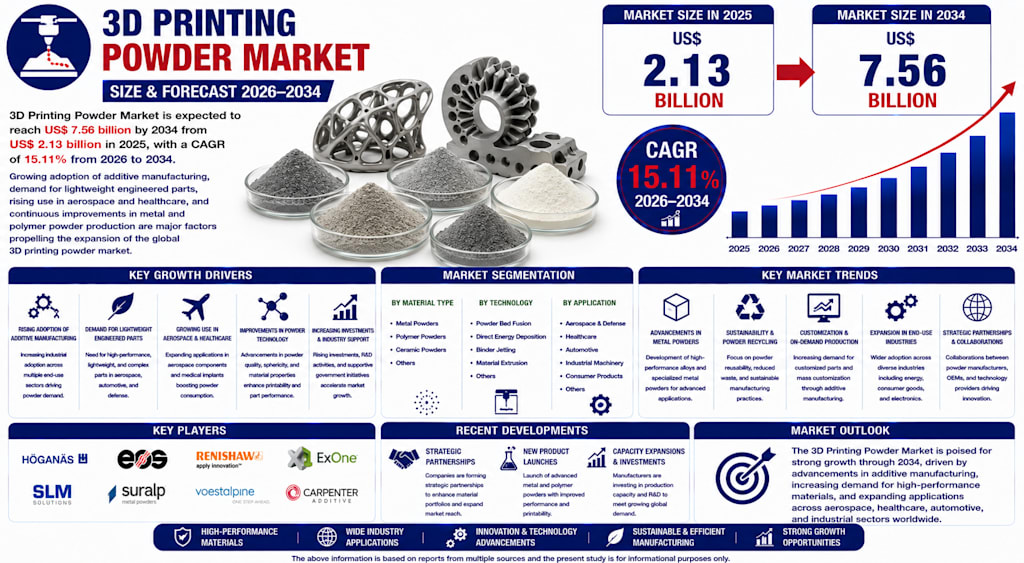
According to Renub Research, the Global 3D Printing Powder Market is expected to grow from US$ 2.13 billion in 2025 to US$ 7.56 billion by 2034, expanding at a strong compound annual growth rate (CAGR) of 15.11% between 2026 and 2034. Rising adoption of additive manufacturing, growing demand for lightweight engineered components, increasing use in aerospace and healthcare applications, and continuous advancements in metal and polymer powder technologies are driving this remarkable growth.
As industries increasingly embrace digital manufacturing, 3D printing powders are becoming a strategic resource for innovation, efficiency, and competitiveness.
Understanding 3D Printing Powders
3D printing powders are specially engineered materials used in additive manufacturing technologies such as:
Selective Laser Sintering (SLS), Selective Laser Melting (SLM), and Electron Beam Melting (EBM).
These powders are carefully manufactured to achieve precise particle size distributions, spherical particle shapes, excellent flow characteristics, and consistent chemical composition.
The quality of the powder directly influences:
Print accuracy, surface finish, mechanical strength, density, durability, and overall performance of the finished component.
Common powder categories include:
Metal powders, polymer powders, ceramic powders, glass powders, and specialty materials.
Metals such as titanium, aluminum, stainless steel, cobalt-chromium, and nickel alloys are widely used for high-performance industrial applications.
Polymer powders such as nylon are frequently utilized for prototyping, functional parts, and lightweight manufacturing.
Because additive manufacturing depends on precision at every stage, powder quality remains one of the most important factors influencing success.
Additive Manufacturing Is Moving Beyond Prototyping
In its early years, 3D printing was primarily associated with rapid prototyping.
Today, that perception has changed dramatically.
Manufacturers increasingly use additive manufacturing for full-scale production of critical components rather than merely testing concepts.
Several factors are driving this transition:
Reduced material waste, faster development cycles, lower tooling costs, greater design flexibility, and the ability to manufacture complex geometries that traditional methods cannot easily produce.
Companies across aerospace, automotive, healthcare, energy, and industrial sectors are integrating additive manufacturing into mainstream production strategies.
As production volumes increase, demand for reliable and high-performance powders continues to grow.
This shift from prototyping to production represents one of the most important drivers of long-term market expansion.
Aerospace and Defense Lead Market Growth
The aerospace and defense sector remains one of the most influential users of 3D printing powders.
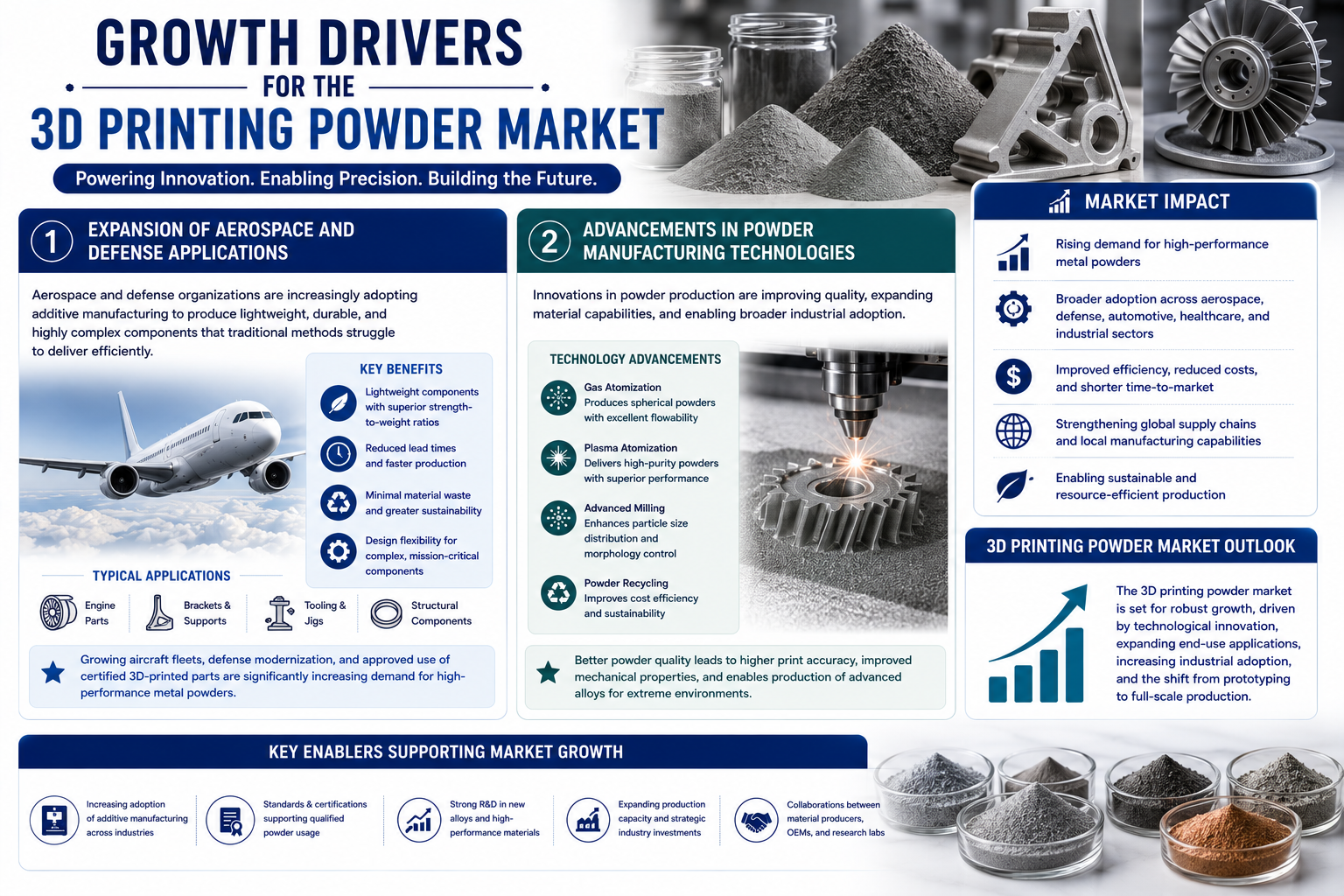
Aircraft manufacturers and defense contractors increasingly rely on additive manufacturing to produce lightweight, high-strength components capable of withstanding extreme operating conditions.
Materials such as:
Titanium alloys, nickel-based superalloys, and advanced aluminum powders are widely used in engine components, structural parts, brackets, tooling systems, and aerospace assemblies.
The benefits are substantial.
Additive manufacturing enables:
Weight reduction, fuel efficiency improvements, shorter production cycles, reduced waste, and enhanced design flexibility.
As commercial aviation expands and defense organizations modernize equipment, demand for aerospace-grade powders continues rising.
Because reliability and performance are critical in these industries, certified metal powders remain essential to future growth.
Healthcare Is Unlocking New Possibilities
Healthcare has emerged as another major growth engine for the 3D printing powder market.
Medical professionals increasingly use additive manufacturing to create customized products tailored to individual patient needs.
Applications include:
Orthopedic implants, dental restorations, prosthetics, surgical instruments, cranial implants, and patient-specific medical devices.
Biocompatible powders such as titanium and cobalt-chromium are particularly valuable because they combine strength, durability, and biological compatibility.
One of the most exciting advantages of additive manufacturing is the ability to create porous structures that encourage bone integration and improve healing outcomes.
Healthcare organizations are also investing in in-house additive manufacturing capabilities to reduce lead times and improve treatment personalization.
As demand for customized healthcare solutions grows, consumption of specialized medical-grade powders is expected to increase significantly.
Powder Manufacturing Technology Is Rapidly Advancing
Continuous innovation in powder production is helping unlock new industrial applications.
Modern manufacturing techniques such as:
Gas atomization, plasma atomization, and advanced milling technologies produce powders with superior consistency and performance.
These processes create highly spherical particles with excellent flow characteristics and predictable melting behavior.
The result is improved:
Print quality, material density, mechanical performance, and manufacturing efficiency.
Researchers are also developing new alloys capable of withstanding extreme temperatures, pressures, and environmental conditions.
At the same time, improved powder recycling technologies are helping reduce waste and lower production costs.
As additive manufacturing systems become more sophisticated, demand for premium-quality powders with tighter tolerances continues increasing.
Metal Powders Dominate High-Performance Applications
Among all material categories, metal powders remain the most important segment for industrial additive manufacturing.
Industries requiring structural strength, thermal resistance, and durability increasingly depend on metal-based solutions.
Popular materials include:
Titanium, stainless steel, aluminum, nickel alloys, cobalt-chromium, and specialty metal blends.
Metal powders support applications across:
Aerospace, defense, healthcare, automotive, industrial machinery, and energy sectors.
As manufacturers seek lighter and stronger components, metal additive manufacturing continues gaining momentum.
The ability to produce intricate designs while maintaining exceptional performance characteristics makes metal powders indispensable to modern manufacturing strategies.
Automotive Manufacturers Are Accelerating Adoption
The automotive industry is increasingly embracing additive manufacturing.
Manufacturers use 3D printing powders to create:
Prototypes, tooling, lightweight components, custom parts, and performance-enhancing vehicle systems.
Electric vehicle development is creating additional opportunities.
EV manufacturers continuously seek methods for reducing vehicle weight and improving production efficiency.
Additive manufacturing supports these objectives by enabling optimized component designs that are difficult to achieve through traditional manufacturing methods.
As automotive companies expand investments in digital manufacturing technologies, demand for high-quality powders continues to rise.
Sustainability Benefits Support Market Expansion
Environmental sustainability has become an important consideration across manufacturing industries.
Traditional manufacturing processes often generate significant material waste.
Additive manufacturing offers a more resource-efficient alternative.
Because components are built layer by layer, material usage is optimized and waste is minimized.
Improved powder recycling technologies further enhance sustainability benefits.
Manufacturers are increasingly attracted to additive manufacturing's potential to reduce environmental impact while improving operational efficiency.
As sustainability goals become more important across industries, additive manufacturing is expected to play an increasingly significant role in future production systems.
Plastic Powders Remain Essential for Functional Manufacturing
While metal powders dominate industrial applications, plastic powders continue serving a vital role in additive manufacturing.
Materials such as nylon offer:
Lightweight properties, cost efficiency, flexibility, durability, and design versatility.
Plastic powders are widely used for:
Functional prototypes, consumer products, industrial components, medical applications, and customized manufacturing solutions.
Advancements in polymer science continue improving material performance while expanding application possibilities.
As industries increasingly adopt additive manufacturing for both development and production purposes, demand for advanced polymer powders remains strong.
United States Maintains Global Leadership
The United States remains one of the most advanced markets for 3D printing powders.
The country benefits from:
Strong aerospace and defense sectors, advanced medical device industries, robust research capabilities, and extensive investment in advanced manufacturing technologies.
Government initiatives supporting industrial modernization further encourage adoption.
American manufacturers increasingly utilize additive manufacturing for production-grade applications, driving demand for premium-quality powders.
The presence of major technology developers, research institutions, and industrial users helps maintain the country's leadership position within the global market.
Germany Drives European Innovation
Germany serves as a major center for additive manufacturing innovation within Europe.
The country's engineering excellence, automotive leadership, and industrial manufacturing expertise create favorable conditions for market growth.
German companies are actively investing in advanced powder development, digital manufacturing technologies, and Industry 4.0 initiatives.
Demand remains particularly strong within automotive, machinery, and aerospace sectors.
Germany's emphasis on quality, certification, and precision manufacturing continues influencing additive manufacturing standards worldwide.
China Is Expanding Rapidly
China is quickly becoming one of the world's largest 3D printing powder markets.
Government support for industrial modernization, combined with the country's massive manufacturing base, is accelerating adoption.
Chinese companies are investing heavily in:
Powder production technologies, additive manufacturing equipment, advanced materials research, and industrial-scale deployment.
Applications across aerospace, healthcare, automotive, and consumer electronics continue expanding rapidly.
With strong policy support and growing technological capabilities, China is expected to remain a major force within the global additive manufacturing industry.
Recent Industry Developments Highlight Momentum
The industry continues experiencing significant innovation and investment.
In June 2025, Sandvik and Additive Industries announced a partnership focused on supplying metal powders directly to the Powder Load Tool (PLT), an industrial hopper designed to streamline powder delivery within metal additive manufacturing environments.
In July 2024, Höganäs became the first metal powder manufacturer to provide product-specific carbon footprint data according to ISO 14067:2018 standards. This initiative reflects growing emphasis on sustainability and transparency within the industry.
Such developments demonstrate how innovation continues shaping the future of additive manufacturing.
Challenges Remain
Despite strong growth prospects, several challenges persist.
One major obstacle is cost.
Producing high-quality metal powders requires sophisticated manufacturing technologies, strict quality controls, and significant capital investment.
These factors contribute to high material prices that may limit adoption among smaller manufacturers.
Standardization also remains a concern.
Variations in particle size, purity, moisture content, and flow characteristics can affect printing performance and final product quality.
Industries such as aerospace and healthcare require rigorous certification standards, making consistency essential.
The absence of universally adopted standards continues creating challenges for manufacturers and suppliers alike.
Addressing these issues will be critical for supporting broader adoption.
Final Thoughts
The global 3D printing powder market is becoming a foundational component of the digital manufacturing revolution.
Driven by advancements in additive manufacturing, aerospace innovation, healthcare customization, automotive development, and sustainable production practices, demand for high-performance powders continues rising rapidly.
Manufacturers are increasingly recognizing the advantages of additive manufacturing, from reduced waste and faster development cycles to unprecedented design flexibility.
With the market projected to grow from US$ 2.13 billion in 2025 to US$ 7.56 billion by 2034, opportunities for innovation and expansion remain substantial.
As industries continue embracing smarter and more efficient production methods, 3D printing powders will play a critical role in shaping the future of manufacturing—one precisely engineered layer at a time.
About the Creator
Enjoyed the story? Support the Creator.
Subscribe for free to receive all their stories in your feed.
Comments
There are no comments for this story
Be the first to respond and start the conversation.