
Power Equipment Market to Reach USD 46.34 Billion by 2033 as Renewable Energy and Grid Modernization Accelerate Worldwide
Rising Investments in Smart Grids, Renewable Infrastructure, and Electrification Are Fueling the Next Phase of Global Power Equipment Industry Expansion

Introduction
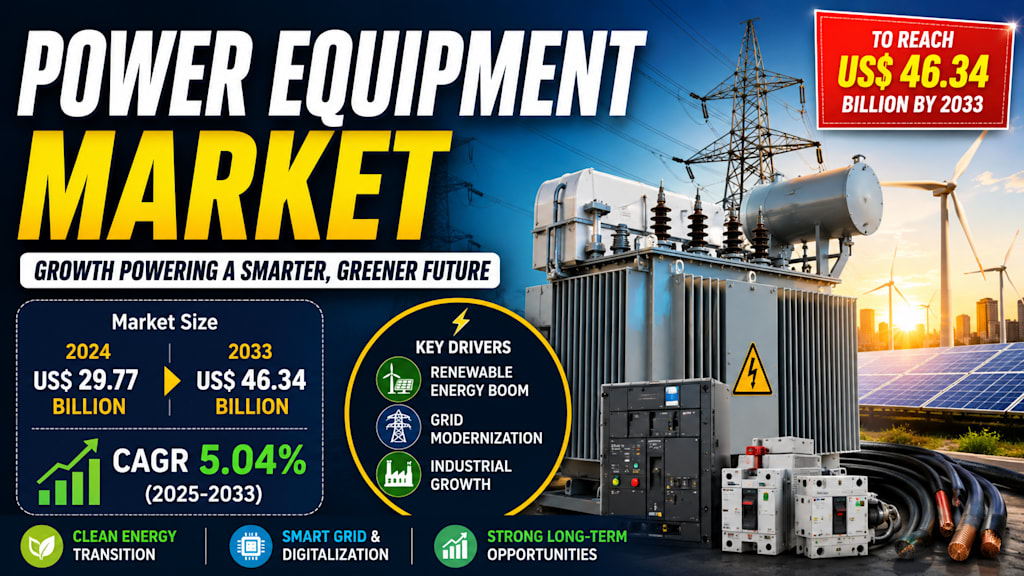
The global power equipment market is entering a transformative phase as countries across the world accelerate investments in renewable energy, smart grids, industrial electrification, and resilient energy infrastructure. According to Renub Research, the Power Equipment Market is projected to grow from US$ 29.77 billion in 2024 to US$ 46.34 billion by 2033, expanding at a CAGR of 5.04% during the forecast period from 2025 to 2033.
Power equipment plays a critical role in electricity generation, transmission, and distribution. Products such as transformers, generators, switchgears, circuit breakers, and power cables are essential for ensuring uninterrupted power supply across residential, industrial, commercial, and utility sectors. With increasing global electricity demand and rapid digitalization, governments and private players are modernizing aging grid systems and investing heavily in advanced power infrastructure.
The transition toward cleaner and more sustainable energy systems is further reshaping the industry landscape. Renewable energy projects, electric vehicles, smart cities, and energy storage systems are generating unprecedented demand for modern power equipment solutions capable of handling variable power loads efficiently.
Renewable Energy Expansion Creating Massive Opportunities
One of the biggest growth drivers in the global power equipment market is the rapid deployment of renewable energy infrastructure. Countries worldwide are prioritizing solar, wind, hydro, and nuclear energy to reduce dependence on fossil fuels and meet carbon neutrality goals.
As renewable capacity expands, demand for efficient transmission and distribution systems is also increasing. Renewable power generation requires highly sophisticated transformers, switchgears, and grid-balancing equipment to manage intermittent energy flows effectively.
The International Renewable Energy Agency (IRENA) reported that renewable power capacity reached more than 3,300 GW globally, and the figure continues to rise annually. This surge is creating strong demand for smart grid technologies, advanced substations, and energy-efficient transmission equipment.
Latin America has emerged as a key renewable energy hotspot. Brazil, Chile, Peru, and Colombia are investing heavily in solar and wind projects, which is directly supporting the regional power equipment industry. For example, Brazil recently secured large-scale wind energy projects involving advanced turbine and transmission technologies. Similarly, Peru’s San Juan de Marcona wind farm demonstrates the region’s growing commitment toward sustainable electricity generation.
Smart Grid Modernization Reshaping the Industry
Modernization of power grids is another major factor driving the market forward. Aging transmission networks in developed countries and expanding electricity access in emerging nations are creating strong demand for upgraded power infrastructure.
Governments and utility companies are increasingly adopting smart grids equipped with IoT sensors, AI-driven analytics, and digital monitoring systems. These technologies help utilities improve operational efficiency, reduce transmission losses, and enhance grid reliability.
Smart substations, intelligent switchgears, automated transformers, and predictive maintenance systems are rapidly becoming mainstream. Utilities are also implementing real-time energy management systems to improve power distribution and minimize outages.
Countries such as the United States, the United Kingdom, China, and Saudi Arabia are leading large-scale grid modernization programs. These projects involve substantial investments in advanced power equipment to support renewable integration and growing electricity consumption.
The adoption of decentralized power generation systems and energy storage facilities is also increasing the need for flexible and digitally connected equipment capable of managing complex energy networks.
Urbanization and Industrialization Boosting Demand
Rapid urbanization and industrial expansion in developing economies continue to strengthen the global demand for power equipment. Growing cities require reliable electricity networks to support residential buildings, transportation systems, manufacturing plants, data centers, and commercial infrastructure.
Industrial sectors such as automotive, oil & gas, mining, chemicals, construction, and telecommunications are heavily dependent on uninterrupted power supply. This dependence is increasing investments in backup generators, industrial transformers, switchgears, and voltage regulation systems.
Latin American countries are witnessing rapid industrial infrastructure development. Costa Rica recently attracted substantial investments in manufacturing expansion, while Chile’s growing data center industry is increasing demand for stable and efficient power distribution systems.
Construction activities are also fueling market growth. Thousands of ongoing infrastructure projects worldwide require advanced electrical systems to support both temporary and permanent energy requirements. Ports, airports, metro rail systems, and smart city projects are especially significant contributors to equipment demand.
Electrification Trends Supporting Long-Term Growth
The global shift toward electrification is opening new growth opportunities for the power equipment sector. Electric vehicles (EVs), electrified public transportation, and smart mobility infrastructure are increasing pressure on existing electricity networks.
As EV adoption rises, governments are investing in EV charging stations, transmission systems, and upgraded utility networks. This transition requires advanced transformers, switchgears, circuit protection systems, and high-capacity power cables.
Electrification is also expanding in industrial heating, residential appliances, and commercial systems as countries aim to reduce carbon emissions from fossil fuel consumption. These developments are expected to generate sustained long-term demand for reliable and energy-efficient power equipment.
Technology Innovations Driving Competitive Advantage
Technological innovation has become a defining factor in the power equipment industry. Manufacturers are integrating advanced digital capabilities into equipment to improve efficiency, monitoring, and predictive maintenance.
Artificial intelligence, machine learning, and cloud-based analytics are helping operators detect failures before they occur, minimizing downtime and operational costs. Smart transformers and intelligent switchgears are enabling remote monitoring and automated fault detection.
Energy-efficient products are gaining popularity as industries seek to reduce operational costs and comply with environmental regulations. Modern power equipment is increasingly designed with sustainability, compactness, and low-maintenance features.
Battery storage integration is another emerging trend shaping the market. Energy storage systems require highly reliable power conversion and distribution infrastructure, creating additional demand for advanced electrical equipment.
Manufacturers are also focusing on cybersecurity protection for digital power systems as utility infrastructure becomes increasingly connected.
Challenges Facing the Global Power Equipment Market
Despite strong growth prospects, the industry faces several challenges that could impact expansion.
One major concern is the shortage of skilled labor. The integration of digital technologies, renewable energy systems, and smart grid infrastructure requires highly trained engineers and technicians. However, many regions face talent shortages that can delay installations and maintenance activities.
Supply chain disruptions remain another critical issue. Fluctuating raw material prices, semiconductor shortages, transportation bottlenecks, and geopolitical tensions continue to affect manufacturing timelines and project costs.
Environmental and social concerns surrounding large infrastructure projects can also create delays. Transmission lines, substations, and renewable installations often face opposition related to land acquisition, ecological impact, and community displacement.
Regulatory compliance adds another layer of complexity. Manufacturers must meet stringent energy efficiency, safety, and environmental standards that vary across different regions.
Regional Insights
United States
The United States remains one of the largest and most technologically advanced power equipment markets globally. Investments in renewable energy, grid modernization, and electrification are driving substantial demand for advanced equipment solutions.
Federal support for clean energy projects and infrastructure upgrades is accelerating deployment of smart transformers, transmission systems, and energy storage technologies. The rise of electric vehicles and data centers is further strengthening electricity demand nationwide.
United Kingdom
The United Kingdom’s commitment to achieving net-zero emissions by 2050 is significantly boosting investments in renewable power infrastructure. Offshore wind farms, battery storage projects, and EV charging networks are increasing the need for reliable power equipment.
The country is also modernizing its transmission infrastructure through extensive grid enhancement programs designed to support clean energy integration and long-term energy resilience.
China
China continues to dominate the global power equipment industry through its large-scale manufacturing capabilities and aggressive renewable energy expansion. Massive investments in solar, wind, hydro, and ultra-high-voltage transmission systems are driving domestic demand.
Chinese manufacturers are also strengthening their global market presence by exporting cost-effective power equipment worldwide. Innovation in smart grid technologies and energy storage solutions remains a key strategic priority for the country.
Saudi Arabia
Saudi Arabia is rapidly transforming its energy sector under Vision 2030. The country is investing heavily in renewable energy projects, smart grid infrastructure, and advanced power generation facilities.
Large-scale solar projects, combined-cycle power plants, and transmission upgrades are increasing demand for transformers, generators, and digital power management systems. The Kingdom’s push toward sustainable energy diversification is expected to create long-term opportunities for global equipment suppliers.
Competitive Landscape
The global power equipment market remains highly competitive, with major international players focusing on innovation, sustainability, and strategic partnerships to strengthen their market positions.
Leading companies are investing heavily in research and development to introduce energy-efficient and digitally integrated products. Many firms are also expanding manufacturing capacity and forming collaborations with utilities and renewable energy developers.
Some of the major companies operating in the market include:
General Electric Company
Siemens AG
Schneider Electric SE
Mitsubishi Electric Corporation
Eaton Corporation plc
Honeywell International Inc.
Bharat Heavy Electricals Limited (BHEL)
Crompton Greaves Ltd.
Rockwell Automation, Inc.
These companies are actively focusing on smart technologies, renewable integration, and advanced grid management solutions to capture emerging opportunities.
10 Recent Developments in the Power Equipment Industry
Siemens AG expanded its smart grid solutions portfolio to support renewable energy integration across Europe and Asia.
Schneider Electric launched advanced digital substations designed to improve grid reliability and operational efficiency.
General Electric strengthened investments in grid modernization technologies for renewable energy transmission projects.
Eaton Corporation introduced next-generation intelligent circuit protection systems for industrial applications.
Mitsubishi Electric announced new high-efficiency transformer solutions targeting sustainable infrastructure projects.
Honeywell International enhanced its AI-based power monitoring technologies for utility operators.
Bharat Heavy Electricals Limited secured multiple renewable energy equipment contracts in India.
Rockwell Automation expanded automation capabilities for industrial power management systems.
Crompton Greaves focused on smart distribution transformer technologies for urban infrastructure modernization.
Several global manufacturers accelerated investments in EV charging infrastructure equipment to support the rapid adoption of electric vehicles.
Future Outlook
The future of the global power equipment market appears highly promising as nations continue investing in clean energy, electrification, and resilient infrastructure. Renewable integration, digital transformation, and smart grid expansion are expected to remain the primary growth catalysts over the next decade.
Emerging economies across Asia, Latin America, and Africa are likely to witness particularly strong growth due to rising electricity demand and infrastructure development. Meanwhile, developed nations will focus on grid modernization, energy storage, and decarbonization initiatives.
Manufacturers that prioritize innovation, sustainability, cybersecurity, and digital intelligence will be best positioned to capitalize on evolving market opportunities.
Final Thoughts
The global power equipment industry is becoming increasingly vital in supporting the world’s transition toward sustainable and digitally connected energy systems. With rising investments in renewable energy, smart grids, industrial electrification, and advanced transmission infrastructure, the market is set for stable long-term growth.
As governments, utilities, and industries work together to modernize global energy networks, demand for efficient, reliable, and environmentally friendly power equipment will continue to rise. Companies capable of delivering technologically advanced and energy-efficient solutions are expected to lead the next phase of industry transformation.
Tags: Power Equipment Market, Smart Grid, Renewable Energy, Transformers, Switchgear, Electricity Infrastructure, Grid Modernization, Industrial Power, Energy Storage, EV Infrastructure
About the Creator
Enjoyed the story? Support the Creator.
Subscribe for free to receive all their stories in your feed.
Comments
There are no comments for this story
Be the first to respond and start the conversation.