
Point of Sale Terminal Market Set for Steady Expansion as Cashless Payments Reshape Global Commerce
From retail counters to hospitals and restaurants, POS terminals are becoming the quiet engine of faster payments, smarter operations, and connected customer experiences.

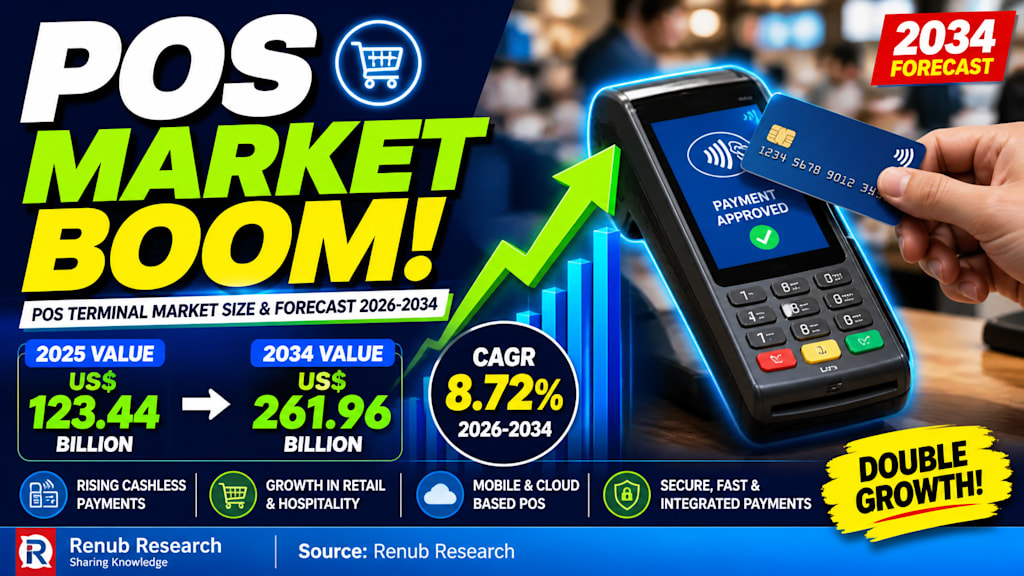
The global point of sale terminal market is moving into a new phase of steady, practical growth. According to Renub Research, the market is projected to rise from US$ 123.44 billion in 2025 to US$ 261.96 billion by 2034, expanding at a CAGR of 8.72% from 2026 to 2034. That growth story is not built on hype. It is being shaped by a real-world shift in how people pay, how merchants operate, and how businesses connect billing, inventory, and customer service into one seamless system.
At first glance, a POS terminal may look like a simple checkout device. In reality, it has become a central business tool. Modern terminals do far more than process a card swipe or tap. They support contactless transactions, mobile wallets, inventory tracking, sales reporting, loyalty programs, and cloud-based operations. As retail, hospitality, healthcare, and service businesses continue to digitize, the POS terminal is no longer just a payment endpoint. It is becoming a decision-making hub.
The shift to cashless and contactless payments
The most powerful force behind the market’s rise is the global movement toward cashless and contactless transactions. Consumers now expect payments to be quick, convenient, and secure. Credit cards, debit cards, QR payments, mobile wallets, and NFC-enabled tap-to-pay experiences have changed the checkout moment completely. Businesses that once relied on traditional cash registers are increasingly adopting smarter POS systems to keep up with these expectations.
This shift was accelerated by the pandemic, but it did not disappear when restrictions eased. Instead, contactless payment behavior became embedded in everyday life. Today, people choose the fastest payment option available, and merchants know that speed at checkout often translates into better customer satisfaction and smoother operations. Governments and financial institutions are also encouraging digital payment adoption because of transparency, financial inclusion, and reduced friction in commerce.
The market is also benefiting from new payment innovations. In June 2025, CaixaBank became the first financial institution in Spain to offer Tap to Pay on iPhone, enabling businesses to accept contactless payments directly through an iPhone without additional hardware. That kind of development shows how POS functionality is becoming more mobile, more flexible, and easier to deploy in real-world business settings.

Retail and hospitality are driving everyday demand
A major reason POS terminals continue to gain traction is the expansion of retail and service-based industries. Supermarkets, convenience stores, restaurants, cafés, hotels, and specialty shops all need fast transaction processing and reliable customer management tools. In these industries, even small improvements in checkout speed and data visibility can have a meaningful effect on revenue and efficiency.
Restaurants are one of the clearest examples. They need systems that handle tables, orders, payments, menu updates, kitchen communication, and delivery integration. POS terminals help streamline all of this. For quick-service restaurants and food outlets, mobile POS units and self-service kiosks are becoming increasingly important because they reduce queue times and improve service flow. As omnichannel dining grows, restaurants are also looking for systems that can support both in-store and online orders from one platform.
Retail is undergoing a similar transformation. Modern POS terminals help merchants manage not only sales but also inventory, promotions, and customer data. This is especially important in omnichannel retail, where shoppers may research online, purchase in-store, return elsewhere, and expect consistent service across channels. POS terminals help keep the full retail experience connected.
A good example of this broader shift came in December 2025, when Banner Health rolled out a cashless payment option across its facilities to improve efficiency, strengthen security, and lower operating costs while offering a more convenient experience for patients and visitors. That type of adoption shows that POS terminals are no longer limited to shops and restaurants. They are becoming part of modern service delivery across sectors.
Cloud POS and mobile solutions are changing the game
One of the biggest structural changes in the market is the movement from conventional, hardware-heavy systems to cloud-based and mobile POS platforms. Cloud POS gives merchants remote access to sales information, automatic updates, centralized data, and easier system synchronization. For businesses with multiple locations, that flexibility is especially valuable. Instead of managing each outlet separately, owners can monitor performance in real time from one platform.
Mobile POS and tablet POS are also gaining ground because they lower entry barriers. Many small businesses do not want a large upfront investment or a complex installation process. A tablet-based setup can deliver checkout, inventory, and customer service functions at a lower cost and with greater portability. That makes it attractive not only to SMEs but also to large businesses that want more flexibility on the floor.
Technology companies are responding to this shift. SAP, for example, launched a cloud-based version of its Customer Checkout solution to modernize retail operations for global customers. The move reflects an industry-wide understanding that POS is no longer a narrow payment product. It is a connected business platform that must integrate with ERP systems, accounting tools, and omnichannel commerce infrastructure.
Why software and services matter as much as hardware
The POS terminal market is not just about the machine sitting at the counter. It is increasingly about the software and services around it. POS software now handles billing, inventory tracking, sales analytics, reporting, and customer management. It helps merchants understand buying patterns and respond faster to changing demand. For many businesses, the value of a POS system now lies in the data and automation it delivers.
Subscription-based software models are especially appealing because they reduce upfront expenses and provide automatic updates. This matters in a fast-moving digital environment where payment rules, security requirements, and customer expectations keep changing. In parallel, POS services such as installation, technical support, maintenance, training, and integration are seeing stronger demand because businesses want systems that work smoothly without draining internal IT resources.
Managed POS services are becoming more important as systems grow more complex. With cloud connectivity, omnichannel functions, and cybersecurity concerns all rising at the same time, many companies prefer third-party expertise to maintain reliability and compliance. For SMEs in particular, outsourced support can make the difference between a system that becomes a growth tool and one that becomes an operational burden.
Security and integration remain real challenges
Despite the positive outlook, the market does face barriers. The first is cost. For small businesses, the initial investment in hardware, software, installation, and staff training can be significant. On top of that, integrating a POS system with existing inventory, ERP, and accounting platforms can take time, effort, and technical resources. Ongoing subscription and upgrade costs can also be a concern.
The second major challenge is security. POS terminals handle sensitive payment information, which makes them a target for cyberattacks, fraud, and data breaches. Businesses have to stay compliant with standards such as PCI DSS, and that requires continuous investment in security tools and processes. Even a small lapse can damage customer trust and create financial losses. In a market built on speed and convenience, trust is still the foundation.
Regional markets show different growth patterns
The United States remains one of the most mature POS terminal markets, supported by strong adoption of cashless and contactless payments, wide card usage, and growing mobile wallet penetration. Cloud-based and mobile POS systems are finding strong acceptance among retailers, restaurants, and service providers. Self-service checkout and integrated POS applications are also becoming standard expectations in many segments. In April 2025, Ingenico and Visa Cybersource announced pre-integrated payment apps for AXIUM terminals, helping reduce merchants’ qualification time by 18 months. That kind of integration speed matters in a market where businesses want faster deployment and less friction.
The United Kingdom also stands out as a mature market, helped by widespread contactless card use and broad consumer familiarity with NFC payments. Small and medium-sized businesses are increasingly using mobile and tablet POS options, while cloud systems are gaining popularity because they can scale more easily. In May 2025, Square launched Square Handheld, a portable terminal priced at $399 that combines payment, barcode scanning, and inventory functions. That kind of compact product reflects the demand for flexibility across modern retail.
China remains a major opportunity because of its huge retail base, widespread digital payment usage, and continued adoption of advanced POS systems for QR code payments, card acceptance, and cloud-linked operations. Urbanization and the growth of SMEs are supporting further demand. In March 2025, China launched a payment service district along the Central Axis and introduced overseas credit card tap-to-ride metro operations for visitors from more than 100 countries, underlining the country’s focus on connected, international-ready payment infrastructure.
Brazil is another emerging growth market. Electronic payments are rising, and government-backed digital inclusion efforts are pushing adoption across SMEs, retailers, and food service businesses. Mobile POS units are especially attractive for street vendors and small merchants because they are affordable and practical. Even so, infrastructure limitations and cost sensitivity still shape the pace of adoption.
The UAE is also progressing rapidly, supported by strong government-led digital transformation, high smartphone adoption, and strong demand from retail, hospitality, tourism, and transportation sectors. Smart city initiatives and cloud-based deployment trends are helping the market move forward quickly.
End-use industries are widening the market’s reach
What makes the POS terminal market especially resilient is its cross-industry relevance. Retail may be the most obvious use case, but healthcare, hospitality, entertainment, and warehousing all depend on efficient payment and transaction systems. In healthcare, POS terminals help with billing, appointment payments, pharmacy transactions, and insurance-related co-payments. They improve accuracy, speed up billing, and reduce manual error. As hospitals and clinics digitize more of their operations, POS integration becomes even more valuable.
Entertainment venues also depend heavily on POS systems because they manage high transaction volumes at ticket counters, food stalls, and merchandise points. Wireless and contactless options help reduce queues and improve customer satisfaction. In this sector, POS terminals are less about a single payment and more about keeping the entire experience moving smoothly.
This broad industry spread is one of the market’s biggest strengths. It reduces dependence on any single sector and gives the industry a more balanced long-term growth base. As digital commerce and service automation continue to expand, POS terminals will remain essential infrastructure rather than optional add-ons.
Final thoughts
The point of sale terminal market is expanding because it sits at the intersection of two major trends: the move toward digital payments and the need for smarter business operations. What was once a simple checkout tool is now a platform for analytics, customer management, inventory control, and omnichannel commerce. Renub Research’s forecast points to a market that will more than double in value by 2034, and the underlying reasons are easy to understand. Businesses want speed, flexibility, security, and visibility, while customers want convenience and choice. POS terminals deliver both sides of that equation.
About the Creator
Enjoyed the story? Support the Creator.
Subscribe for free to receive all their stories in your feed.
Comments
There are no comments for this story
Be the first to respond and start the conversation.