
Playtime Meets Innovation: How Germany’s Toy Industry Is Shaping the Future of Learning, Creativity, and Sustainable Fun
Educational toys, eco-friendly materials, digital integration, and expanding e-commerce channels are transforming Germany into one of Europe’s most dynamic toy markets.

In an age dominated by smartphones, streaming platforms, and digital entertainment, toys continue to hold a unique and essential place in childhood development. Far from being simple sources of amusement, modern toys serve as educational tools, creativity boosters, social development aids, and gateways to lifelong learning.
Germany has long been recognized as one of the world's most influential toy-producing nations. Home to iconic brands, world-renowned craftsmanship, and a culture that values both education and quality, Germany's toy industry continues to evolve in response to changing consumer preferences and technological advancements.
Today's parents are looking beyond traditional playthings. They increasingly seek products that support learning, encourage creativity, and align with environmental values. As a result, educational toys, STEM-focused products, sustainable materials, and digitally connected play experiences are driving a new era of growth within the German toy market.
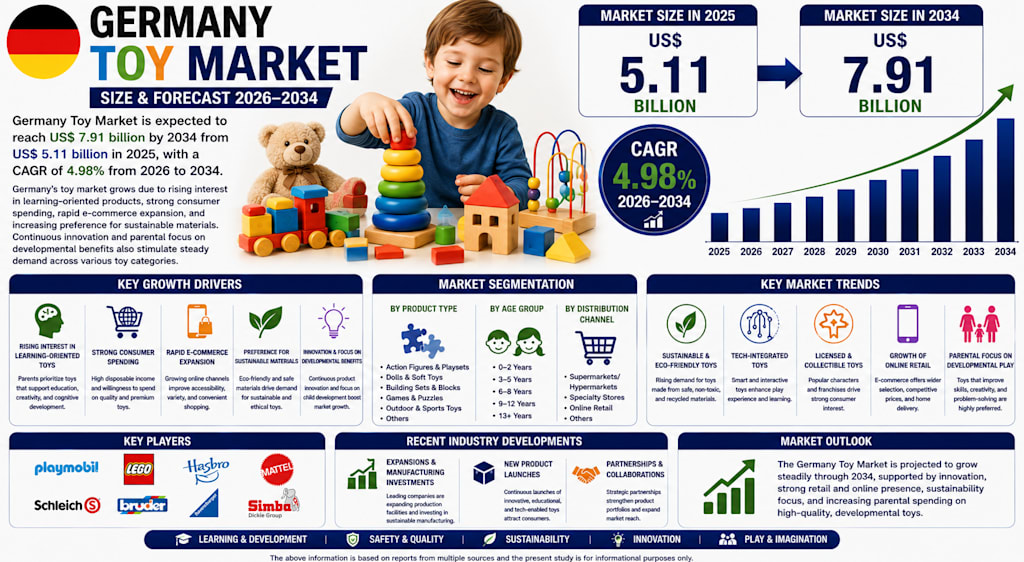
According to Renub Research, the Germany Toy Market is expected to grow from US$ 5.11 billion in 2025 to US$ 7.91 billion by 2034, expanding at a compound annual growth rate (CAGR) of 4.98% between 2026 and 2034. Rising demand for learning-oriented products, growing e-commerce adoption, increasing interest in sustainability, and strong consumer spending continue to support long-term market expansion.
As innovation reshapes the industry, Germany's toy market is proving that play remains one of the most powerful tools for education, development, and imagination.
Toys Are Becoming Essential Learning Tools
The role of toys has changed dramatically over the years.
While traditional toys focused primarily on entertainment, modern products increasingly combine fun with educational value. Parents, educators, and childcare providers now recognize that play contributes significantly to cognitive, emotional, and social development.
Toys help children develop problem-solving abilities, communication skills, creativity, coordination, and emotional intelligence.
From building blocks and puzzles to robotics kits and coding games, today's toys often support structured learning while maintaining the excitement of play.
Germany's strong educational culture has accelerated this shift.
Parents increasingly view toys as investments in childhood development rather than simply recreational products. This perspective has created significant opportunities for manufacturers capable of combining entertainment with meaningful learning outcomes.
Educational and STEM Toys Are Driving Growth
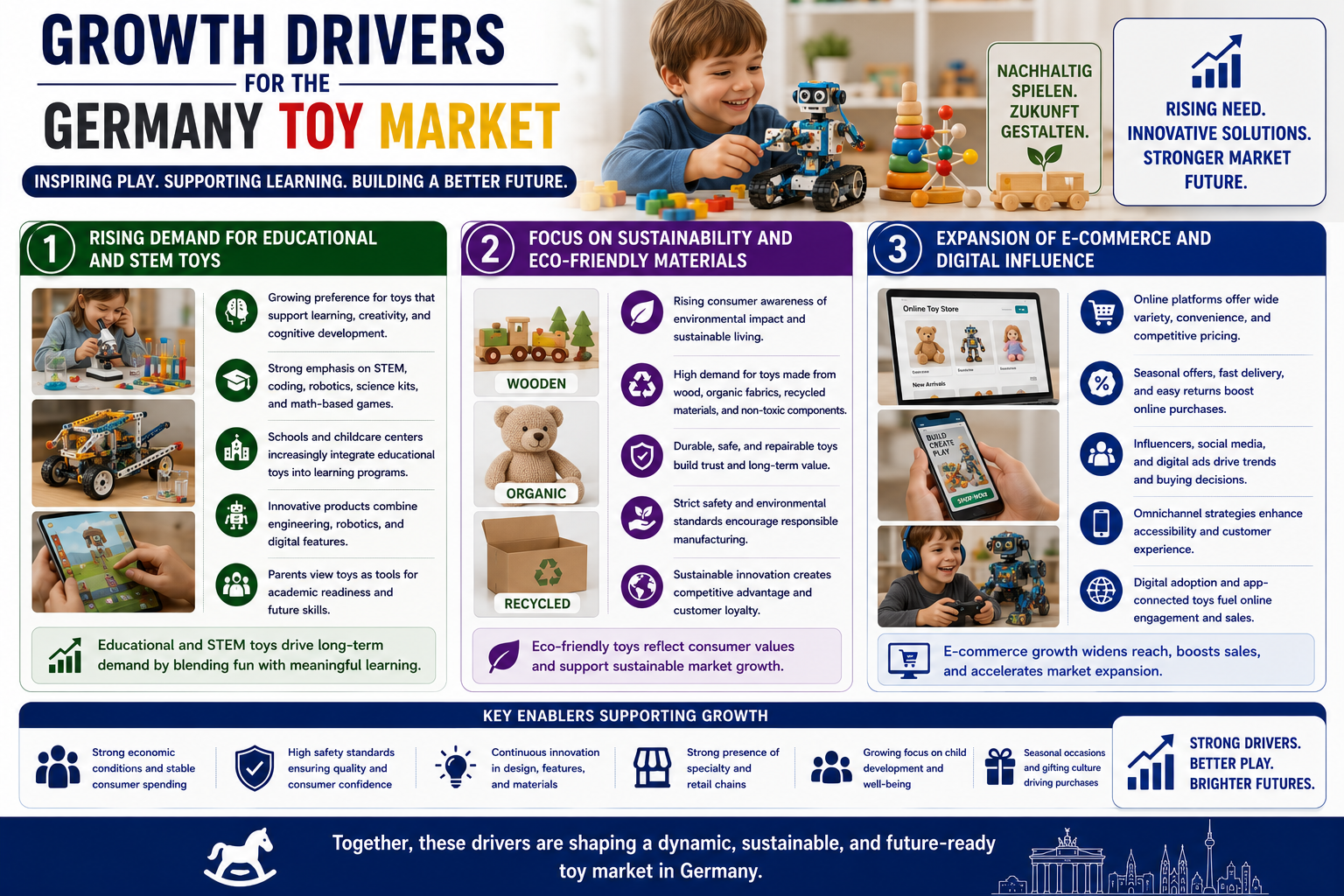
One of the most important drivers of Germany's toy market is the growing popularity of educational and STEM-based toys.
Science, Technology, Engineering, and Mathematics products have become increasingly attractive to parents seeking toys that encourage critical thinking and skill development.
Coding kits, construction sets, engineering challenges, science experiments, and mathematics games are now common features in children's playrooms.
These products provide hands-on learning experiences that help children develop practical skills while fostering curiosity and creativity.
Germany's emphasis on academic achievement and technical excellence further strengthens demand for STEM-related products.
Schools, educational institutions, and childcare centers increasingly incorporate learning-focused toys into their programs, creating additional market opportunities.
Manufacturers continue introducing innovative products that integrate robotics, programming concepts, engineering challenges, and digital learning tools to meet evolving consumer expectations.
As parents increasingly prioritize developmental value, educational toys are expected to remain one of the fastest-growing segments of the market.
Sustainability Is Reshaping Consumer Preferences
Environmental awareness has become a defining characteristic of German consumer behavior.
This trend extends strongly into the toy industry.
Parents increasingly prefer products manufactured from sustainable, recyclable, biodegradable, and ethically sourced materials.
Wooden toys, organic fabrics, recycled plastics, and non-toxic materials are gaining popularity among environmentally conscious families.
German manufacturers are particularly well positioned to benefit from this trend due to their long-standing reputation for craftsmanship, durability, and quality.
Many companies now emphasize:
Reduced packaging, renewable materials, responsible sourcing, repairable products, and long product lifecycles.
These efforts align closely with broader national sustainability goals and strengthen consumer trust.
The demand for eco-friendly toys extends across multiple categories, including puzzles, plush toys, construction sets, arts and crafts products, and educational games.
As sustainability becomes an increasingly important purchasing factor, environmentally responsible brands are likely to gain a significant competitive advantage.
E-Commerce Is Transforming Toy Shopping
The rapid growth of e-commerce has fundamentally changed how consumers purchase toys.
Online platforms offer extensive product variety, competitive pricing, convenient delivery options, and access to customer reviews.
Busy parents increasingly appreciate the convenience of comparing products, researching educational benefits, and making purchases from home.
Digital channels also provide smaller brands with greater visibility, allowing them to compete effectively alongside established manufacturers.
Social media, influencer marketing, and digital advertising have further accelerated online toy sales.
Trending products, collectible items, licensed merchandise, and educational kits often gain popularity through online exposure.
Retailers are increasingly adopting omnichannel strategies that combine physical stores with digital platforms, creating seamless shopping experiences.
As Germany's digital economy continues expanding, e-commerce is expected to remain one of the most important drivers of toy market growth.
Digital Integration Is Creating New Opportunities
Technology is becoming increasingly integrated into toy design.
Modern children grow up in highly connected environments, and toy manufacturers are adapting accordingly.
Interactive toys, app-connected products, augmented reality experiences, and educational electronics are becoming more common across multiple age groups.
Many modern products combine traditional physical play with digital learning experiences.
This hybrid approach helps maintain engagement while supporting educational objectives.
Rather than replacing traditional toys, technology is enhancing their capabilities.
Manufacturers are finding innovative ways to merge hands-on play with digital functionality, creating richer and more immersive experiences.
As children become increasingly comfortable with technology from an early age, digitally enhanced toys are expected to represent a growing share of the market.
Construction Toys Continue to Thrive
Construction toys remain among the most popular categories within Germany's toy industry.
Building sets encourage creativity, spatial reasoning, engineering skills, and problem-solving abilities.
Parents often view construction toys as valuable educational tools that support long-term cognitive development.
The popularity of brands such as LEGO has helped maintain strong consumer interest in this category.
Manufacturers continue introducing increasingly sophisticated construction products that incorporate robotics, coding, and engineering concepts.
These innovations help attract both younger children and older age groups.
As educational value remains a key purchasing consideration, construction toys are expected to continue performing strongly.
Collectibles and Character-Based Merchandise Remain Popular
Licensed toys and collectible products continue attracting significant consumer interest.
Popular entertainment franchises frequently inspire demand for action figures, trading cards, themed games, dolls, and collectible merchandise.
In September 2024, Spin Master expanded its Unicorn Academy franchise into new categories including publishing, tabletop games, and collectible trading cards while also granting German-language audio rights to Sony Music Entertainment. This expansion highlights the growing importance of multimedia brand development within the toy industry.
Consumers increasingly seek products connected to favorite characters, television shows, books, and online content.
This trend continues creating opportunities for licensing partnerships and cross-platform marketing strategies.
Outdoor Play Is Making a Comeback
Despite increasing digital engagement, outdoor toys remain an important segment of Germany's toy market.
Parents recognize the importance of physical activity, social interaction, and outdoor exploration for healthy childhood development.
Products such as climbing structures, sports equipment, ride-on toys, and activity sets continue generating strong demand.
A notable example occurred in August 2024 when Simba Dickie Group's BIG Kraxxl – The Giant won the German Toy Award 2024 in the category "for my friends and me."
The product encourages cooperative outdoor play, physical activity, and motor skill development while offering flexible assembly options and easy construction.
As concerns about screen time increase, outdoor play products are likely to remain highly relevant.
Major Cities Drive Market Expansion
Germany's largest cities play important roles in shaping toy market trends.
Frankfurt
Frankfurt benefits from strong purchasing power, an international population, and advanced retail infrastructure.
Consumers often seek premium, educational, and imported toys, while efficient logistics networks support both physical retail and e-commerce growth.
Munich
Munich's affluent households place strong emphasis on education, craftsmanship, and sustainability.
Parents actively invest in premium toys designed to encourage creativity, learning, and skill development. Sustainable and wooden products are especially popular within the city.
Hamburg
Hamburg's international trade connections support broad availability of global toy brands.
Demand remains strong for educational products, outdoor toys, and environmentally responsible offerings. The city's cultural diversity also influences consumer preferences and product selection.
Berlin
Berlin's youthful population and creative culture make it one of Germany's most innovative toy markets.
Consumers frequently seek unique, design-focused, educational, and digitally integrated products. The city's startup ecosystem also encourages experimentation and innovation within the toy sector.
Challenges Facing the Industry
Despite strong growth prospects, Germany's toy market faces several challenges.
One significant issue involves strict regulatory requirements.
Manufacturers must comply with rigorous German and European Union safety standards covering materials, durability, chemical composition, and mechanical safety.
While these regulations help protect consumers and maintain trust, they also increase production costs and create operational challenges, particularly for smaller manufacturers.
Another challenge comes from digital entertainment.
Children increasingly spend time using smartphones, tablets, video games, and streaming platforms.
These alternatives compete directly with traditional toys for attention and leisure time.
As a result, toy companies must continuously innovate and develop products that remain engaging in an increasingly digital world.
Successfully balancing traditional play experiences with technological integration will be essential for future growth.
Innovation Continues Across the Industry
Manufacturers continue investing heavily in product development and sustainability.
In May 2024, the company behind Playmobil introduced environmentally friendly Wiltopia figures made from 95% sugarcane-based material for inclusion in McDonald's Happy Meals.
Developed in partnership with McDonald's, the collection features 14 animal figures and demonstrates the industry's commitment to sustainable innovation.
Such initiatives illustrate how toy manufacturers are adapting to evolving consumer values while maintaining strong product appeal.
Innovation remains critical to attracting new customers and maintaining long-term competitiveness.
Final Thoughts
Germany's toy industry demonstrates that play remains one of the most valuable tools for learning, creativity, and personal development.
Driven by rising demand for educational products, sustainability-focused purchasing behavior, technological innovation, and expanding e-commerce channels, the market continues to evolve in exciting ways.
Parents increasingly seek toys that deliver meaningful developmental benefits while aligning with broader environmental and educational values.
With the Germany Toy Market projected to grow from US$ 5.11 billion in 2025 to US$ 7.91 billion by 2034, opportunities for manufacturers, retailers, and innovators remain substantial.
As the boundaries between learning, entertainment, and technology continue to blur, Germany's toy industry is well positioned to lead the future of intelligent, sustainable, and engaging play experiences for generations to come.
About the Creator
Enjoyed the story? Support the Creator.
Subscribe for free to receive all their stories in your feed.
Comments
There are no comments for this story
Be the first to respond and start the conversation.