
Philippines Vegetable Oil Market 2026: Food Industry Growth, Import Dependency & Health Trends Driving Demand
How rising food consumption, expanding processing industries, and shifting consumer preferences are shaping the Philippines vegetable oil market

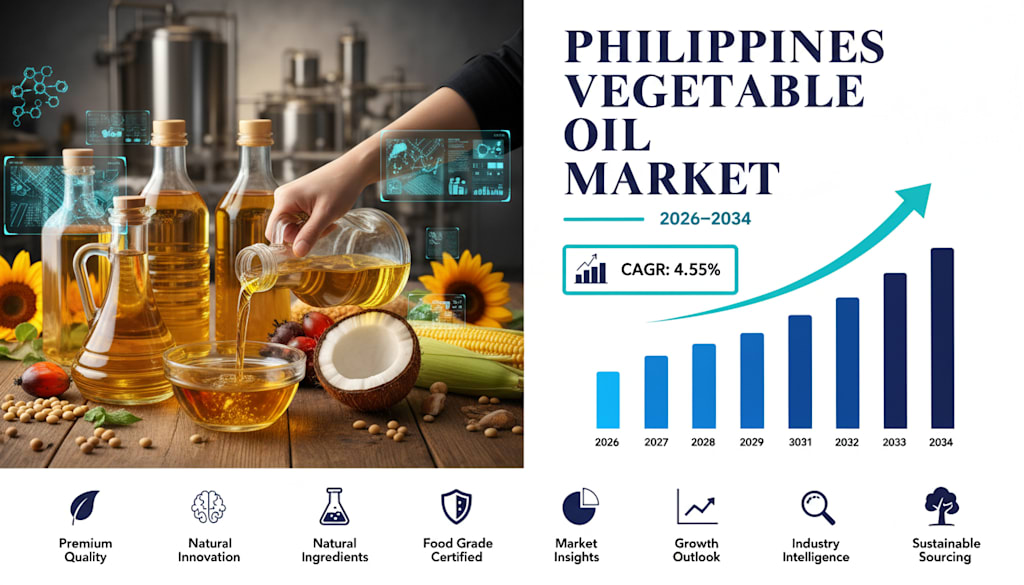
Philippines Vegetable Oil Market Overview
The Philippines vegetable oil market is a significant segment of the country’s food and agriculture industry, covering a wide range of oils such as coconut oil, palm oil, soybean oil, sunflower oil, and canola oil used in cooking, food processing, and industrial applications.
According to IMARC Group, the Philippines vegetable oil market size reached USD 1.3 Billion in 2025 and is projected to reach USD 2.0 Billion by 2034, exhibiting a compound annual growth rate (CAGR) of 4.55% during 2026–2034.
The market is driven by consistent household consumption, expansion of the processed food industry, and a balanced supply chain supported by domestic coconut oil production and imports of other vegetable oils.
Key Market Drivers
Strong Household Consumption and Food Culture
Vegetable oil is a staple in Filipino cooking, widely used across households, street food vendors, and restaurants, ensuring steady baseline demand.
Expansion of Processed Food Industry
The growing production of packaged foods such as snacks, noodles, baked goods, and ready-to-eat meals is significantly increasing industrial demand for vegetable oils.
Growth of Foodservice and Quick-Service Restaurants
The rapid expansion of fast-food chains and dining establishments is driving large-scale consumption of cooking oils for frying and food preparation.
Balanced Supply Through Imports and Domestic Production
The Philippines is a major producer of coconut oil, but limited local production of other oils leads to high imports, particularly palm oil, ensuring stable supply across sectors.
Government Support for Coconut Industry
Initiatives such as replanting programs, price stabilization, and infrastructure development are improving productivity and supporting long-term supply stability.
Request a Sample Report with the Latest 2026 Data & Forecasts
What the Opportunities Are
Growth in Processed Food Manufacturing
As food manufacturing expands, demand for vegetable oils in frying, baking, and preservation applications continues to rise.
Increasing Demand for Premium and Healthier Oils
Urban consumers are shifting toward healthier options such as olive oil and premium coconut oil, creating opportunities in higher-value segments.
Expansion of Oleochemical Industry
Byproducts of vegetable oils, including glycerin and fatty acids, are widely used in cosmetics, pharmaceuticals, and cleaning products, supporting additional market growth.
Development of Sustainable and Traceable Supply Chains
Producers are focusing on sustainable sourcing and eco-friendly packaging to meet global standards and consumer expectations.
Rising Demand in Rural and Emerging Markets
Improved logistics and distribution networks are increasing product accessibility in remote regions, boosting nationwide consumption.
Recent Trends and Developments
April 2026: The Philippines vegetable oil sector is being affected by rising production and supply chain costs linked to fuel price volatility. Due to global disruptions, diesel prices increased by about 59.5% year-on-year, while inflation crossed 4% in March 2026, significantly raising transportation and processing costs across the food supply chain. This has directly impacted vegetable oil distribution and pricing, as oils are essential inputs in both household cooking and food manufacturing.
April 2026: Price dynamics in the vegetable oil segment remain volatile but relatively stable compared to crude oil. While global crude oil prices rose sharply (up to 13% weekly increases, reaching around $111 per barrel), vegetable oil prices remained near multi-year highs but showed limited short-term fluctuation, indicating supply tightness but some resistance to extreme volatility. Coconut oil prices also adjusted, with the premium over palm kernel oil narrowing significantly to about $80 per tonne (down from $300 earlier in 2026), reflecting shifting global supply-demand conditions.
March 2026: The Philippines declared a national energy emergency due to disruptions in global oil supply, as the country imports about 98% of its oil requirements. This has major implications for the vegetable oil market, as energy costs affect processing, refining, and transportation of edible oils. The crisis also reduced national fuel reserves to around 45 days of supply, increasing uncertainty across food-related industries.
March 2026: Agricultural production challenges are indirectly impacting vegetable oil demand and supply chains. Rising fuel and input costs have forced some farmers to reduce or abandon production, with farmgate prices for crops dropping to as low as ₱3 per kilo versus production costs of ₱18–20 per kilo. This disruption affects oilseed and coconut supply chains, which are critical for domestic vegetable oil production.
April 2026: According to USDA data, the Philippines is expected to see improved availability of copra (raw coconut material), supporting higher coconut oil production levels. Coconut oil remains the dominant domestic vegetable oil, with the Philippines producing around 1.2 million tons globally (about 51% of world supply in recent years), although a large share—about 90% (1.1 million tons)—is exported, limiting domestic availability.
2025 (latest available data): The Philippines vegetable oil market reached approximately USD 1.3 billion, driven by strong household consumption and demand from processed food industries. The market relies on a mix of domestic coconut oil production and imported palm oil to ensure supply stability across regions.
2025–2026 (market trend): The sector is being shaped by rising food consumption, expansion of fast food and packaged food industries, and increasing reliance on imports to meet domestic demand. At the same time, cost pressures from energy, inflation, and supply disruptions are creating short-term challenges, affecting pricing, availability, and overall market stability.
Why You Should Know About the Philippines Vegetable Oil Market?
The Philippines vegetable oil market is a stable and essential industry supporting food consumption and manufacturing activities.
With projected growth from USD 1.3 Billion in 2025 to USD 2.0 Billion by 2034, the market demonstrates steady expansion driven by population growth, food industry development, and evolving consumer preferences.
As the country balances domestic production with imports and adapts to health and sustainability trends, the vegetable oil market is expected to remain a key component of the Philippines’ food and agricultural economy.
About the Creator
Enjoyed the story? Support the Creator.
Subscribe for free to receive all their stories in your feed.
Comments
There are no comments for this story
Be the first to respond and start the conversation.