
Philippines Textile Recycling Market 2026: Sustainable Fashion, Circular Economy & Waste Management Innovation
How rising environmental awareness, textile waste generation and recycling initiatives are shaping the Philippines’ textile recycling industry

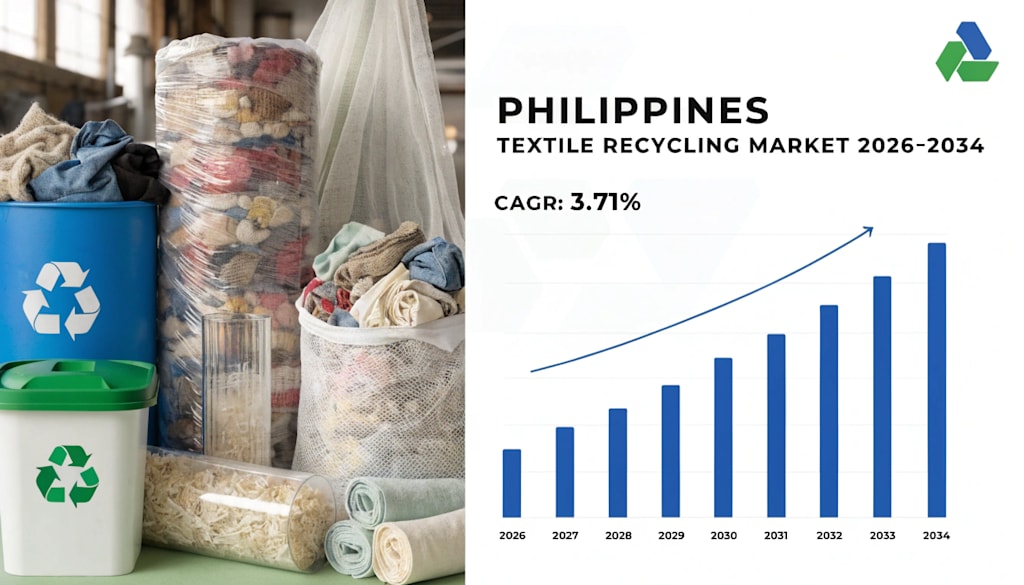
Philippines Textile Recycling Market Overview
The Philippines textile recycling market is an emerging segment within the country’s waste management and sustainable fashion ecosystem, focusing on the collection, processing and reuse of textile waste into new materials and products. The market plays a crucial role in reducing landfill waste, promoting circular economy practices and supporting sustainable manufacturing.
According to IMARC Group, the Philippines textile recycling market size was valued at USD 25.24 Million in 2025 and is projected to reach USD 35.02 Million by 2034, exhibiting a compound annual growth rate (CAGR) of 3.71% during 2026–2034.
The market is experiencing steady growth, driven by increasing environmental concerns, rising textile waste from fast fashion and growing adoption of sustainable practices by consumers and businesses. Expanding recycling infrastructure and community-based initiatives are further supporting market development.
Key Market Drivers
Rising Environmental Awareness and Sustainability Trends
Growing awareness about the environmental impact of textile waste is encouraging individuals and businesses to adopt recycling and sustainable consumption practices.
Increasing Textile Waste from Fast Fashion
The rapid growth of the fashion industry and changing consumer preferences are generating significant volumes of textile waste, creating demand for efficient recycling solutions.
Government Initiatives and Circular Economy Policies
Supportive government programs and collaborations with private organizations are promoting textile recycling and sustainable waste management practices.
Advancements in Recycling Technologies
Innovations in sorting, separation and fiber recovery technologies are improving recycling efficiency and enabling the reuse of complex textile materials.
Growth of Sustainable Fashion and Upcycling Trends
Increasing demand for eco-friendly clothing and recycled materials is encouraging brands to incorporate recycled textiles into their products.
Request a Sample Report with the Latest 2026 Data & Forecasts
What the Opportunities Are
The Philippines textile recycling market presents steady growth opportunities as sustainability and circular economy initiatives gain momentum.
Expansion of Recycling Infrastructure and Facilities
Investments in modern recycling plants and waste collection systems are improving processing capacity and market scalability.
Growth of Circular Fashion and Sustainable Brands
Fashion brands are increasingly adopting recycled materials, creating demand for high-quality recycled fibers and fabrics.
Increasing Demand for Recycled Polyester and Synthetic Fibers
Polyester recycling is emerging as a key segment due to the high availability of synthetic textile waste and cost-effective processing methods.
Development of Community-Based Recycling Initiatives
Local enterprises and NGOs are driving grassroots recycling efforts, promoting employment and sustainable livelihoods.
Rising Adoption of Eco-Friendly Consumer Practices
Consumers are increasingly supporting secondhand, upcycled and recycled textile products, boosting market demand.
Recent News and Developments
March 2026 – The Philippines textile recycling market maintained niche but growing scale, reaching approximately USD 25.24 million in 2025, reflecting early-stage development driven by rising textile waste and sustainability initiatives.
March 2026 – Waste composition trends show post-consumer textiles accounting for ~60% of total recycled volume, highlighting the dominance of discarded clothing from households and secondhand markets as key feedstock.
February 2026 – Material trends indicate polyester recycling holds ~36% market share, driven by high availability of synthetic textile waste and increasing demand for recycled fibers in apparel manufacturing.
January 2026 – End-use demand remains apparel-driven, with ~45% of recycled textiles used in clothing, reflecting strong alignment with sustainable fashion and circular economy practices.
December 2025 – Distribution channels are dominated by retail integration, with retail and departmental stores accounting for ~73% of sales, indicating growing commercialization of recycled textile products.
November–December 2025 – Regional concentration remains high, with Luzon contributing ~49% of market share, supported by dense urban population, textile manufacturing hubs, and higher waste generation.
November 2025 – Industry development accelerated through sustainability initiatives such as the launch of a textile circularity hub in Manila, aimed at converting textile waste into reusable materials and supporting local livelihoods.
Why You Should Know About the Philippines Textile Recycling Market?
The Philippines textile recycling market plays a crucial role in addressing environmental challenges, reducing textile waste and promoting sustainable resource utilization.
With projected growth from USD 25.24 Million in 2025 to USD 35.02 Million by 2034, the market demonstrates steady expansion potential driven by sustainability trends, technological advancements and policy support.
As the country continues to adopt circular economy principles and eco-friendly practices, the Philippines textile recycling market is expected to remain a key contributor to sustainable development and environmental conservation in the years ahead.
About the Creator
Enjoyed the story? Support the Creator.
Subscribe for free to receive all their stories in your feed.
Comments
There are no comments for this story
Be the first to respond and start the conversation.