
Philippines Remittance Market 2026: OFW Inflows, Digital Transfers & Financial Inclusion Growth
How overseas workforce expansion, fintech innovation and digital platforms are shaping the Philippines’ remittance industry

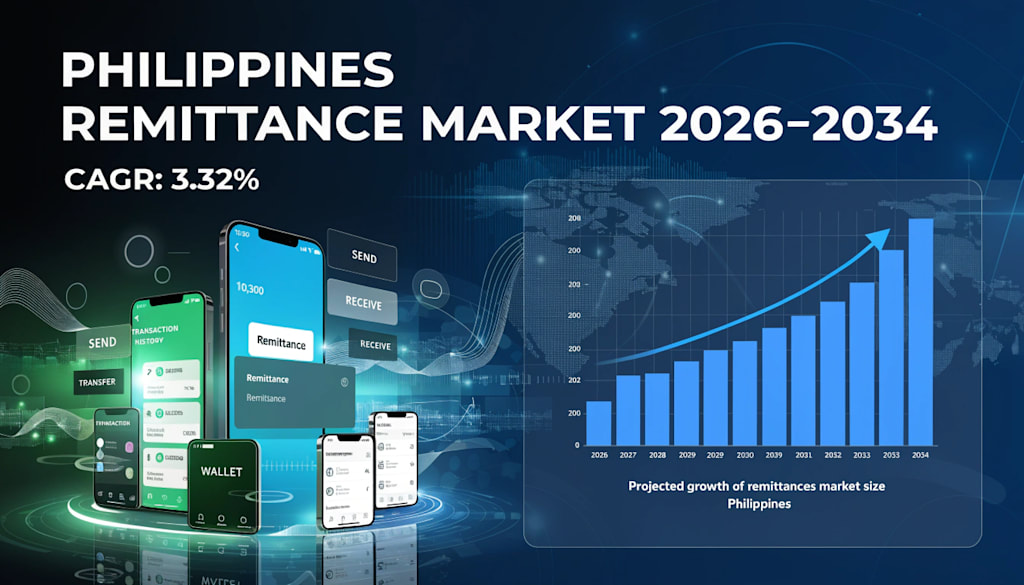
Philippines Remittance Market Overview
The Philippines remittance market is a cornerstone of the country’s economy, driven primarily by inflows from overseas Filipino workers (OFWs). The market encompasses money transfers sent through banks, money transfer operators and digital platforms, supporting household consumption, education and small businesses.
According to IMARC Group, the Philippines remittance market size reached USD 168.1 Billion in 2025 and is projected to reach USD 227.6 Billion by 2034, exhibiting a compound annual growth rate (CAGR) of 3.32% during 2026–2034.
The market continues to expand steadily, supported by a large global Filipino diaspora, increasing digital adoption and improvements in financial infrastructure. Remittances remain a critical source of foreign exchange and a key driver of domestic consumption and economic stability.
Key Market Drivers
Strong Overseas Filipino Workforce (OFW) Presence
A significant number of Filipinos working abroad regularly send money back home, creating a consistent and reliable inflow of remittances that supports millions of households.
Rapid Growth of Digital Remittance Platforms
Mobile wallets, fintech apps and online transfer services are making remittances faster, more secure and cost-effective compared to traditional channels.
Government Support and Policy Initiatives
Government programs aimed at protecting OFWs, improving financial literacy and encouraging formal remittance channels are strengthening market growth and stability.
Expansion of Financial Infrastructure and Inclusion
Improved banking systems, mobile connectivity and digital payment solutions are increasing access to remittance services across urban and rural areas.
Rising Demand for Cross-Border Financial Services
Growing international migration and diversified employment markets are increasing the need for efficient and reliable money transfer solutions.
Request a Sample Report with the Latest 2026 Data & Forecasts
What the Opportunities Are
The Philippines remittance market presents strong opportunities as digital transformation and global workforce mobility continue to expand.
Growth of Digital and Mobile Remittance Solutions
Increasing smartphone penetration and fintech adoption are enabling seamless and instant money transfers, especially through mobile-based platforms.
Expansion into Underserved and Rural Areas
Partnerships between financial institutions and fintech firms are improving access to remittance services in remote regions, supporting financial inclusion.
Integration of AI and Advanced Technologies
AI-driven analytics, fraud detection and automation are enhancing transaction security, efficiency and user experience.
Increasing Partnerships Across Financial Ecosystem
Collaborations between banks, fintech companies and money transfer operators are improving service reach and reducing transaction costs.
Development of New Remittance Corridors
Diversification of overseas employment markets is creating new cross-border transfer channels and expanding market reach.
Recent News and Developments
April 2026 – Remittance inflows remain stable despite macro risks, with cash remittances reaching USD 5.81 billion in Jan–Feb 2026 (+3.1% YoY) and total personal remittances at USD 6.46 billion, highlighting resilience in overseas inflows.
April 2026 – External risks are emerging, as analysts highlight potential slowdown in inflows due to Middle East geopolitical tensions, where remittances contribute ~0.8% of GDP from that region alone, exposing vulnerability to global shocks.
February 2026 – The Philippines remittance market reached approximately USD 41.2 billion in 2025, reinforcing its position as one of the largest remittance-receiving countries globally.
February 2026 – Remittances remain a key macroeconomic pillar, accounting for ~7.3% of GDP and ~6.4% of GNI, supporting household consumption and national liquidity.
January 2026 – Monthly inflows remain strong, with USD 2.91 billion recorded in November 2025 (+3.6% YoY), driven by contributions from major corridors such as the U.S., Singapore, and Saudi Arabia.
December 2025 – Seasonal inflows peaked, with December remittances reaching USD 3.52 billion (+4.2% YoY), reflecting holiday-driven transfers and strong overseas worker contributions.
November–December 2025 – Annual performance remained robust, with cash remittances totaling USD 35.63 billion in 2025 (+3.3% YoY) and personal remittances reaching USD 39.62 billion, indicating consistent growth momentum.
Why You Should Know About the Philippines Remittance Market?
The Philippines remittance market plays a crucial role in supporting household incomes, driving consumer spending and strengthening the country’s financial system.
With projected growth from USD 168.1 Billion in 2025 to USD 227.6 Billion by 2034, the market demonstrates steady expansion potential driven by overseas employment, digital innovation and financial inclusion initiatives.
As global mobility and digital finance continue to evolve, the Philippines remittance market is expected to remain a key pillar of economic resilience and growth in the years ahead.
About the Creator
Enjoyed the story? Support the Creator.
Subscribe for free to receive all their stories in your feed.
Comments
There are no comments for this story
Be the first to respond and start the conversation.