
Philippines Real Estate Market 2026: Urbanization, Infrastructure Growth & Investment Expansion
How rising housing demand, government infrastructure projects and foreign investments are shaping the Philippines’ real estate industry

Philippines Real Estate Market Overview
The Philippines real estate market is a key pillar of the country’s economic growth, encompassing residential, commercial, industrial and mixed-use developments. The sector supports urban development, employment generation and investment activity, driven by increasing population and economic expansion.
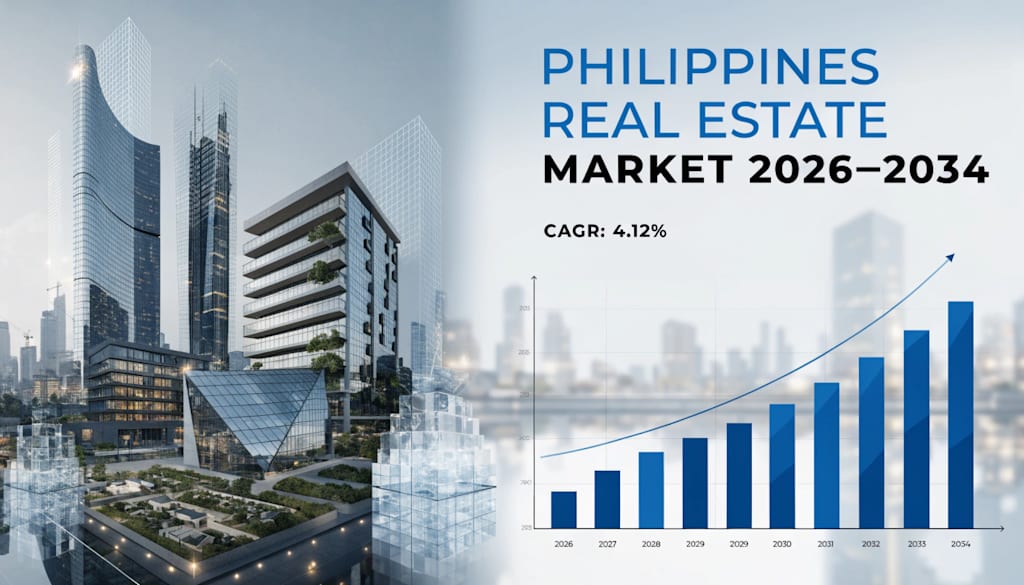
According to IMARC Group, the Philippines real estate market size reached USD 94.4 Billion in 2025 and is projected to reach USD 135.9 Billion by 2034, exhibiting a compound annual growth rate (CAGR) of 4.12% during 2026–2034.
The market is experiencing steady growth, driven by rapid urbanization, expanding middle-class population and strong domestic and foreign investments across residential, commercial and industrial segments.
Key Market Drivers
Rapid Urbanization and Expanding Middle Class
Increasing urban population and rising incomes are driving demand for housing, particularly in major cities such as Metro Manila, Cebu and Davao.
Infrastructure Development and Government Initiatives
Large-scale infrastructure projects, including transportation networks and urban connectivity programs, are boosting property demand and increasing land values across emerging regions.
Growth of the BPO and Services Sector
The expansion of the business process outsourcing (BPO) industry is increasing demand for office spaces, residential units and mixed-use developments near business hubs.
Rising Foreign and Domestic Investments
Strong investor interest in real estate, supported by economic growth and favorable policies, is driving development across multiple property segments.
Increasing Demand for Mixed-Use Developments
Developers are focusing on integrated projects combining residential, commercial and recreational spaces to meet evolving urban lifestyle needs.
Request a Sample Report with the Latest 2026 Data & Forecasts
What the Opportunities Are
The Philippines real estate market presents strong growth opportunities as urban expansion and economic development continue.
Expansion into Emerging Provincial Cities
Developers are increasingly targeting cities such as Iloilo, Bacolod and Cagayan de Oro due to lower costs and rising economic activity.
Growth of Industrial and Logistics Real Estate
The rise of e-commerce and supply chain optimization is increasing demand for warehouses, distribution centers and industrial parks.
Increasing Demand for Affordable Housing
The growing middle-class population is driving demand for affordable and mid-range housing solutions across urban and suburban areas.
Adoption of PropTech and Digital Platforms
Technology-driven solutions such as virtual property tours, AI-based valuation tools and online listing platforms are transforming property transactions.
Development of Sustainable and Smart Cities
Green buildings, energy-efficient designs and smart city initiatives are creating new opportunities for sustainable real estate development.
Recent News and Developments
April 2026 – The market is undergoing recalibration, with property price growth slowing to ~1.6% YoY (Q4 2025), while rental yields average ~5.2% in prime districts, indicating stabilizing returns and more cautious investor sentiment.
April 2026 – Large-scale infrastructure-led development is accelerating, with a planned 4,000-acre industrial hub in New Clark City, expected to boost demand for industrial and commercial real estate assets.
March 2026 – The Philippines real estate market reached approximately USD 94.4 billion in 2025, supported by strong demand across residential, commercial, and industrial segments.
February 2026 – Investment fundamentals remain supported by rental yields ranging ~5.2%–7% in key urban areas, making real estate a relatively attractive income-generating asset class.
January 2026 – Monetary policy is supporting the sector, with interest rates reduced to ~4.25%, improving borrowing conditions and housing affordability for buyers and developers.
December 2025 – Supply-demand imbalance persists, particularly in Metro Manila, with ~81,000 unsold condominium units, highlighting oversupply in the high-density urban housing segment.
November–December 2025 – Urbanization remains a key structural driver, with ~48.7% of the population (≈56.4 million people) living in urban areas, fueling long-term demand for housing and mixed-use developments.
Why You Should Know About the Philippines Real Estate Market?
The Philippines real estate market plays a crucial role in supporting economic growth, urban development and investment opportunities.
With projected growth from USD 94.4 Billion in 2025 to USD 135.9 Billion by 2034, the market demonstrates steady expansion potential driven by urbanization, infrastructure development and strong investor demand.
As the country continues to modernize its cities and expand its economic base, the Philippines real estate market is expected to remain a key contributor to national growth and long-term investment opportunities.
About the Creator
Enjoyed the story? Support the Creator.
Subscribe for free to receive all their stories in your feed.
Comments
There are no comments for this story
Be the first to respond and start the conversation.