
Philippines Online Travel Market 2026: Mobile Bookings, Digital Tourism & Smart Travel Platforms Driving Growth
How rising internet penetration, mobile-first consumers, and digital travel services are transforming the Philippines online travel industry

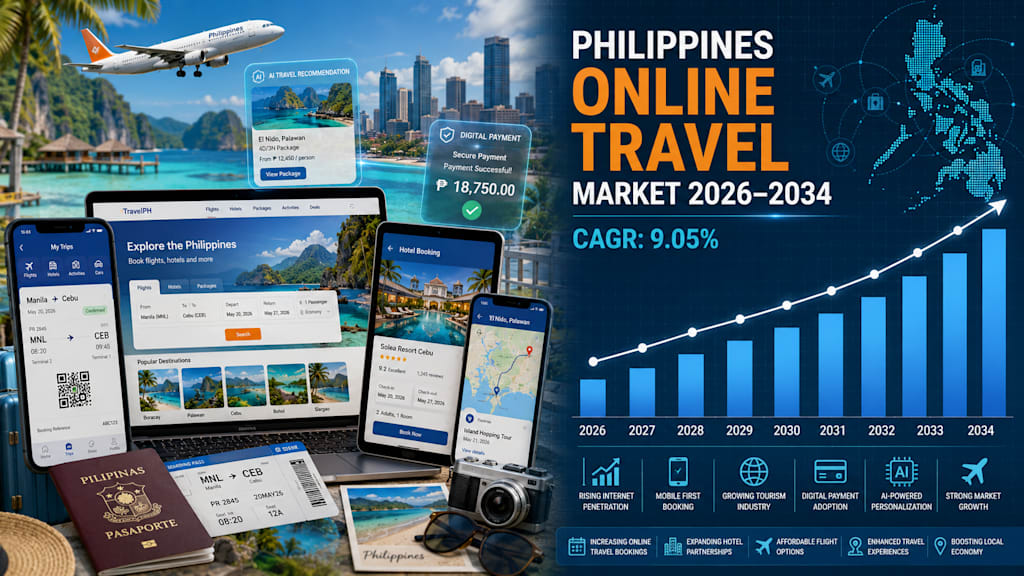
Philippines Online Travel Market Overview
The Philippines online travel market is a rapidly growing segment of the country’s tourism and digital services industry, encompassing online booking platforms for flights, hotels, transportation, vacation packages, and travel experiences. Consumers are increasingly relying on mobile apps and digital platforms for convenient and personalized travel planning.
According to IMARC Group, the Philippines online travel market size reached USD 12,447.9 Million in 2025 and is projected to reach USD 27,778.8 Million by 2034, exhibiting a compound annual growth rate (CAGR) of 9.05% during 2026–2034.
The market is expanding steadily due to increasing smartphone penetration, rising internet accessibility, improved digital payment systems, and growing consumer preference for online travel booking platforms.
Key Market Drivers
Rising Smartphone and Internet Penetration
The growing availability of affordable smartphones and internet connectivity is encouraging consumers to use digital platforms for travel bookings, itinerary planning, and accommodation reservations.
Increasing Preference for Mobile Booking Platforms
Consumers are increasingly using mobile applications for booking flights, hotels, transportation, and tour packages due to convenience and real-time accessibility.
Expansion of Digital Payment Solutions
The rise of e-wallets, online banking, and digital payment systems is making online travel transactions more seamless and secure, supporting market growth.
Growth in Domestic and International Tourism
Increasing travel activity across domestic and international destinations is driving higher demand for online booking services and travel platforms.
Influence of Social Media and Travel Content
Travel influencers, online reviews, and social media platforms are significantly shaping travel decisions and encouraging online travel bookings.
Request a Sample Report with the Latest 2026 Data & Forecasts
What the Opportunities Are
Growth of Digital Nomad and Long-Stay Travel
The Philippines is gaining popularity among digital nomads and remote workers, creating opportunities for platforms offering long-stay accommodations and coworking-friendly travel packages.
Expansion of Eco-Tourism and Sustainable Travel
Travel platforms are increasingly integrating eco-friendly options, sustainability filters, and responsible tourism experiences to meet evolving consumer preferences.
Adoption of AI and Personalized Travel Recommendations
Artificial intelligence and data analytics are enabling personalized travel suggestions, dynamic pricing, and improved customer experiences.
Rising Demand for Flexible Booking Options
Consumers are increasingly seeking flexible cancellations, installment payments, and customized travel packages.
Development of Smart Tourism Platforms
Integration of virtual tours, IoT-enabled accommodations, and digital concierge services is enhancing travel convenience and engagement.
Recent News and Developments
April 2026: The Philippines online travel market continues to benefit from rising digital adoption and demand for flexible travel experiences. Industry data shows that the Philippines online travel market reached approximately USD 12.4 billion in 2025, supported by growing internet penetration, mobile booking usage, and increasing preference for digital travel platforms. Mobile platforms remain dominant as consumers increasingly use smartphones for booking flights, hotels, and travel packages.
April 2026: Filipino travelers are increasingly prioritising value-driven and short-distance travel amid rising costs and economic uncertainty. Data from travel platform Klook revealed a 51% growth in the Philippines market during 2025, driven mainly by short weekend trips to destinations such as Boracay, Cebu, Metro Manila, Pampanga, and Cavite. This reflects shifting travel behavior toward affordable and accessible domestic tourism options.
April 2026: Cruise tourism is emerging as a fast-growing segment within the online travel ecosystem. The planned deployment of the Adora Mediterranea from Manila is expected to strengthen outbound cruise travel by enabling direct sailings to Japan from the Philippines. Online travel agencies and distributors are increasingly offering bundled cruise packages and multi-destination itineraries to capitalize on rising demand for experiential travel.
March 2026: Travel platforms are seeing major changes in booking patterns due to higher fuel prices and global uncertainty. Klook’s Travel Pulse 2026 study, based on responses from 11,000 travelers across Asia-Pacific, found strong demand for domestic and regional travel despite economic pressures. The report also highlighted a 127% increase in hotel bookings and strong growth in travel demand for destinations such as Vietnam, Taiwan, and Thailand.
January 2026: The Philippine Department of Tourism announced a target of achieving more than 6.4 million tourist arrivals in 2026, following approximately 5.94 million foreign visitor arrivals in 2025. This reflects continued recovery in the tourism sector and supports expansion of online booking platforms, digital payment systems, and travel service marketplaces.
January 2026: Budget airlines are intensifying competition in the digital travel space through aggressive online promotions and route expansion. For example, AirAsia Philippines launched new Manila-Hanoi and Manila-Da Nang routes with promotional fares starting at ₱888 one-way, while online seat sales and app-based bookings continue to drive digital travel transactions.
2025–2026: The Philippines online travel market is being shaped by mobile-first booking behavior, rising domestic tourism, and increasing demand for personalized and flexible travel experiences. Trends such as “slow travel,” digital nomad tourism, eco-conscious travel, and AI-enabled travel planning are influencing consumer preferences, while rising fuel costs and global economic uncertainty continue to impact pricing and travel spending patterns.
Why You Should Know About the Philippines Online Travel Market?
The Philippines online travel market is becoming a major pillar of the country’s digital economy and tourism sector.
With projected growth from USD 12,447.9 Million in 2025 to USD 27,778.8 Million by 2034, the market demonstrates strong expansion driven by digital adoption, mobile-first consumers, and increasing travel demand.
As technology continues to reshape consumer behavior and travel planning, online travel platforms are expected to play an increasingly important role in delivering seamless, personalized, and sustainable travel experiences across the Philippines.
About the Creator
Enjoyed the story? Support the Creator.
Subscribe for free to receive all their stories in your feed.
Comments
There are no comments for this story
Be the first to respond and start the conversation.