
Philippines Online Education Market 2026: Digital Learning Adoption, Mobile Connectivity & Workforce Upskilling Driving Growth
How expanding internet access, smartphone penetration, and demand for flexible learning are transforming the Philippines online education industry

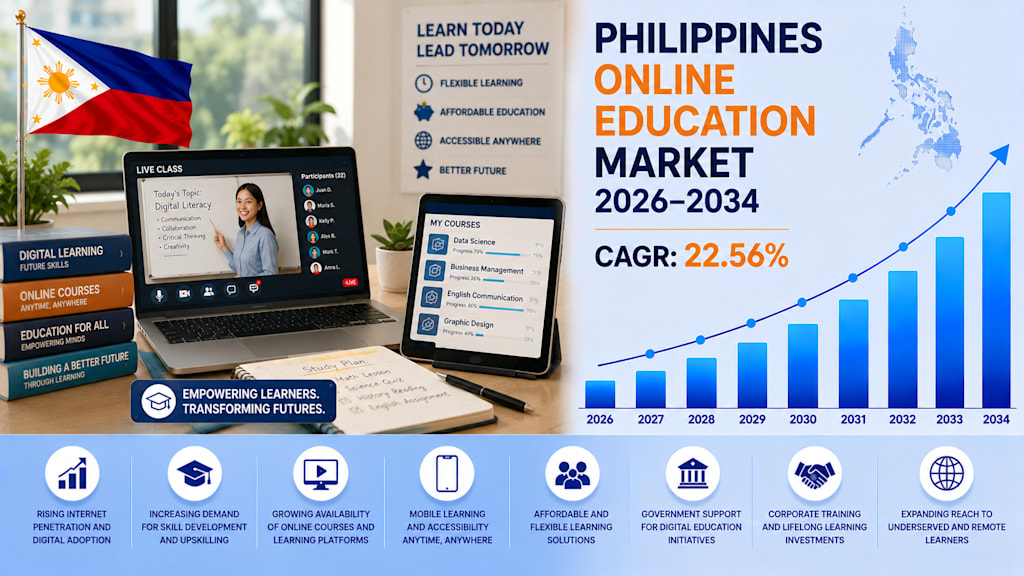
Philippines Online Education Market Overview
The Philippines online education market is emerging as one of the fastest-growing segments of the country’s education and digital services industry, encompassing academic learning, vocational training, corporate e-learning, virtual classrooms, mobile learning platforms, and digital skill development programs.
According to IMARC Group, the Philippines online education market size reached USD 2,202.9 Million in 2025 and is projected to reach USD 14,463.4 Million by 2034, exhibiting a compound annual growth rate (CAGR) of 22.56% during 2026–2034.
The market is witnessing rapid expansion driven by increasing internet penetration, growing smartphone adoption, rising demand for flexible learning solutions, expanding digital infrastructure, and the growing need for professional upskilling and workforce development.
Key Market Drivers
Expanding Internet Access and Digital Infrastructure
Ongoing improvements in broadband connectivity and digital infrastructure across urban and semi-urban regions are increasing access to online learning platforms and virtual educational resources.
Rising Smartphone and Mobile Device Penetration
The widespread availability of affordable smartphones and mobile devices is enabling students and professionals to access educational content anytime and anywhere, accelerating online learning adoption.
Growing Demand for Flexible Learning Solutions
Working professionals, adult learners, and students are increasingly seeking self-paced and remote learning opportunities that provide greater convenience and accessibility.
Corporate Upskilling and Workforce Training
Businesses are increasingly adopting digital learning platforms to train employees, enhance productivity, and support workforce development in response to rapid technological changes.
Cultural Shift Toward Digital Learning
Online education is becoming increasingly accepted as a mainstream educational model as learners, parents, and institutions recognize its flexibility, affordability, and accessibility.
What the Opportunities Are
Growth of Specialized Professional Courses
Demand for industry-focused courses in areas such as artificial intelligence, digital marketing, financial technology, healthcare management, and data analytics is creating significant growth opportunities for online education providers.
Expansion of Rural Education Access
Online learning platforms are helping bridge educational gaps in underserved regions by providing access to quality educational content and training programs across rural communities.
Cross-Border Learning Collaborations
Partnerships between local educational institutions and international universities are expanding access to globally recognized certifications, advanced learning resources, and international curricula.
Increasing Adoption of AI and Interactive Learning Technologies
Artificial intelligence, gamification, virtual simulations, and personalized learning tools are improving learner engagement and enhancing educational outcomes.
Development of Mobile-First Learning Platforms
The growing reliance on smartphones is encouraging education providers to invest in mobile-friendly platforms that support flexible and on-demand learning experiences.
Request a Sample Report with the Latest 2026 Data & Forecasts
Recent News and Developments
May 2026 : The Philippines online education market continued expanding as educational institutions, corporate organizations, and learners increasingly adopted digital platforms for academic and professional development. Online learning providers focused on enhancing user engagement through interactive content and personalized learning experiences.
May 2026: Technology integration remained a major trend across the online education ecosystem. Providers increasingly incorporated artificial intelligence, learning analytics, gamification, and cloud-based systems to improve educational effectiveness and learner retention.
April 2026 : Mobile learning adoption continued growing nationwide as smartphone usage expanded across various demographic groups. Mobile-first educational applications and responsive learning platforms strengthened accessibility among students and working professionals.
March 2026 : Corporate training programs increasingly shifted toward digital learning solutions as businesses invested in employee upskilling initiatives to address changing workforce requirements and digital transformation objectives.
February 2026 : Educational institutions expanded blended and hybrid learning models by integrating virtual classrooms, digital content delivery systems, and cloud-based educational resources into traditional teaching frameworks.
January 2026 : Government initiatives supporting digital education infrastructure and public-private partnerships continued strengthening the accessibility of online learning resources across multiple regions of the Philippines.
December 2025 : Demand for professional certifications, vocational education, and career-oriented digital courses increased significantly as learners sought practical skills aligned with evolving labor market requirements.
November 2025 : Investments in broadband infrastructure, educational technology platforms, and digital learning ecosystems continued supporting long-term growth across the Philippines online education sector.
2025–2026 (Market Trend) : The Philippines online education market is being shaped by expanding internet connectivity, increasing smartphone penetration, growing acceptance of digital learning, and rising demand for lifelong education. Educational institutions and platform providers are increasingly investing in artificial intelligence, personalized learning systems, mobile-first platforms, and interactive digital content to enhance learner engagement and educational outcomes. At the same time, affordability challenges, digital accessibility gaps, learner retention concerns, and quality assurance requirements continue influencing market development across the country.
Why You Should Know About the Philippines Online Education Market?
The Philippines online education market is becoming an increasingly important component of the country’s education system, workforce development strategy, and digital economy.
With projected growth from USD 2,202.9 Million in 2025 to USD 14,463.4 Million by 2034, the market demonstrates strong long-term potential supported by technological advancement, increasing digital adoption, and evolving educational preferences.
As online education providers continue investing in mobile learning, artificial intelligence, professional certifications, and flexible learning solutions, the sector is expected to play a critical role in improving educational accessibility, workforce competitiveness, and digital transformation across the Philippines.
About the Creator
Enjoyed the story? Support the Creator.
Subscribe for free to receive all their stories in your feed.
Comments
There are no comments for this story
Be the first to respond and start the conversation.