
Philippines Food and Grocery Retail Market 2026: Modern Retail Expansion, E-Commerce Growth & Changing Consumer Preferences Driving Market Growth
How rising household consumption, expanding organized retail networks, and digital grocery shopping are transforming the Philippines food and grocery retail industry

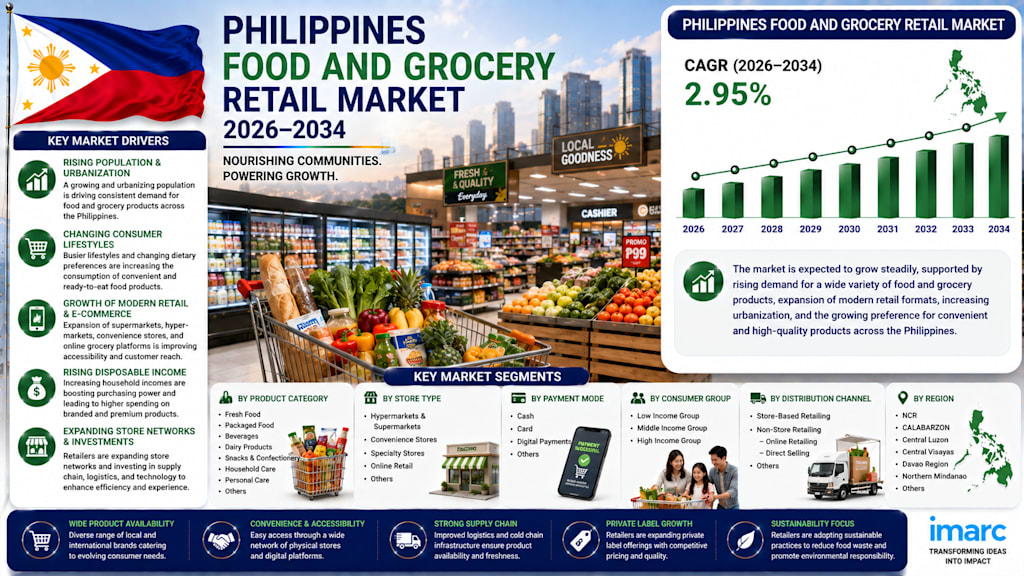
Philippines Food and Grocery Retail Market Overview
The Philippines food and grocery retail market is one of the largest segments of the country's retail sector, comprising supermarkets, hypermarkets, convenience stores, specialty food retailers, traditional grocery stores, online grocery platforms, and neighborhood retail outlets offering fresh produce, packaged foods, beverages, dairy products, frozen foods, household essentials, and other daily consumer goods.
According to IMARC Group, the Philippines food and grocery retail market size reached USD 55.2 Billion in 2025. Looking forward, IMARC Group expects the market to reach USD 71.6 Billion by 2034, exhibiting a CAGR of 2.95% during 2026–2034.
The market is witnessing stable growth driven by rising disposable incomes, increasing urbanization, expanding organized retail chains, growing adoption of online grocery shopping, continuous improvements in supply chain infrastructure, and changing consumer preferences toward convenience, product variety, and premium food offerings.
Key Market Drivers
Rising Household Consumption
Population growth, improving purchasing power, and increasing demand for essential food and grocery products continue to support the expansion of the retail market.
Expansion of Organized Retail Chains
The growing presence of supermarkets, hypermarkets, and convenience stores is improving product accessibility while enhancing shopping convenience and customer experience.
Growth of E-Commerce and Online Grocery Platforms
Consumers are increasingly using digital platforms and mobile applications to purchase groceries, supported by convenient home delivery services and secure digital payment options.
Increasing Demand for Convenience Foods
Busy lifestyles and urban living are encouraging greater demand for ready-to-eat meals, packaged foods, frozen products, and quick shopping solutions.
Advancements in Retail Technology
Retailers are adopting artificial intelligence, inventory management systems, digital payment technologies, and customer loyalty programs to improve operational efficiency and strengthen customer engagement.
Request a Sample Report with the Latest 2026 Data & Forecasts
What the Opportunities Are
Expansion of Omnichannel Retail
Retailers can integrate physical stores with online platforms to offer seamless shopping experiences through click-and-collect services, home delivery, and mobile commerce.
Growth of Private Label Products
Increasing consumer acceptance of affordable, high-quality private label brands presents opportunities for retailers to improve profitability and customer loyalty.
Rising Demand for Healthy and Premium Food Products
Growing health awareness is creating opportunities to expand offerings of organic foods, functional beverages, fresh produce, and premium grocery products.
Adoption of Smart Retail Technologies
Artificial intelligence, automated inventory systems, self-checkout solutions, and personalized promotions can improve operational efficiency while enhancing the customer experience.
Expansion into Emerging Cities
Retail chains have opportunities to strengthen their presence in developing urban centers and underserved communities where demand for organized retail continues to increase.
Recent News and Developments
June 2026: Grocery retailers expanded omnichannel capabilities by enhancing online ordering platforms, home delivery services, and digital payment solutions to improve customer convenience.
May 2026: Supermarket operators invested in supply chain modernization and inventory optimization technologies to improve product availability and operational efficiency.
April 2026: Retailers expanded private label offerings and premium grocery selections to address evolving consumer preferences and strengthen market competitiveness.
February 2026: Convenience store chains accelerated expansion across urban and suburban locations to improve accessibility and capture rising consumer demand.
January 2026: Food retailers introduced AI-powered customer engagement tools, digital loyalty programs, and personalized promotional campaigns to enhance shopping experiences.
December 2025: Continued growth in online grocery shopping and consumer demand for convenience supported ongoing investments in digital retail infrastructure and logistics across the Philippines.
Why You Should Know About the Philippines Food and Grocery Retail Market?
The Philippines food and grocery retail market remains a cornerstone of the country's consumer goods and retail industries.
With the market projected to grow from USD 55.2 Billion in 2025 to USD 71.6 Billion by 2034, at a CAGR of 2.95%, the industry presents stable long-term growth opportunities supported by expanding organized retail, rising household consumption, increasing digital grocery adoption, and continuous retail innovation.
As supermarket operators, convenience store chains, e-commerce platforms, food manufacturers, and retail technology providers continue investing in omnichannel strategies, advanced supply chains, smart retail solutions, and customer-centric shopping experiences, the Philippines food and grocery retail market is expected to remain a major contributor to the country's retail sector throughout the forecast period.
About the Creator
Enjoyed the story? Support the Creator.
Subscribe for free to receive all their stories in your feed.
Comments
There are no comments for this story
Be the first to respond and start the conversation.