
Philippines Fertilizer Market: RCEF Expansion, Import Resilience & Bio Fertilizer Shift
How a 3x RCEF budget increase, a 90% import dependency and a ₱10 billion bio fertilizer pledge are reshaping Philippine agriculture

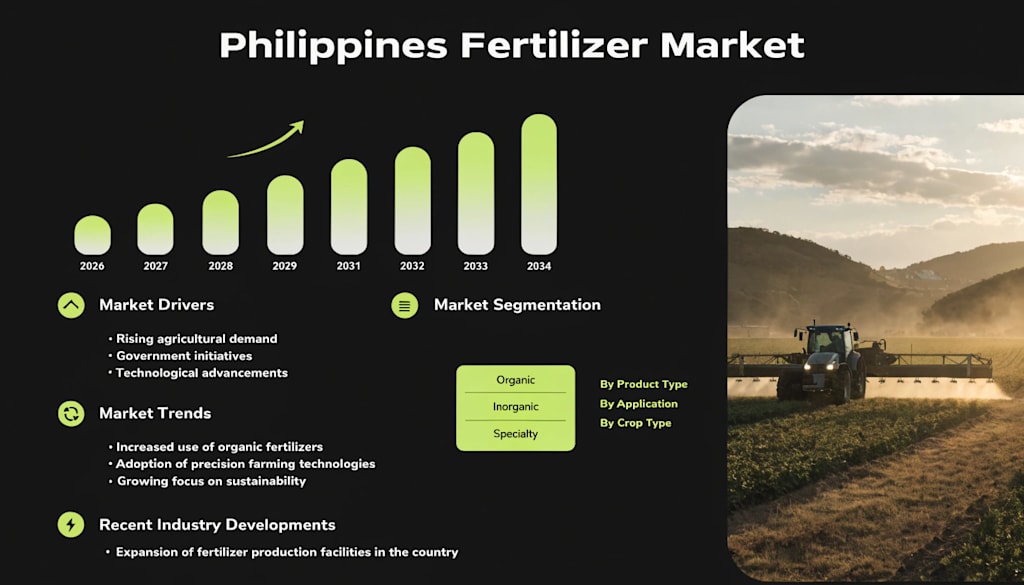
The Philippines fertilizer market is at the crossroads of two powerful forces: the imperative to boost agricultural productivity and the urgent need to reduce a 90% import dependency in the face of soaring global prices. According to IMARC Group, the Philippines fertilizer market size reached USD 3,646.00 Million in 2025 and is projected to reach USD 4,773.86 Million by 2034, exhibiting a moderate compound annual growth rate (CAGR) of 3.04% during 2026–2034.
Fertilizers — including straight nitrogenous (urea), phosphatic, potassic, and mixed formulations — are deployed across the country's 713,000 hectares of agricultural land to support staple crops like rice, corn, sugarcane, and bananas. As the government triples its flagship subsidy programme, pursues a historic domestic urea plant and accelerates bio fertilizer adoption, the fertilizer value chain is undergoing a strategic realignment that will determine the nation's food security for a generation.
What's Driving Market Growth?
Tripling of the Rice Competitiveness Enhancement Fund (RCEF). On 9 December 2024, President Ferdinand R. Marcos Jr. signed Republic Act No. 12078, amending the Rice Tariffication Law to extend the Rice Competitiveness Enhancement Fund until 2031. Crucially, the amendment increased the annual RCEF budget from PHP 10 Billion to PHP 30 Billion, with PHP 6 Billion allocated for high quality rice seeds, PHP 9 Billion for farm mechanization, and PHP 15 Billion for extension and training programmes, rice farmers' financial assistance, expanded credit assistance, composting facilities for biodegradable wastes, pest and disease management, soil health improvement and solar powered irrigation systems. For fertilizer manufacturers and distributors, this translates into predictable large scale procurement programmes and opportunities to innovate in line with sustainable farming practices.
90% Import Dependency and Supply Chain Realignment. The Philippines imports about 90% of its fertilizer requirements, a figure that exposes the nation to global price volatility and geopolitical shocks. World urea prices nearly doubled between February and April 2026, following the escalation of the US Iran conflict and the restriction of trade through the Strait of Hormuz. Notably, only about 20 percent of the country's 713,000 metric tons of imported urea originates from Qatar and Saudi Arabia, with the vast majority sourced from Asian partners including Indonesia, Brunei, Malaysia, China and Vietnam. However, heavy reliance on a single supplier has deepened: imports from China rose to 1.27 million MT in 2025, equivalent to 53.6% of total shipments.
Accelerating Transition to Bio Fertilizers and Alternatives. The Department of Agriculture is shifting from supply concerns to cost control. Officials are aggressively promoting non traditional inputs such as biofertilizers, liquid fertilizers and soil enhancers to shield farmers from rising global prices. Locally developed biofertilizers by researchers from the University of the Philippines Los Baños can significantly cut dependence on imported chemical inputs: one kilogram of the biofertilizer can replace two 50 kg bags of urea based fertilizer. The DA has allocated P500 million to bankroll biofertilizer procurement, doubling down on efforts to cushion the impact of surging imported fertilizer prices.
International Partnerships for Supply Security and Technology Transfer. The Philippine government is actively pursuing strategic international partnerships to enhance supply security, reduce costs and facilitate technology transfer. In July 2024, Agriculture Secretary Francisco P. Tiu Laurel Jr. led a delegation to Vietnam to meet with executives of Binh Dien Fertilizer Joint Stock Co., Vietnam's top producer of NPK fertilizers with a total capacity of 1 million metric tons, to discuss local fertilizer production collaboration.
First Domestic Urea Fertilizer Plant Underway. In a landmark move to reduce import vulnerability, the Philippines fast tracked plans for its first domestic urea fertilizer plant. Construction could begin as early as 2026, with a fully operational facility projected before the end of 2027. To support early stage planning, the DA is pursuing a $1 million feasibility grant from the Asian Development Bank.
Market Segmentation & Key Insights
By Product Type, the market includes straight nitrogenous fertilizers (urea, prilled and granular), phosphatic, potassic, and mixed/compound fertilizers. Nitrogenous fertilizer, mostly urea, accounted for 61.3% of total imports over 2023 2025, followed by mixed fertilizer at 28.7% and potassic fertilizer at 9.6%. Urea (both prilled and granular) and complete fertilizers are the most widely used grades across all crops.
By Crop Type, the market supports rice production (largest consumer of fertilizers in the Philippines), corn and feed crops, sugarcane, bananas, coconut, high value commercial crops and perennial industrial crops. Rice cultivation accounts for the dominant share of market demand, supported by government subsidies and self sufficiency programmes.
By Region, the market is distributed across Luzon, Visayas and Mindanao, with Luzon accounting for the largest share due to the concentration of rice and corn producing regions, infrastructure access and DA subsidy distribution networks.
What the Opportunities Are?
Domestic Fertilizer Manufacturing and Strategic Stockpiling. The pipeline for the country's first urea plant signals a long term shift. Investors positioned to support phosphate rock exploration and NPK blending facilities can reduce import exposure and gain price advantages. The government is simultaneously proposing agricultural commodity reserve buffers and fertilizer stockpiling to mitigate future price shocks, creating opportunities for storage infrastructure and inventory management.
Bio Fertilizer and Organic Input Scaling. With P500 million allocated for biofertilizer procurement and a PHP 10 billion fund under the Presidential Assistance for Farmers and Fisherfolk programme, domestic bio fertilizer producers are positioned for substantial growth. The UP Los Baños formulation — which replaces two 50 kg urea bags with one kg of biofertilizer — offers a cost effective alternative for price sensitive smallholders.
Supply Chain Diversification and Alternative Sourcing. With 53.6% of imports concentrated in China and the House think tank calling for diversified sources, there is urgent demand for fertilizer importers to build relationships with alternative suppliers in Indonesia, Malaysia, Vietnam, Brunei, and new markets in the Middle East and Africa.
Precision Agriculture and Digital Fertilizer Advisory. Adoption of digital farming solutions, IoT enabled nutrient management systems and customized soil specific fertilizer blends is gaining traction. The DA's balanced fertilization strategy, which promotes integrated nutrient management to address rising inorganic fertilizer costs, creates opportunities for digital platforms that deliver real time nutrient recommendations, precision application mapping and supply chain digitalization.
Climate Resilient Crop Nutrition. With PAGASA reporting a 92 percent probability of a moderate to strong El Niño striking in the fourth quarter of 2026 and projected rice production drops of up to 700,000 MT, there is demand for slow release fertilizer formulations that optimize nutrient use under water limited conditions, complementary to cloud seeding, solar powered irrigation and planting calendar adjustments.
Recent News and Developments in Philippines Fertilizer Market
May 2026: The Congressional Policy and Budget Research Department warned that China alone accounted for 53.6% of the country's total fertilizer supply in 2025, urging diversification to reduce exposure to global supply shocks and geopolitical risks.
May 2026: PAGASA reported a 92 percent probability of a moderate to strong El Niño striking in Q4 2026, with projected rice production drops of up to 700,000 MT (3.5% of the annual target), creating urgency for climate resilient nutrient management.
April 2026: The Philippines fast tracked plans for its first domestic urea fertilizer plant. Construction could begin as early as 2026, with a fully operational facility projected before the end of 2027, supported by a $1 million ADB feasibility grant.
April 2026: World urea prices nearly doubled between February and April 2026, prompting the DA to allocate P500 million to bankroll biofertilizer procurement and promote alternatives such as liquid fertilizers and soil enhancers.
April 2026: The DA warned that escalating regional tensions could reduce palay output by as much as 1.1 million MT, adjusting its 2026 projection from 20.3 million MT to 19.87 million MT.
March 2026: The DA announced plans to tap the PHP 10 billion Presidential Assistance for Farmers and Fisherfolk fund and nearly PHP100 million in unused fuel subsidy funds to support farmers facing rising input costs.
December 2024: President Marcos Jr. signed Republic Act No. 12078, amending the Rice Tariffication Law to extend the RCEF until 2031 and triple the annual budget from PHP 10 Billion to PHP 30 Billion.
Why Should You Know About Philippines Fertilizer Market?
You should know about this market because it captures how food security policy, import dependency and price resilience intersect to shape the backbone of Philippine agriculture. Fertilizer is not merely a crop input — it is the critical lever that determines whether the nation can feed its growing population, maintain rice self sufficiency and protect smallholder livelihoods from global price shocks.
For investors, the Philippine fertilizer market offers exposure to a stable growth agricultural input category anchored in the PHP 30 billion RCEF, the $1 million ADB supported domestic urea plant and the structural shift toward bio fertilizer adoption. The projected CAGR of 3.04% reflects steady baseline demand, while higher growth sub segments — including domestic manufacturing, bio fertilizer scaling and digital nutrient management — offer differentiated upside.
For agricultural traders, procurement specialists and agribusiness investors, understanding the segmentation between urea, mixed and potassic fertilizers, the shifting landscape of import sourcing, and the emerging role of bio fertilizers in government subsidy programmes helps shape intelligent procurement, inventory and capital allocation strategies that deliver measurable input security, farm productivity and food supply outcomes.
In essence, the Philippines fertilizer market captures how agricultural intensification, import resilience and sustainable input innovation converge — making it a compelling area for investors, manufacturers and supply chain strategists seeking smarter approaches to crop nutrition, food security and price resilient farming systems across one of Southeast Asia's most dynamic agricultural economies.
About the Creator
Thomas
Market Research Analyst | Industry Trends & Forecasting | Turning market data into clear, actionable business insights across global sectors.
Enjoyed the story? Support the Creator.
Subscribe for free to receive all their stories in your feed.
Comments
There are no comments for this story
Be the first to respond and start the conversation.