
Philippines E-Invoicing Market 2026: Digital Tax Compliance, Cloud Adoption & Business Automation Driving Growth
How government digitization initiatives, paperless operations, and automated financial systems are transforming the Philippines e-invoicing industry

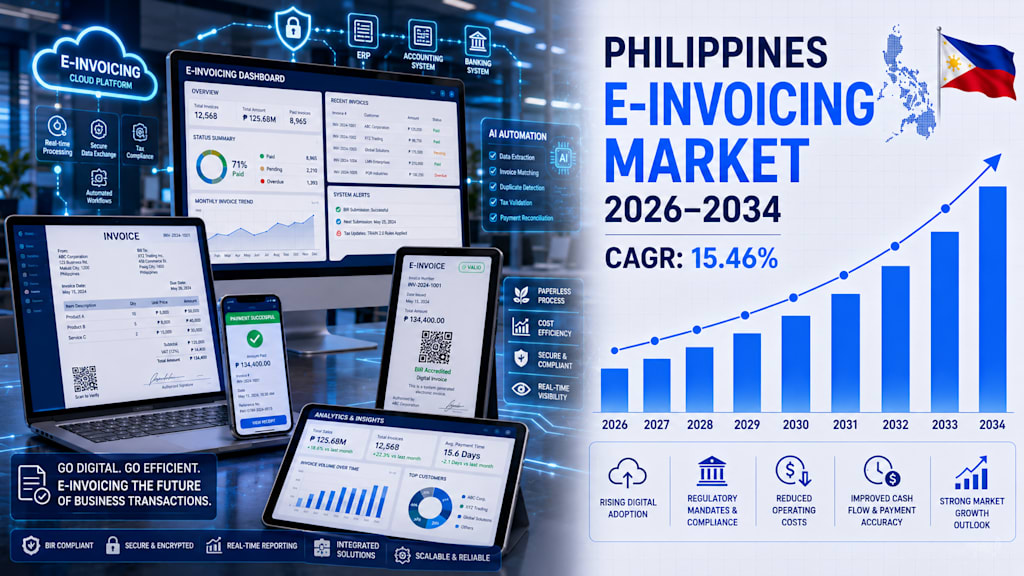
Philippines E-Invoicing Market Overview
The Philippines e-invoicing market is becoming a crucial segment of the country’s digital business and financial technology ecosystem, enabling businesses to generate, process, store, and exchange invoices electronically through secure digital platforms. E-invoicing solutions help organizations improve operational efficiency, regulatory compliance, and transaction transparency.
According to IMARC Group, the Philippines e-invoicing market size reached USD 371.4 Million in 2025 and is projected to reach USD 1,405.8 Million by 2034, exhibiting a compound annual growth rate (CAGR) of 15.46% during 2026–2034.
The market is witnessing rapid growth driven by increasing government support for tax digitization, rising adoption of cloud-based accounting solutions, expanding digital transformation initiatives, and growing demand for automated financial management systems.
Key Market Drivers
Government Push for Digital Tax Compliance
Regulatory authorities in the Philippines are increasingly encouraging electronic invoicing systems to improve tax transparency, reduce fraud, and strengthen financial reporting compliance.
Rising Adoption of Cloud-Based Financial Solutions
Businesses are rapidly shifting toward cloud accounting and enterprise resource planning (ERP) systems, boosting demand for integrated e-invoicing platforms.
Growing Demand for Paperless Business Operations
Organizations are adopting digital invoicing systems to reduce paperwork, lower operational costs, and improve workflow efficiency.
Expansion of Small and Medium Enterprises (SMEs)
The growing SME sector is driving demand for affordable and scalable e-invoicing solutions that simplify billing and accounting processes.
Increasing Digital Transformation Across Industries
Companies across retail, manufacturing, healthcare, logistics, and banking sectors are implementing automated invoicing systems to improve productivity and transaction management.
Request a Sample Report with the Latest 2026 Data & Forecasts
What the Opportunities Are
Integration with AI and Automation Technologies
Artificial intelligence and machine learning are enabling automated invoice processing, fraud detection, and intelligent financial analytics.
Growth of Mobile and SaaS-Based E-Invoicing Platforms
Mobile-compatible and software-as-a-service (SaaS) invoicing solutions are creating opportunities for flexible and cost-effective deployment.
Expansion of Cross-Border Digital Transactions
Growing international trade and digital commerce are increasing demand for standardized and compliant electronic invoicing systems.
Rising Demand for Real-Time Invoice Tracking
Businesses are increasingly seeking solutions with real-time monitoring, payment tracking, and automated reconciliation features.
Development of Blockchain-Enabled Invoicing Systems
Blockchain technology is emerging as a secure solution for invoice verification, transparency, and fraud prevention.
Recent News and Developments
April 2026: The Philippines e-invoicing market is witnessing strong momentum following the government’s push toward digital tax compliance and business automation. The Bureau of Internal Revenue (BIR) continues expanding the Electronic Invoicing System (EIS), encouraging wider adoption among large taxpayers and enterprises to improve tax transparency and reduce manual processing inefficiencies.
March 2026: Digital transformation initiatives are accelerating adoption of cloud-based invoicing platforms among businesses of all sizes. Companies are increasingly implementing automated invoicing solutions integrated with accounting, ERP, and payment systems to improve operational efficiency and reduce administrative costs. This trend is especially strong among retail, logistics, and e-commerce businesses.
February 2026: The Philippines’ rapidly growing digital economy is supporting e-invoicing expansion, with the country’s e-commerce market reaching approximately USD 28 billion in 2024. Rising digital transactions and online business activity are increasing the need for automated invoicing, tax reporting, and electronic documentation systems across industries.
December 2025: SMEs are becoming a major growth segment for e-invoicing providers as affordable subscription-based software solutions gain popularity. Businesses are increasingly shifting away from paper-based invoicing to reduce processing time, minimize errors, and improve compliance with tax reporting requirements.
2025–2026 (market trend): The Philippines e-invoicing market is being shaped by digitalisation, tax compliance reforms, and increasing cloud adoption. AI-powered invoice automation, real-time reporting, and integration with digital payment systems are becoming key trends. At the same time, challenges such as cybersecurity risks, implementation costs, and limited digital readiness among smaller enterprises continue to influence adoption across the market.
Why You Should Know About the Philippines E-Invoicing Market?
The Philippines e-invoicing market is becoming a major driver of digital business transformation and financial modernization.
With projected growth from USD 371.4 Million in 2025 to USD 1,405.8 Million by 2034, the market demonstrates strong expansion potential supported by regulatory digitization, cloud adoption, and increasing automation across industries.
As businesses continue transitioning toward paperless and data-driven financial systems, e-invoicing solutions are expected to play a critical role in improving operational efficiency, compliance management, and digital transaction transparency across the Philippines.
About the Creator
Enjoyed the story? Support the Creator.
Subscribe for free to receive all their stories in your feed.
Comments
There are no comments for this story
Be the first to respond and start the conversation.